Standard Toilet Dimensions: Rough-In, Bowl Size & Height
Introduction
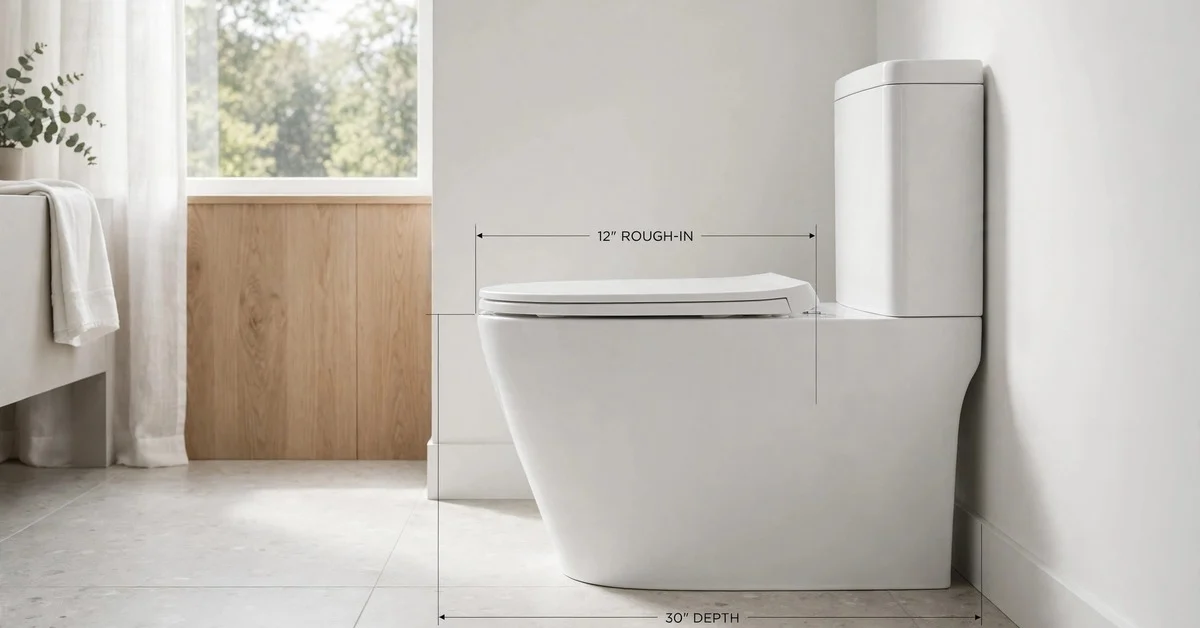
Replacing a toilet sounds simple, but a standard toilet needs a 12-inch rough-in and measures about 28 inches deep from the wall to the front of the bowl. Will it fit your drain? Will it leave enough room in front? That bolded answer decides both questions.
That 28-inch depth equals roughly 71 cm. Most American toilets are built around that 12-inch rough-in, the distance from the finished wall to the center of the floor drain. Knowing this one number prevents the most expensive mistake in bathroom remodeling.
You will need these numbers in real situations. When you swap an old toilet for a new one, the rough-in must match or the base will not line up. In a small bathroom remodel, the depth and width decide whether the door can swing and whether code clearances are met. And when you pick between a round bowl and an elongated bowl, a couple of inches make the difference between comfort and a cramped fit.
Standard Toilet Size Chart
| Measurement | Inches | Centimeters |
|---|---|---|
| Rough-in (drain center to wall) | 12 in | ≈ 30.5 cm |
| Overall depth, elongated bowl | 28 in | ≈ 71.1 cm |
| Overall depth, round bowl | 25–26 in | ≈ 63.5–66 cm |
| Overall width | 20 in | ≈ 50.8 cm |
| Standard seat height | 15–16 in | ≈ 38.1–40.6 cm |
| Comfort (chair) seat height | 17–19 in | ≈ 43.2–48.3 cm |
| Tank height from floor | 27–30 in | ≈ 68.6–76.2 cm |
| Clearance in front (code minimum) | 21 in | ≈ 53.3 cm |
| Clearance from center to side wall | 15 in | ≈ 38.1 cm |
Common Toilet Types & Their Approximate Dimensions
| Toilet Type | Approximate Depth | Approximate Width |
|---|---|---|
| Standard elongated two-piece | 28 in | 20 in |
| Round-front bowl | 25–26 in | 20 in |
| Comfort-height elongated | 28 in | 20 in |
| One-piece toilet | 26–28 in | 20–24 in |
| Wall-hung (bowl only) | 21–23 in from wall | 14–16 in |
| Corner toilet | 26–30 in projection | 20 in |
| Dual-flush two-piece | 28 in | 20 in |
| Smart/bidet toilet | 28–30 in | 20 in |
More Toilet Sizes & Related Measurements
| Item | Approximate Size |
|---|---|
| Compact small-space toilet | 25–26 in deep, 17–18 in wide |
| Portable camping toilet | 13–15 in seat height, 14–16 in wide |
| Wall-mounted urinal | Rim ~24 in above floor |
| ADA-compliant toilet | 17–19 in seat height |
| 10-inch rough-in toilet | 26–27 in deep |
| 14-inch rough-in toilet | 30–31 in deep |
| Standard toilet seat | 16.5 in (round) / 18.5 in (elongated) long |
How Big Is a Standard Toilet?
A standard toilet takes up about the same floor space as a small armchair. The footprint is roughly 28 inches deep and 20 inches wide. It sits lower than a dining chair, with the seat at about 15 to 16 inches off the floor on a standard model.
Two references make the size easy to picture. A kitchen base cabinet is about 24 inches deep, so a toilet sticks out about 4 inches farther. A standard pillow is about 26 inches long, very close to a round-bowl toilet’s depth.
Easy ways to estimate toilet dimensions in everyday life:
- Printer paper: A standard sheet is 11 inches long. Two and a half sheets laid end to end reach about 28 inches, the depth of an elongated toilet.
- Your forearm: Most adult forearms measure roughly 10 to 12 inches, about the same as the standard 12-inch rough-in.
- A step stool: Many kitchen step stools stand about 15 inches tall, matching standard toilet seat height.
- Hand spans: An average hand spans about 8 to 9 inches. Two hand spans get you close to the 17 to 19 inch comfort-height seat.
- Soda cans: A soda can is roughly 4.8 inches tall. Stack four of them and you get about 19 inches, near the top of comfort seat height.
1. Standard Elongated Two-Piece Toilet
The two-piece toilet is what most people picture. The tank bolts onto a separate bowl, and together they measure about 28 inches deep and 20 inches wide. The seat sits 15 to 16 inches off the floor, which suits most adults.
It is the best-selling style for a simple reason: it fits the standard 12-inch rough-in, parts are cheap and easy to find, and any plumber can install one in under an hour. The tank top usually lands 27 to 30 inches from the floor.
The trade-off is the seam where the tank meets the bowl, where dust and grime collect and cleaning takes more effort. Still, for a straightforward replacement that matches your existing drain, this is the safe default choice.
2. Round-Front Bowl Toilet
A round bowl keeps the same width and seat height but pulls the front edge back to about 25 to 26 inches deep. That saves two to three inches of floor space compared with an elongated bowl.
Those few inches matter in a tight powder room. If your door swings close to the bowl, a round bowl can solve the problem without moving any plumbing.
Comfort is the compromise. The seating area is shorter and a bit narrower, so taller adults may find it cramped. Many pick round bowls for guest baths and half baths where space wins over luxury. For a main bathroom with room to spare, elongated usually feels better.
3. Comfort-Height (Chair-Height) Toilet
Comfort-height toilets raise the seat to 17 to 19 inches from the floor. That is roughly the height of a dining chair, which is where the “chair height” nickname comes from.
Sitting down and standing up takes less effort at this height. Taller people, older adults, and anyone with knee trouble tend to prefer it, and many models meet ADA guidelines for accessible bathrooms.
The taller bowl does not change the footprint: depth stays around 28 inches on elongated models with the same 12-inch rough-in. If everyone in the household is on the shorter side, the extra height can feel awkward, so consider who will use the bathroom most before you buy.
4. One-Piece Toilet
On a one-piece toilet, the tank and bowl are molded as a single unit. The look is smooth and modern, and the footprint runs about 26 to 28 inches deep and 20 to 24 inches wide.
Cleaning is the big selling point: with no seam between tank and bowl, there are fewer places for dust and moisture to hide.
Two downsides: they cost more than similar two-piece models, and the single molded body is heavier to carry up stairs. Measure your doorways and stairwell turns before delivery day if you order one of these.
5. Wall-Hung (Wall-Mounted) Toilet
A wall-hung toilet hides its tank inside the wall and leaves only the bowl visible. The bowl projects about 21 to 23 inches from the finished wall, and its width is a slim 14 to 16 inches.
The open floor underneath makes mopping easy and makes a small bathroom look larger. The plumber can set the seat height anywhere from about 15 to 19 inches, so you pick standard or comfort height during install.
The catch is the in-wall carrier frame that holds the weight. It must be installed while the wall is open, which makes this style a remodel project rather than a simple swap. Repairs also take more work since the tank sits behind drywall.
6. Corner Toilet
Corner toilets use a triangular tank designed to sit at a 45-degree angle in the corner of a room. The bowl projects about 26 to 30 inches out from the corner, and the width across the front is close to 20 inches.
This layout rescues bathrooms with an awkward corner, tucking the toilet away to free wall space for other fixtures.
Plumbing limits where you can use one: the water supply and drain must reach that corner, and moving a drain line is expensive. They also cost more and offer fewer styles than standard models. But in the right floor plan, they turn dead space into a working bathroom.
7. Dual-Flush Two-Piece Toilet
A dual-flush toilet looks like a standard two-piece but the tank has two buttons on top: a light flush for liquid waste and a full flush for solid waste. Dimensions match the standard elongated two-piece at about 28 inches deep and 20 inches wide.
Water savings are the point. The light flush uses noticeably less water, which adds up in a busy household and shows on the water bill. Most models use the standard 12-inch rough-in, so they drop into the same spot as the old toilet.
The flush buttons sit on the tank lid, so check that the lid lifts easily for maintenance. Otherwise daily use feels identical to a regular toilet.
8. Smart/Bidet Toilet
Smart toilets add a built-in bidet, heated seat, and sometimes a warm-air dryer and automatic lid. The body runs about 28 to 30 inches deep with a seat height of 17 to 19 inches.
These units need more than a water line: a GFCI outlet near the toilet, so plan for an electrician if your bathroom lacks one. The seat also adds a few inches of height over a bare bowl.
Prices run well above standard toilets, though fans say the comfort is worth it. When you measure for one, add a couple of inches for the longer body, and confirm the outlet sits within reach of the power cord.
9. Compact Small-Space Toilet
Compact toilets shrink the footprint to about 25 to 26 inches deep and 17 to 18 inches wide. They pair a round bowl with a narrower tank to squeeze into the smallest legal bathroom.
Powder rooms under stairs, converted closets, and tiny basement baths are their natural home, since every inch counts when the room is only a few feet across.
The smaller bowl means a smaller seat, so larger adults may feel squeezed. Check your local code too: even a compact toilet still needs the 21-inch front clearance and 15-inch side clearance, and the door must clear the bowl — compare against standard door sizes. Compact helps, but it cannot make an undersized room legal on its own.
10. Portable Camping Toilet
Portable camping toilets stand about 13 to 15 inches tall at the seat and measure roughly 14 to 16 inches wide. They hold waste in a sealed tank or bag for later disposal.
Campers, RVers, and boat owners use them where no plumbing exists. Chemical models treat waste with fluid, while simpler bag models work like a lined bucket with a seat.
They are no substitute for a home toilet: capacity is small, usually just a few gallons, and emptying the tank is a chore nobody enjoys. For a weekend off the grid, though, the size is about right: low enough to sit on comfortably, small enough to stash in a vehicle.
11. Wall-Mounted Urinal
A wall-mounted urinal hangs with its rim about 24 inches above the finished floor. The bowl projects roughly 14 to 18 inches from the wall.
You will see these mostly in commercial restrooms, though some homeowners add one to a large master bath. They use far less water per use than a toilet and take up less wall space.
Installation needs a drain at the right height and a water supply line, so adding one means opening the wall. Waterless models skip the supply line but need special cartridges. For most homes, a urinal is a luxury add-on rather than a necessity.
12. 10-Inch Rough-In Toilet
A 10-inch rough-in means the drain center sits 10 inches from the finished wall instead of 12. Toilets built for this spacing measure about 26 to 27 inches deep, about two inches shorter than standard.
Older homes, especially those built before the 1960s, sometimes have this tighter spacing. If you buy a standard 12-inch toilet for a 10-inch drain, the tank will hit the wall before the base reaches the drain.
Always measure your rough-in before shopping. Hook a tape measure from the finished wall (not the baseboard) to the center of the floor bolts. If it reads about 10 inches, shop for 10-inch rough-in models, which are widely available though the selection is smaller.
13. 14-Inch Rough-In Toilet
The 14-inch rough-in is the mirror image: the drain center sits 14 inches from the wall. Toilets made for it run about 30 to 31 inches deep.
This spacing shows up in some older homes and in bathrooms where the wall was furred out or tiled over. A standard 12-inch toilet on a 14-inch drain leaves an ugly two-inch gap behind the tank.
Fourteen-inch models are less common, so expect fewer styles and higher prices. An offset flange is one alternative, but that is a plumber’s job and not always allowed by code. If your measurement reads 14 inches, start your search with that exact term.
14. ADA-Compliant Toilet
ADA-compliant toilets are built for accessible bathrooms. The seat height runs 17 to 19 inches, matching comfort height, and the bowl is almost always elongated.
Height is only part of the story. Accessible bathrooms also need clear floor space around the toilet, grab bars on the side and rear walls, and a flush control that is easy to reach and operate. These rules come from accessibility codes, so the exact layout depends on your local requirements.
Even if nobody in your home needs accessible features today, a comfort-height elongated toilet gives you most of the benefit and suits guests of all ages.
15. Standard Toilet Seat
The seat itself has standard sizes too. A round-bowl seat measures about 16.5 inches long, while an elongated seat runs about 18.5 inches. Both are roughly 14 to 15 inches wide, and the mounting bolts sit about 5.5 inches apart.
Matching the seat to the bowl shape matters more than people expect. An elongated seat on a round bowl overhangs the front, and a round seat on an elongated bowl leaves an uncomfortable gap.
When you replace a seat, measure from the center of the bolt holes to the front edge of the bowl. That single measurement tells you whether you need round or elongated, and it takes less than a minute.
Frequently Asked Questions
What is the standard rough-in for a toilet?
The standard rough-in is 12 inches, measured from the finished wall to the center of the drain pipe. Older homes sometimes have 10-inch or 14-inch rough-ins. Measure before you buy, because the toilet must match.
Should I choose a round or elongated bowl?
Pick elongated if you have the space: at about 28 inches deep it offers more sitting room. Choose round, at 25 to 26 inches deep, when a few inches of floor space decide whether the layout works.
How much clearance does a toilet need?
Building codes call for at least 21 inches of clear space in front of the bowl and 15 inches from the centerline to each side wall. These are minimums — around 30 inches in front feels much more comfortable in daily use.
What is the difference between standard and comfort height?
A standard toilet seat sits 15 to 16 inches off the floor, while a comfort-height (chair-height) seat sits 17 to 19 inches. Comfort height makes sitting and standing easier, especially for taller people and older adults. Shorter users sometimes prefer the standard height.
Final Thoughts
Toilet dimensions come down to a handful of numbers worth memorizing. The 12-inch rough-in decides which models fit your drain. The 28-inch depth and 20-inch width decide whether the bathroom feels open or cramped. And the choice between a 15-inch standard seat and a 17 to 19 inch comfort seat decides daily comfort.
You can estimate all of these without special tools. A forearm covers the rough-in, two and a half sheets of paper cover the depth, and a step stool matches the seat height. These quick checks work in the store aisle just as well as they do at home.
Whether you are swapping a worn-out toilet, planning a remodel, or just making sure the door clears the bowl, start with the tape measure and these numbers. Getting the fit right the first time saves a return trip, a second delivery fee, and a lot of frustration.

I’m Elena Cross, a content writer at MeasuresIt.com, where I turn complex measures, units, and mathematical concepts into clear, accurate, and easy-to-read articles. I’m passionate about precision in numbers and in words and I write to help readers actually understand measurements, not just memorize them.