How Tall Is a Kangaroo? Red Kangaroo Size in Feet
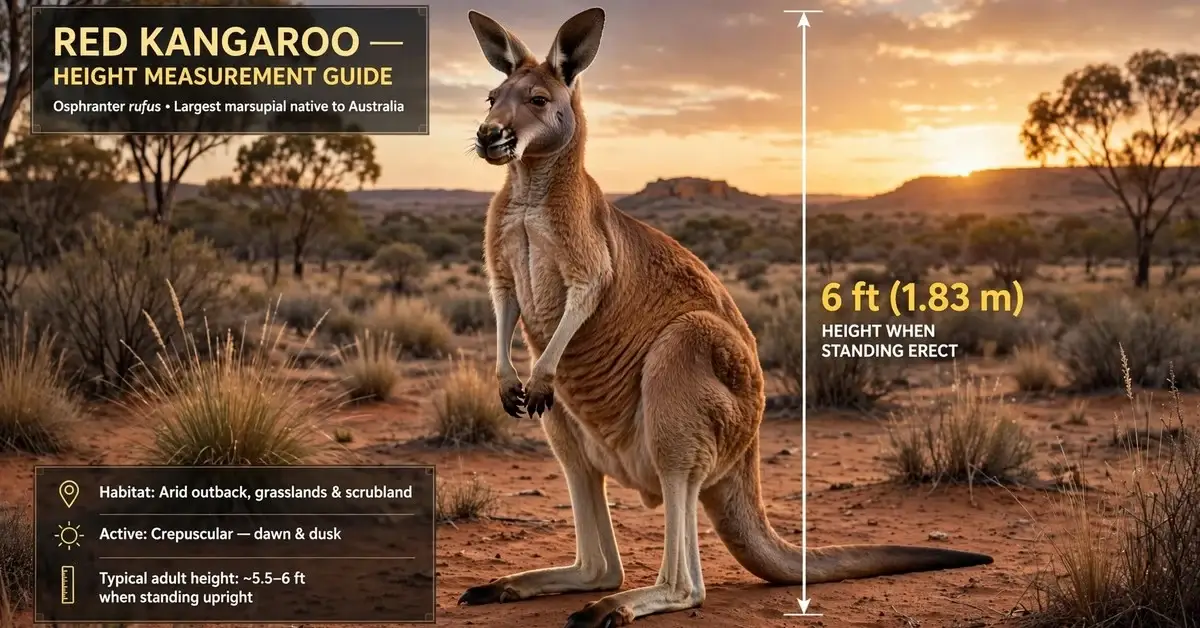
A large male red kangaroo can stand about 6 feet tall, roughly the height of an adult man. Females are considerably smaller at around 4 feet, and a newborn joey is barely an inch long — smaller than a jellybean. Kangaroo height is measured standing upright on the hind feet, the posture males adopt when boxing or surveying for danger, though they spend most of their time leaning forward in a crouch that looks much shorter.
Australia hosts four kangaroo species plus dozens of wallabies and wallaroos, and “how tall is a kangaroo” almost always means the red kangaroo — the largest marsupial on earth and the animal on the Australian coat of arms. This guide covers exact heights for every species, the astonishing size range from joey to boomer, and comparisons that put six feet of muscle-bound marsupial into perspective.
Kangaroo Height Conversion Chart
| Measurement | Feet | Meters | Inches |
|---|---|---|---|
| Red kangaroo male (large) | 5.5–6.5 ft | 1.7–2.0 m | 66–78 in |
| Red kangaroo female | 3.5–4.5 ft | 1.1–1.4 m | 42–54 in |
| Eastern grey male | 4.5–5.5 ft | 1.4–1.7 m | 54–66 in |
| Western grey male | 4–5 ft | 1.2–1.5 m | 48–60 in |
| Antilopine kangaroo male | 4–5 ft | 1.2–1.5 m | 48–60 in |
| Newborn joey | ~1 in | ~2.5 cm | ~1 in |
| Joey at pouch exit | ~2 ft | ~0.6 m | ~24 in |
Kangaroo Species Compared
| # | Species | Male height | Female height | Weight (male) |
|---|---|---|---|---|
| 1 | Red kangaroo | 5.5–6.5 ft | 3.5–4.5 ft | 120–200 lb |
| 2 | Eastern grey kangaroo | 4.5–5.5 ft | 3.5–4.5 ft | 110–145 lb |
| 3 | Western grey kangaroo | 4–5 ft | 3–4 ft | 60–120 lb |
| 4 | Antilopine kangaroo | 4–5 ft | 3–4 ft | 110–155 lb |
| 5 | Red kangaroo joey (birth) | ~1 in | ~1 in | ~0.03 oz |
| 6 | Red kangaroo joey (6 months) | ~1.5 ft | ~1.5 ft | ~5 lb |
| 7 | Red kangaroo joey (leaving pouch) | ~2 ft | ~2 ft | ~10 lb |
| 8 | Big red “boomer” (record) | ~6.9 ft | — | ~202 lb |
Kangaroo Size in Everyday Context
| # | Comparison | Size | Context |
|---|---|---|---|
| 9 | Average adult man | 5 ft 9 in | Eye-to-eye with a big red male |
| 10 | Standard interior door | 6 ft 8 in | A 6-ft roo clears it standing |
| 11 | Kangaroo hop (single bound) | up to 30 ft | Longer than a school bus |
| 12 | Hind foot (large male) | ~12–18 in | Among the longest feet of any animal |
| 13 | Tail (large male) | 3–4 ft | Fifth limb for balance and pentapedal walk |
| 14 | Boxing reach | ~4 ft | Forelimbs strike in male contests |
| 15 | Top hopping speed | ~44 mph | Sustained 15 mph for miles |
1. Red Kangaroo Males: 5.5 to 6.5 Feet
Male red kangaroos — called boomers — stand 5.5 to 6.5 feet tall when fully upright, with exceptional individuals reported near 6.9 feet. They weigh 120 to 200 pounds of dense muscle built for hopping and fighting. The red kangaroo is the largest marsupial alive, and mature boomers develop the massively muscled forearms and deep chest that make their boxing matches so famous. A 6-foot boomer standing alert in the outback is genuinely imposing: imagine a 200-pound athlete balanced on two feet, staring you down from your own eye level.
2. Red Kangaroo Females: 3.5 to 4.5 Feet
Female red kangaroos — blue flyers, for their blue-grey coats — stand 3.5 to 4.5 feet tall and weigh 40 to 90 pounds, roughly half the mass of a big male. This dramatic size difference is among the most extreme sexual dimorphism in mammals. Females do nearly all the parenting, carrying a single joey in the pouch for about eight months. Their smaller size is an advantage for a mother that must feed herself and a growing joey on sparse outback vegetation — less body means less food required.
3. Eastern Grey Kangaroos: 4.5 to 5.5 Feet
Eastern grey males stand 4.5 to 5.5 feet tall and weigh 110 to 145 pounds, making them the second-largest kangaroo species. They inhabit the fertile eastern third of Australia, where better grazing supports dense populations — mobs of dozens are common. Eastern greys are the kangaroos most tourists encounter, and their slightly smaller stature compared to reds reflects a life in woodland edges rather than open desert. Females run 3.5 to 4.5 feet, overlapping with red females.
4. Western Grey and Antilopine: 4 to 5 Feet
Western grey males reach 4 to 5 feet and 60 to 120 pounds in Australia’s southwest, while antilopine males hit similar heights of 4 to 5 feet and 110 to 155 pounds across the tropical north. The antilopine is sometimes called the “antelope kangaroo” for its behavior and reddish coat. Both species are less famous than reds and eastern greys but fill the same ecological role in their regions. Their modest height compared to big red boomers shows how much the red kangaroo stands apart — literally — from its cousins.
5. Joey at Birth: 1 Inch Long
A newborn kangaroo is about an inch long and weighs roughly 0.03 ounces — smaller than a jellybean and lighter than a paperclip. Blind, hairless, and barely formed, it hauls itself with oversized forelimbs from the birth canal to the pouch, a journey of a few inches that takes several minutes. Once inside, it latches onto a teat and stays fused there for weeks. That a 1-inch embryo grows into a 6-foot adult is one of the most extreme growth trajectories of any mammal — a 72-fold increase in length.
6. Joey Development: Pouch to 2 Feet
At six months, a joey is about 1.5 feet long and 5 pounds, fully furred and peeking from the pouch. By eight months it starts leaving the pouch for short excursions, standing roughly 2 feet tall and weighing 10 pounds. Full pouch exit comes around 10 to 12 months, though joeys keep nursing and diving back in for safety for months more. Watching a 2-foot joey wrestle its way back into the pouch headfirst is a classic wildlife sight — the pouch stretches remarkably to admit an animal a third the mother’s height.
7. Record-Size Boomers: Near 7 Feet
The largest reliably measured red kangaroos approached 6.9 feet tall and 202 pounds — just shy of 7 feet of marsupial. These record boomers are old males in prime outback habitat with years of good seasons behind them. Claims of taller animals circulate, but verified measurements with the animal standing upright are rare because wild kangaroos do not pose for tape measures. Treat anything over 7 feet as unverified. Even at “only” 6.5 feet, a big boomer outweighs most human heavyweight boxers.
8. Kangaroo vs. Adult Man: 5 Feet 9 Inches
The average adult man stands 5 feet 9 inches — just below a large male red kangaroo’s 6 feet. This is why photos of boomers facing off with people look so startling: the kangaroo meets the human eye-to-eye, then outweighs him by 30-plus pounds of hopping muscle. Wildlife guides stress keeping distance not because kangaroos hunt people, but because a 6-foot, 180-pound animal defending itself can disembowel with a hind-foot kick. Respect the height — it is attached to serious weaponry.
9. The 30-Foot Hop
A red kangaroo can cover 30 feet in a single bound and sustain 15 mph for miles, topping out near 44 mph in short bursts. That 30-foot leap is longer than a school bus and comes from hind legs with Achilles-like tendons that store elastic energy like springs. At speed, the tail swings as a counterbalance; at slow speeds, it becomes a fifth limb in the odd “pentapedal” walk. The hop is so efficient that a kangaroo uses less energy the faster it goes — the opposite of running.
10. Hind Feet: 12 to 18 Inches
A big male’s hind feet measure 12 to 18 inches long — among the longest feet relative to body size of any animal. Each foot ends in a single long clawed toe that does the kicking in male combat. When boxing, males grapple with their forelimbs and rake downward with those hind feet, which is why male kangaroos are genuinely dangerous at close range. The feet also work as radiators: kangaroos lick their forearms and feet to cool down, using evaporation across large surface areas.
11. The Tail: 3 to 4 Feet
A large male’s tail runs 3 to 4 feet long and functions as a fifth limb. When grazing slowly, kangaroos plant the tail and swing both hind legs forward together — the only pentapedal gait in nature. At speed it streams behind as a counterbalance, and in fights it braces the famous double hind-leg kick. The tail’s muscles are so powerful that a kangaroo can briefly balance its entire weight on tail and hind legs while lashing out with both feet.
12. Boxing: 4-Foot Reach
Male kangaroos box for dominance and mating rights, striking with forelimbs that reach about 4 feet. Bouts start with staring and posturing, escalate to forelimb grappling, and peak with the hind-leg kick braced on the tail. Fights rarely cause serious injury — they are ritualized contests — but the strength involved is real: a boomer’s kick can bend sheet metal. Females occasionally box too, usually over food rather than mates.
13. Speed: 44 mph Top, 15 mph Cruise
Red kangaroos top out near 44 mph — faster than a charging hippo and quick enough to outrun most predators over distance. More impressive is the cruise: 15 mph sustained for miles on hopping legs that recycle energy with each bounce. Dingoes, their main predator, top out around 35 mph but cannot sustain it. For a 6-foot animal built like a coiled spring, speed is the primary defense, and mobs scatter at the first sign of danger.
14. Measuring a Kangaroo
Kangaroo height is measured with the animal standing fully upright on its hind feet — the alert posture, not the grazing crouch. In practice, researchers estimate from photographs with scale references or measure captive animals against marked posts. Wild measurements are approximate because a kangaroo’s posture shifts constantly: the same boomer might present as 4 feet in a crouch and 6 feet upright seconds later. Published heights assume the full upright stance, which is the animal’s true maximum.
15. Growth: 1 Inch to 6 Feet
No land mammal grows through a wider size range than the kangaroo: from a 1-inch, 0.03-ounce newborn to a 6-foot, 200-pound adult male. That is a 72-fold increase in length and a roughly 100,000-fold increase in weight. Growth is fastest in the pouch and continues for years after emergence — males keep filling out well into adulthood. Females mature smaller and faster, breeding from about 18 months. The whole trajectory, from jellybean to boomer, takes about three to four years.
FAQs
How tall can a kangaroo stand?
A large male red kangaroo can stand about 6 feet tall, with exceptional individuals approaching 6.9 feet. Females reach 3.5 to 4.5 feet. Height is measured in the upright alert posture; grazing kangaroos look much shorter because they lean forward.
How tall is a kangaroo compared to a human?
A big male red kangaroo stands about 6 feet — roughly the height of an adult man, and sometimes taller. Females at 3.5 to 4.5 feet compare to a child or small adult. The size overlap with humans is why confrontations feel so uncanny.
How big is a baby kangaroo?
A newborn joey is about 1 inch long and weighs 0.03 ounces. It grows to 1.5 feet by six months and leaves the pouch at around 2 feet tall near its first birthday. Full adult size takes three to four years.
What is the largest kangaroo species?
The red kangaroo is the largest: males to 6.5 feet and 200 pounds. Eastern greys are second at 5.5 feet, followed by western greys and antilopines at 4 to 5 feet. The red kangaroo is also the largest marsupial on earth.
Final Thoughts
The red kangaroo’s 6-foot standing height puts the largest males eye-to-eye with adult humans, while females at 4 feet and newborn joeys at a single inch show the species’ staggering range. Remember that published heights assume the upright alert posture — a grazing kangaroo presents a much lower profile. The supporting cast of numbers tells the real story: 30-foot bounds, 18-inch hind feet, 4-foot tails working as fifth limbs, and 44-mph top speeds. Whether you picture a boomer clearing a standard doorway upright or a 1-inch joey climbing to the pouch, the measurements turn Australia’s most famous animal from a cartoon silhouette into a precisely scaled creature. Six feet of muscle, balanced on two toes and a tail, remains one of nature’s great engineering feats.

I’m Marcus Kane, a measurement content specialist at MeasuresIt.com. I write clear, accurate, and practical articles about measurements, dimensions, conversions, and everyday size comparisons, making complex topics simple and easy to understand.