How Tall Is a Horse? Hands, Feet & Breed Sizes
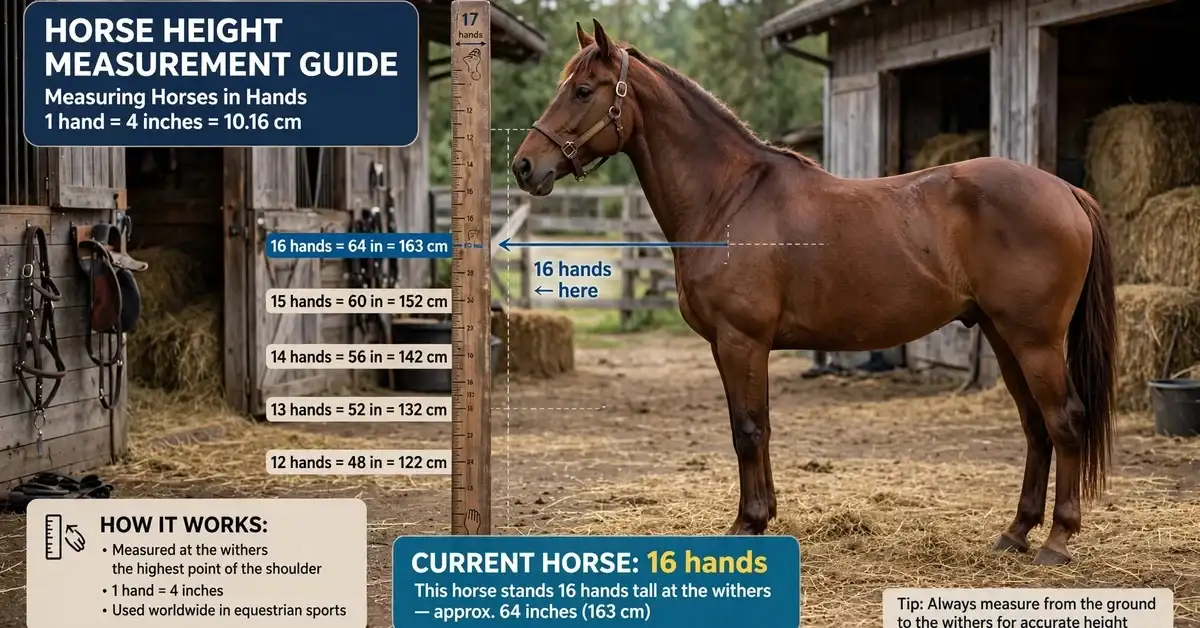
Most horses stand 14 to 17 hands tall, and one hand equals exactly 4 inches — so the average horse measures 56 to 68 inches at the shoulder. That unusual unit, the hand, is measured at the withers, the ridge between the shoulder blades where the neck meets the back. Once you understand hands, every horse height you will ever encounter — from a 12-hand pony to a 19-hand draft giant — converts to feet and inches in seconds.
The hand dates back centuries to a time when traders literally measured horses with the width of a man’s hand. It stuck because it works: horses vary enormously by breed, and hands give buyers, riders, and veterinarians a precise shared language. This guide explains the hand system, converts every common height, and walks through breed sizes from the smallest ponies to the tallest draft horses ever recorded.
Horse Height Conversion Chart
| Hands | Inches | Feet & Inches | Centimeters |
|---|---|---|---|
| 12 hands | 48 in | 4 ft 0 in | 122 cm |
| 13 hands | 52 in | 4 ft 4 in | 132 cm |
| 14 hands | 56 in | 4 ft 8 in | 142 cm |
| 14.2 hands | 58 in | 4 ft 10 in | 147 cm |
| 15 hands | 60 in | 5 ft 0 in | 152 cm |
| 16 hands | 64 in | 5 ft 4 in | 163 cm |
| 17 hands | 68 in | 5 ft 8 in | 173 cm |
| 18 hands | 72 in | 6 ft 0 in | 183 cm |
| 19 hands | 76 in | 6 ft 4 in | 193 cm |
Horse Breeds by Height
| # | Breed / Type | Typical height | Weight | Notes |
|---|---|---|---|---|
| 1 | Shetland pony | 9–11 hands | 400–450 lb | Smallest common pony breed |
| 2 | Welsh pony | 12–14 hands | 500–700 lb | Children’s mounts, hardy |
| 3 | Arabian | 14.1–15.1 hands | 800–1,000 lb | Ancient breed, dished face |
| 4 | Quarter Horse | 14.3–16 hands | 950–1,200 lb | America’s most popular breed |
| 5 | Thoroughbred | 15.2–17 hands | 1,000–1,200 lb | Racehorses, long legs |
| 6 | Warmblood (Dutch/Hanoverian) | 16–17.2 hands | 1,200–1,400 lb | Sport horses, jumpers |
| 7 | Clydesdale | 16–18 hands | 1,600–2,000 lb | Feathered feet, parade breed |
| 8 | Percheron | 16.2–17.3 hands | 1,800–2,200 lb | French draft, often gray |
Horse Height in Everyday Context
| # | Comparison | Size | Context |
|---|---|---|---|
| 9 | Standard interior door | 6 ft 8 in (20 hands) | Taller than most horses |
| 10 | Average adult man | 5 ft 9 in (~17.2 hands) | Eye-to-eye with a 17-hand horse |
| 11 | Pony cutoff | 14.2 hands (58 in) | The official pony/horse divide |
| 12 | Tallest horse ever (Sampson) | 21.2 hands (7 ft 2.5 in) | Shire gelding, 1846 |
| 13 | Smallest horse ever (Thumbelina) | 17.5 in (4.1 hands) | Miniature horse, world record |
| 14 | Horse trailer interior | ~7 ft 6 in tall | Fits horses up to ~18 hands |
| 15 | Mounting block (standard) | ~2 ft tall | Bridges the gap to the saddle |
1. What Is a Hand?
A hand is 4 inches, measured with the fingers held together and the thumb excluded — roughly the width of an adult man’s palm. The unit is always written as hands followed by remaining inches: 15.2 hands means 15 hands plus 2 inches (62 inches total), not 15.2 in decimal. This notation trips up beginners constantly, because 15.3 hands does not exist — after 15.2 comes 16.0, since three inches rolls over into the next hand. Once that clicks, the whole system is simple arithmetic.
2. Where Horses Are Measured: The Withers
Horses are measured at the withers, the bony ridge between the shoulder blades where the neck meets the back. The withers are used because they are the highest fixed point of the skeleton — the head bobs up and down, but the withers stay put whether the horse is grazing or alert. A measuring stick with a sliding arm rests on the withers while the horse stands square on level ground. This is the same principle as measuring an elephant at the shoulder: pick the anatomical point that does not move.
3. Reading Horse Height Notation
Horse people write 16.1, 16.2, 16.3, then 17 — never 16.4, because four inches make a full hand. So 16.2 hands equals 66 inches (16 × 4 + 2), which is 5 feet 6 inches. When you see a horse advertised at “15.3,” that is 63 inches or 5 foot 3. Sales listings, breed registries, and vet records all use this notation, and misreading it is the classic beginner mistake. If you want to double-check any conversion with a tape, our guide on how to read a measuring tape covers the inch markings you will need.
4. The Pony Cutoff: 14.2 Hands
Anything 14.2 hands (58 inches) and under is officially a pony; anything taller is a horse. The cutoff is strict in competition: a 14.2-hand animal competes as a pony, while a 14.3-hand animal — just one inch taller — competes as a horse. Ponies are not simply young or small horses; they are distinct types with thicker manes, shorter legs relative to body depth, and famously sturdy constitutions. The 14.2 line is why you will see heights like “14.1 and three-quarter” debated passionately at pony sales.
5. Shetland Ponies: 9 to 11 Hands
Shetland ponies stand 9 to 11 hands (36 to 44 inches) and weigh 400 to 450 pounds — small enough that an adult can look one nearly in the eye while standing. Bred on Scotland’s Shetland Islands, they are among the strongest animals pound-for-pound on earth, historically pulling carts in coal mines. Their tiny stature hides remarkable hardiness: thick double coats, efficient metabolisms, and a stubborn intelligence that makes them beloved children’s mounts and notorious escape artists in equal measure.
6. Arabians: 14.1 to 15.1 Hands
Arabians typically stand 14.1 to 15.1 hands (57 to 61 inches) and weigh 800 to 1,000 pounds. One of the oldest breeds on earth, the Arabian’s compact size belies extraordinary endurance — they dominate long-distance racing at 50 and 100 miles. Their dished faces, arched necks, and high tail carriage are unmistakable. An Arabian at 15 hands is technically a small horse, yet the breed’s influence runs through nearly every modern light horse breed, including the Thoroughbred.
7. Quarter Horses: 14.3 to 16 Hands
The American Quarter Horse stands 14.3 to 16 hands (59 to 64 inches) and weighs 950 to 1,200 pounds, making it the most popular breed in the United States by registration numbers. Bred for explosive speed over a quarter mile — hence the name — Quarter Horses are compact, heavily muscled, and famously calm-minded. Their moderate height is part of their versatility: big enough for adult ranch work, small enough for youth riders, and athletic enough for everything from cutting cattle to barrel racing.
8. Thoroughbreds: 15.2 to 17 Hands
Thoroughbred racehorses stand 15.2 to 17 hands (62 to 68 inches) and weigh 1,000 to 1,200 pounds. Bred for speed over distances from five furlongs to two miles, they are longer-legged and leaner than Quarter Horses, with deep chests housing enormous hearts and lungs. A 16.2-hand Thoroughbred at full gallop covers roughly 25 feet per stride. Their height range is wide because the breed prioritizes performance over uniformity — a champion can be 15.3 or 17 hands.
9. Warmbloods: 16 to 17.2 Hands
European warmbloods — Dutch Warmbloods, Hanoverians, Holsteiners — stand 16 to 17.2 hands (64 to 70 inches) and weigh 1,200 to 1,400 pounds. These are the purpose-built athletes of dressage and show jumping, bred for powerful hindquarters, elastic movement, and a temperament that tolerates intense training. At 17 hands, a warmblood’s withers reach 5 feet 8 inches — the rider’s eye sits a full 8-plus feet off the ground. Their size is functional: scope over big fences demands long levers.
10. Clydesdales: 16 to 18 Hands
Clydesdales stand 16 to 18 hands (64 to 72 inches) and weigh 1,600 to 2,000 pounds, instantly recognizable by their feathered lower legs and usually bay coats with white markings. The Budweiser Clydesdales made the breed famous, but working Clydesdales still pull in logging and farming. An 18-hand Clydesdale’s withers stand 6 feet tall — a 6-foot person looking the horse in the eye is looking slightly uphill. Their huge, dinner-plate hooves can measure 10 inches across.
11. Percherons: 16.2 to 17.3 Hands
Percherons stand 16.2 to 17.3 hands (66 to 69 inches) and weigh 1,800 to 2,200 pounds, among the heaviest horse breeds in the world. This French draft breed is usually gray or black, with a clean-legged look — no feathering — that distinguishes it from Clydesdales and Shires. Percherons pulled artillery in both World Wars and now pull carriages, plows, and competitive hitch teams. Their combination of height and massive bone gives them pulling power that belies their calm, willing temperament.
12. The Tallest Horse Ever: 21.2 Hands
The tallest horse ever documented was Sampson, a Shire gelding born in 1846, who measured 21.2 hands — 7 feet 2.5 inches at the withers — and weighed an estimated 3,360 pounds. That is taller than a standard interior door by half a foot. Modern record-holder Big Jake, a Belgian gelding, measured 20.2 hands (6 feet 10.75 inches) before his death in 2021. These giants are outliers even among draft breeds, which is precisely why they were recorded.
13. The Smallest Horse Ever: 17.5 Inches
Thumbelina, a miniature horse, holds the world record at 17.5 inches tall — about 4.1 hands — and roughly 60 pounds. Miniature horses are a distinct breed, not stunted ponies, with proportions like a full-size horse scaled down. At under a foot and a half, Thumbelina stood shorter than many dogs. The contrast with Sampson — 86 inches versus 17.5 — shows the staggering 5-to-1 height range within a single species, wider than almost any other domesticated animal.
14. Why Height Matters for Riders
A rider’s leg should hang with the stirrup at about ankle-bone level when mounted, which is why horse height and rider height are matched. A 5-foot-2 rider on a 17.2-hand warmblood looks perched; the same rider on a 15-hand Quarter Horse looks balanced. Taller horses also mean longer falls, higher mounting blocks (standard blocks are about 2 feet tall), and horse trailers with 7-foot-6-inch interiors to clear an 18-hand draft’s ears. Event organizers set fence heights and trailer dimensions around these numbers.
15. Measuring Your Own Horse
To measure a horse, stand it square on level ground — front legs vertical, hind legs positioned naturally — and place a measuring stick at the highest point of the withers. A proper horse measuring stick has a sliding horizontal arm; a tape measure works in a pinch but sags. Record in hands and inches: divide total inches by 4, with the remainder as the decimal. A horse measuring 63 inches is 15.3 hands (15 × 4 = 60, plus 3). Re-measure young horses every few months — they grow until age five or six.
FAQs
How many inches is a hand in horse height?
One hand equals exactly 4 inches. A 16-hand horse stands 64 inches (5 feet 4 inches) at the withers. Heights are written as hands plus remaining inches: 15.2 hands means 15 hands and 2 inches, or 62 inches total — never read the decimal as a fraction.
What is considered a tall horse?
Horses 17 hands (68 inches, 5 feet 8 inches) and above are considered tall. Most riding horses fall between 15 and 16.2 hands. Draft breeds regularly reach 17 to 18 hands, and anything over 18 hands is exceptionally tall.
How tall is a pony vs a horse?
The official cutoff is 14.2 hands (58 inches): animals 14.2 and under are ponies, while anything taller is a horse. Ponies are distinct types with stockier builds and thicker coats, not merely small or young horses. The one-inch difference between 14.2 and 14.3 determines competition categories.
How tall was the tallest horse ever?
Sampson, a Shire gelding born in 1846, measured 21.2 hands (7 feet 2.5 inches) at the withers and reportedly weighed 3,360 pounds. The modern record holder, Big Jake the Belgian, measured 20.2 hands. Both were geldings of draft breeds, which produce the tallest individuals.
Final Thoughts
Most horses stand 14 to 17 hands — 56 to 68 inches — with the hand’s 4-inch unit turning every height into quick mental math once you learn the notation. Ponies stop at 14.2 hands, sport horses cluster around 16 to 17 hands, and draft breeds stretch from 16 hands toward the 18-hand giants. The extremes, from Thumbelina’s 17.5 inches to Sampson’s 21.2 hands, show how much variation selective breeding packed into one species. Whether you are reading a sale ad, choosing a mount, or just satisfying curiosity, the withers-to-hands system gives you an exact picture in seconds. Remember the two rules that prevent every beginner mistake: measure at the withers, and count inches — 15.2 means 15 hands plus 2 inches, never 15 and two-tenths.

I’m Elena Cross, a content writer at MeasuresIt.com, where I turn complex measures, units, and mathematical concepts into clear, accurate, and easy-to-read articles. I’m passionate about precision in numbers and in words and I write to help readers actually understand measurements, not just memorize them.