How Tall Is a Polar Bear? Standing Height in Feet
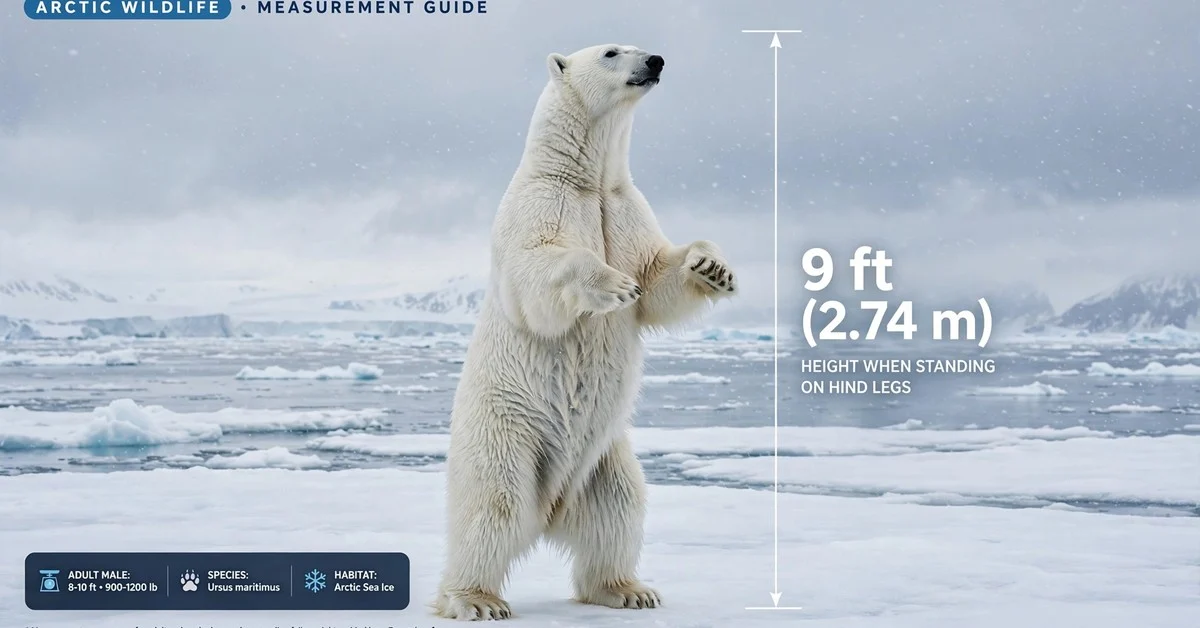
A large male polar bear stands 8 to 10 feet tall on its hind legs, making it the tallest and heaviest land predator on earth. Females are considerably smaller at 6 to 8 feet standing, and on all fours a big male’s shoulder reaches about 5 feet. Polar bears are measured two ways — shoulder height on all fours and full standing height — and the standing number is the one that stops people cold, because 10 feet of white bear rearing up is genuinely terrifying to picture.
As the Arctic’s apex predator, the polar bear’s size is functional: bulk conserves heat, power takes down seals, and long legs cover vast ice distances efficiently. This guide gives exact heights for males, females, and cubs, explains how researchers measure bears that do not cooperate, and anchors every number to objects you have stood beside.
Polar Bear Height Conversion Chart
| Measurement | Feet | Meters | Inches |
|---|---|---|---|
| Male standing (large) | 8–10 ft | 2.4–3.0 m | 96–120 in |
| Female standing | 6–8 ft | 1.8–2.4 m | 72–96 in |
| Male shoulder (all fours) | 4.5–5.5 ft | 1.4–1.7 m | 54–66 in |
| Female shoulder (all fours) | 3.5–4.5 ft | 1.1–1.4 m | 42–54 in |
| Newborn cub | ~1 ft long | ~0.3 m | ~12 in |
| Yearling cub | ~2.5 ft shoulder | ~0.75 m | ~30 in |
| Paw width (male) | ~12 in | ~30 cm | ~12 in |
Polar Bear Size Compared
| # | Bear | Standing height | Weight | Notes |
|---|---|---|---|---|
| 1 | Polar bear male (large) | 8–10 ft | 900–1,600 lb | Largest land predator |
| 2 | Polar bear female | 6–8 ft | 400–700 lb | Dens with cubs in winter |
| 3 | Kodiak bear male | 8–10 ft | 800–1,500 lb | Rival for largest land bear |
| 4 | Grizzly male (interior) | 6–8 ft | 400–800 lb | Smaller inland cousin |
| 5 | Black bear male | 5–7 ft | 250–600 lb | Common North American bear |
| 6 | Polar bear cub (newborn) | ~1 ft | ~1 lb | Blind, helpless, tiny |
| 7 | Polar bear yearling | ~4 ft standing | ~100–150 lb | Leaves den at 3–4 months |
| 8 | Largest recorded polar bear | ~11 ft | ~2,200 lb | 1960 Alaska specimen |
Polar Bear Size in Everyday Context
| # | Comparison | Size | Context |
|---|---|---|---|
| 9 | Basketball hoop | 10 ft | A big male’s nose reaches the rim |
| 10 | Standard interior door | 6 ft 8 in | A male must duck significantly |
| 11 | Compact car length | ~13–14 ft | A standing bear is 3/4 of a car |
| 12 | Refrigerator | ~5 ft 10 in | Shoulder-high on a big male |
| 13 | Dinner plate | ~10–12 in | Matches a male’s paw width |
| 14 | Human arm span | ~5–6 ft | A bear’s standing reach far exceeds it |
| 15 | Two-story house eave | ~16–18 ft | A rearing bear reaches halfway |
1. Male Polar Bears: 8 to 10 Feet Standing
Male polar bears stand 8 to 10 feet tall on their hind legs and weigh 900 to 1,600 pounds, with the largest verified individuals pushing past both numbers. On all fours, a big male’s shoulder stands 4.5 to 5.5 feet — already taller than most kitchen counters — and the long body stretches 8-plus feet nose to tail. Males keep growing into their teens, and the biggest bears are old males in rich seal-hunting territory like the Canadian Arctic Archipelago. At 10 feet standing, a male polar bear’s head clears a basketball rim.
2. Female Polar Bears: 6 to 8 Feet Standing
Female polar bears stand 6 to 8 feet on their hind legs and weigh 400 to 700 pounds — roughly half the mass of a large male. On all fours their shoulders reach 3.5 to 4.5 feet. Females fast for up to eight months while denning, living off fat reserves while nursing cubs, and can lose half their body weight in the process. A 700-pound female emerging from the den in spring is lean and hungry; by fall, gorged on seals, she may weigh half again as much. The sex difference is stark: a big male outweighs a small female threefold.
3. Shoulder Height on All Fours: 5 Feet
On all fours — the posture bears use nearly all the time — a large male’s shoulder stands about 5 feet high. This is the measurement researchers prefer because it does not depend on the bear choosing to stand up. Five feet at the shoulder means a bear walking toward you on the ice carries its back at your eye level if you are of average height. Females run 3.5 to 4.5 feet at the shoulder. Wildlife photographers lying prone for a shot have the bear’s shoulder line well above their camera.
4. Cubs: 1 Foot at Birth, 4 Feet at One Year
Polar bear cubs are born about a foot long and weigh roughly a pound — astonishingly small for an animal that will grow to half a ton. Blind and helpless, they nurse in the dark of the maternity den through the Arctic winter. By den emergence at 3 to 4 months they are about 2.5 feet long and 20-plus pounds; by one year they stand roughly 4 feet tall next to their mother and weigh 100 to 150 pounds. Cubs stay with their mother for two to three years, learning to hunt seals before facing the ice alone.
5. The Record Bear: 11 Feet, 2,200 Pounds
The largest polar bear on record was a male shot in Alaska in 1960 that reportedly measured about 11 feet standing and weighed roughly 2,200 pounds — a full ton-plus of bear. Treat historical records with some caution, since measurement methods varied, but even discounted slightly it dwarfs modern averages. For perspective, 2,200 pounds is the weight of a small car concentrated into an animal that can sprint 25 mph. No reliably measured bear since has matched it, suggesting it was a genuine outlier.
6. Polar Bear vs. Kodiak Bear
The Kodiak bear of Alaska’s Kodiak Archipelago is the polar bear’s only rival for largest land predator: males stand 8 to 10 feet and weigh 800 to 1,500 pounds. The two species overlap in maximum size, with individual champions on both sides. Polar bears are longer-bodied and longer-necked — adaptations for swimming and reaching into seal breathing holes — while Kodiaks are stockier with the classic grizzly shoulder hump. In a pound-for-pound debate among bear enthusiasts, the title of “largest” genuinely depends on which individual you measure.
7. Paws: 12 Inches Wide
A large male’s front paw measures about 12 inches wide — the size of a dinner plate — with claws adding a couple more inches. The paws are partially webbed and furred underneath for traction on ice, functioning as snowshoes that distribute 1,500 pounds across soft snow. Trackers identify individuals by print size and claw marks. A 12-inch print in the snow is unmistakable: nothing else in the Arctic makes a mark that size, and Inuit hunters have read such prints for centuries.
8. Polar Bear vs. Basketball Hoop: 10 Feet
A regulation basketball rim sits 10 feet off the floor — exactly the standing height of a large male polar bear. Picture the bear’s nose at rim level, paws raised higher still, and the comparison turns visceral. The hoop is designed for the tallest human athletes; the bear matches it without jumping. Photographers who have watched bears rear up beside research structures describe the moment the animal’s head clears the roofline of a single-story building’s eaves — roughly the same 10-foot mark.
9. Polar Bear vs. Standard Door: 6 Feet 8 Inches
A standard interior door is 6 feet 8 inches tall — a female polar bear standing upright would need to duck, and a male would need to fold himself nearly in half. Standard door sizes are built for 6-foot humans with clearance to spare; a 10-foot bear exceeds them by more than 3 feet. This is why polar bear enclosures at zoos use moated or glass barriers rather than anything resembling a gate a bear could reach over — at 10 feet standing, their reach over a barrier is enormous.
10. Weight: 900 to 1,600 Pounds
Male polar bears weigh 900 to 1,600 pounds, with weight fluctuating enormously by season. A bear that gorges through spring seal-hunting season can add hundreds of pounds of blubber; the same bear after a lean summer on shore may be gaunt. Females range 400 to 700 pounds, doubling before denning. To calibrate: 1,500 pounds is roughly the weight of a grand piano, a full-grown bison, or ten adult men — carried on four dinner-plate feet across shifting sea ice.
11. Length: 8 Feet Nose to Tail
A large male measures about 8 feet from nose to tail tip, with females around 6 to 7 feet. That body length, combined with 5-foot shoulder height, gives the polar bear its famously long, low-slung profile — quite different from the compact bulk of a grizzly. The long body is a swimming adaptation: polar bears are powerful swimmers that cross miles of open water, and length improves efficiency. On land, that 8-foot length means a bear’s nose can be well inside your comfort zone while its hindquarters are still emerging from behind cover.
12. Why Standing Height Matters
Bears rear up to see farther, smell better, and intimidate — standing is a sensory and social posture, not a locomotion mode. A 10-foot standing bear is surveying, threatening, or investigating; it drops to all fours to move. Researchers note that a bear’s decision to stand near humans is usually curiosity rather than aggression — but at 10 feet, curiosity is intimidating enough. The famous “bear hugs” of nature documentaries are almost always this investigative rear-up, frozen by the camera at maximum drama.
13. Measuring a Polar Bear
You do not walk up to a polar bear with a tape measure. Researchers estimate height from photographs with known scale references, measure tranquilized bears during collaring operations, or extrapolate from track and den measurements. Shoulder height on all fours is the standard scientific measurement because it can be taken from a darted, sleeping bear. Standing height is almost always estimated — which is why reputable sources give ranges (8 to 10 feet) rather than false precision.
14. Claws and Teeth at Scale
At 10 feet standing, the bear’s claws — 2 to 3 inches of curved digging tools — sit at a height where they can hook the edge of a standard door frame. The canine teeth run about 2 inches long. Everything about the animal scales together: 12-inch paws, 5-foot shoulders, 10-foot reach. When Inuit carvers depict bears in soapstone, they exaggerate the paws and claws slightly — but anyone who has seen the real proportions knows the exaggeration is barely needed.
15. Growth: 1 Pound to 1,600 Pounds
A polar bear grows from a 1-pound newborn to a 1,600-pound adult male — a 1,600-fold weight increase, one of the most extreme growth trajectories among mammals. Cubs nurse on milk that is over 30 percent fat, the richest of any bear. Males grow for 10-plus years; females mature faster and smaller. An adult’s final size reflects a lifetime of seal-hunting success across an Arctic that is changing fast — researchers now track body condition as a direct indicator of sea-ice health.
FAQs
How tall is a polar bear standing up?
A large male polar bear stands 8 to 10 feet tall on its hind legs. Females reach 6 to 8 feet. On all fours, a big male’s shoulder stands about 5 feet high. Standing height is usually estimated from observation; shoulder height is the standard scientific measurement.
How much does a polar bear weigh?
Males weigh 900 to 1,600 pounds, with the record around 2,200 pounds. Females weigh 400 to 700 pounds. Weight varies hugely by season — bears bulk up on spring seals and slim down during summer fasts.
Are polar bears bigger than grizzlies?
Yes, substantially. A large male polar bear (8–10 ft standing, up to 1,600 lb) dwarfs an interior grizzly male (6–8 ft, 400–800 lb). Only the Kodiak bear rivals the polar bear for maximum size among land predators.
How big are polar bear cubs?
Newborn cubs are about a foot long and weigh roughly a pound. By den emergence at 3–4 months they exceed 20 pounds, and yearlings stand about 4 feet tall beside their mother. Cubs stay with her for two to three years.
Final Thoughts
The polar bear’s 8 to 10-foot standing height and 900 to 1,600-pound weight make it the largest land predator on earth, with females a clear step smaller at 6 to 8 feet and 400 to 700 pounds. The 5-foot shoulder on all fours is the working measurement — the number researchers actually take — while the 10-foot rear-up is the posture that fixes itself in memory. From 12-inch dinner-plate paws to a record bear of 11 feet and 2,200 pounds, every dimension scales to an animal built for an environment that forgives nothing. Anchor it to the basketball rim at exactly 10 feet, and the abstraction collapses: the next documentary bear that rears up is standing rim-high, and you will never unsee the measurement.

Hi, I’m Vera Lindqvist, a content writer at MeasuresIt.com, where I turn measurement standards, unit conversions, and precision tools into clear, practical guides. I care about getting the details right so you don’t have to second-guess them.