How Long Is an Anaconda? Green Anaconda Size in Feet
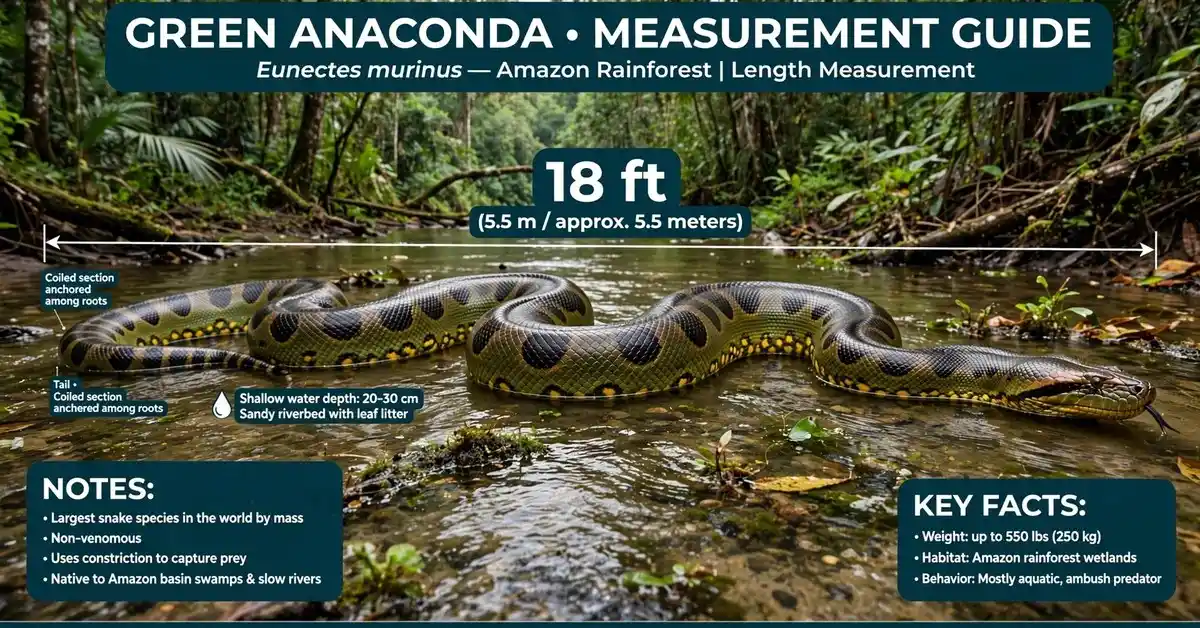
Female green anacondas typically reach 15 to 20 feet long, making them the heaviest snakes in the world and among the longest. Males are much smaller at 10 to 15 feet. The largest scientifically verified wild specimen measured 17 feet 1 inch — claims of 30- or 40-foot monsters circulate endlessly, but no specimen of such size has ever been documented with hard evidence.
The green anaconda’s fame rests on bulk as much as length. A 17-foot anaconda can outweigh a 24-foot reticulated python, because the anaconda’s girth is unmatched — a big female’s midbody can exceed 12 inches in diameter. This guide separates verified measurements from jungle legend, compares all four anaconda species, and puts 20 feet of snake into terms you can picture.
Anaconda Length Conversion Chart
| Measurement | Feet | Meters | Inches |
|---|---|---|---|
| Female green (typical large) | 15–17 ft | 4.6–5.2 m | 180–204 in |
| Female green (maximum verified wild) | 17.1 ft | 5.21 m | 205 in |
| Captive record (Pittsburgh Zoo, 1960) | ~20.6 ft | 6.27 m | 247 in |
| Male green (typical) | 10–12 ft | 3.0–3.7 m | 120–144 in |
| Yellow anaconda (max) | ~13 ft | 4.0 m | 156 in |
| Newborn green anaconda | 2–3 ft | 0.6–0.9 m | 24–36 in |
| Girth (large female) | ~3 ft circumference | ~0.9 m | ~36 in |
Anaconda Species Compared
| # | Species | Max length | Build | Range |
|---|---|---|---|---|
| 1 | Green anaconda (female) | 17–20 ft | Massive | Amazon & Orinoco basins |
| 2 | Green anaconda (male) | 10–15 ft | Slender | Same as females |
| 3 | Yellow anaconda | ~13 ft | Heavy | Paraguay–Paraná basin |
| 4 | Bolivian anaconda | ~13 ft | Medium | Bolivia lowlands |
| 5 | Dark-spotted anaconda | ~10 ft | Slender | NE Brazil, Guianas |
| 6 | Reticulated python (comparison) | 20–24 ft | Slender | SE Asia — longer but lighter |
| 7 | Burmese python (comparison) | 16–19 ft | Heavy | SE Asia |
| 8 | African rock python (comparison) | 15–20 ft | Medium | Sub-Saharan Africa |
Anaconda Size in Everyday Context
| # | Comparison | Size | Context |
|---|---|---|---|
| 9 | Standard interior door | 6 ft 8 in | A big female is 3 doors long |
| 10 | Compact car | ~13–14 ft | A 17-ft anaconda outstretches a car |
| 11 | Telephone pole (above ground) | ~30–35 ft | Roughly two big anacondas |
| 12 | Basketball court (half) | 47 ft | Nearly three big females end to end |
| 13 | Garden hose (standard) | 50 ft | About three large anacondas |
| 14 | Human arm span | ~5–6 ft | A big female spans 3+ arm spans |
| 15 | School bus | ~40 ft | Two record anacondas end to end |
1. Female Green Anacondas: 15 to 17 Feet Typical
Adult female green anacondas commonly reach 15 to 17 feet, with a mean length around 15 feet in well-studied Venezuelan populations. Females are dramatically larger than males — among the most extreme size differences in snakes. A 16-foot female is a formidable predator capable of taking caimans, capybaras, and deer. Her bulk is the real story: at 17 feet she may weigh 200-plus pounds, with a midbody girth that no python of equal length can match. In the water, where anacondas hunt, that mass moves with shocking speed.
2. The Verified Record: 17 Feet 1 Inch
The longest scientifically verified wild green anaconda was a female measuring 5.21 meters — 17 feet 1 inch — documented by herpetologist Dr. Jesús Antonio Rivas after examining over 1,000 wild anacondas in Venezuela. She weighed 214 pounds. A 1937 specimen from Guyana reportedly measured 19 feet 4 inches, but the measurement predates modern verification standards. Claims of 30- to 40-foot anacondas have never produced a museum specimen or verifiable photograph — treat them as legend. The honest record is 17 feet of verified snake, which is plenty.
3. Captive Giants: Up to 20 Feet
In captivity, with regular feeding and no energy spent hunting, green anacondas grow larger than wild ones. The verified captive record is a female at the Pittsburgh Zoo that measured 6.27 meters — about 20 feet 6 inches — when she died in 1960. Captive snakes live longer and eat consistently, so they reach sizes wild anacondas rarely attain. This explains part of the confusion around maximum size: the biggest anacondas anyone has actually measured lived in zoos, not rivers. Even the captive record, though, stops well short of the mythic 30-footers.
4. Male Green Anacondas: 10 to 15 Feet
Male green anacondas reach 10 to 15 feet but are strikingly slender compared to females — a 12-foot male may weigh a third of a 16-foot female. Males spend the breeding season tracking females by scent, and smaller, more mobile bodies serve that strategy. In mating balls, several males coil around a single large female, and the size contrast is dramatic: she is the rope-thick center of a knot of comparatively slender suitors. If you see a “small” 11-foot anaconda, it is almost certainly a male.
5. Yellow Anacondas: 13 Feet Maximum
Yellow anacondas of the Paraguay–Paraná basin reach about 13 feet maximum, with most adults 10 to 12 feet. They share the green anaconda’s heavy build and aquatic habits but in a smaller package, with yellow-green coloring marked in black. Yellow anacondas are the species most common in the pet trade, which is why captive-care guides often describe anaconda husbandry in terms of a 12-foot snake. They are still powerful constrictors — just scaled down from their giant Amazonian cousins.
6. Green Anaconda vs. Reticulated Python
The endless debate — longest vs. heaviest — resolves cleanly: reticulated pythons are longer (reliably to 20-plus feet, with claims toward 30), but green anacondas are heavier at any given length. A 17-foot anaconda’s bulk compares to a 24-foot reticulated python’s. The python is a rope; the anaconda is a fire hose. If “biggest snake” means longest, the reticulated python wins. If it means most massive — the animal that would win a wrestling match — the green anaconda takes it. Both deserve respect; neither deserves the monster-movie exaggeration.
7. Newborn Anacondas: 2 to 3 Feet
Green anacondas give live birth to 20 to 40 young, each 2 to 3 feet long — already the length of many adult snakes of other species. There is no parental care; the neonates swim off immediately and must avoid predators including caimans and even adult anacondas. A 2-foot newborn beside its 16-foot mother shows the species’ reproductive strategy: produce many large, capable young rather than a few helpless ones. Within a few years of good feeding, a female neonate can exceed 10 feet.
8. Girth: 12 Inches Plus in Diameter
A large female’s midbody can exceed 12 inches in diameter — thicker than a human thigh — with a circumference around 3 feet. This girth is what makes the anaconda the world’s heaviest snake: a 17-foot female at 214 pounds carries her weight in a cylinder of pure muscle. After swallowing a capybara, a female’s midbody bulge is unmistakable and she may not feed again for months. Measuring girth with a tape measure around a live anaconda is a job for professionals with several assistants.
9. Weight: Up to 550 Pounds Claimed
Weight claims for anacondas run higher than verified scales support. The Rivas-verified 17-footer weighed 214 pounds; exceptional wild females are credibly reported toward 300 pounds; claims of 500-plus pounds lack verification. The Guinness-cited 8.45-meter specimen behind some giant weight claims was never properly documented. A reasonable maximum for a huge wild female is 250 to 350 pounds — still heavier than any other snake on earth at comparable length. Captive giants, fed relentlessly, may push higher.
10. Anaconda vs. Standard Door: 6 Feet 8 Inches
A standard interior door stands 6 feet 8 inches — a 17-foot anaconda stretched straight would span two and a half doorways. Coiled, the same snake fits into a circle roughly 5 feet across, which is why photographs of coiled anacondas mislead: the coil hides the length. When anacondas cross roads or trails, witnesses see the full linear extent, and that is when the “it was 30 feet long!” stories start — an exciting 17 feet feels like 30 when it is sliding past your feet.
11. How Anacondas Are Measured
Measuring a live anaconda means stretching a powerful, uncooperative constrictor along a tape — usually done under sedation by researchers. The standard is total length, snout to tail tip, with the snake as straight as safely possible. Shed skins stretch and overstate length by 10 percent or more, which historically inflated records. Photographs need a scale reference to mean anything. Rivas’s 17-foot record stands because it was measured properly on a live animal by a scientist who had handled a thousand of them.
12. Why Females Are So Much Larger
Female anacondas outgrow males because fecundity favors size: a bigger female produces more and larger young. A 16-foot female may bear 40 neonates; a 12-foot female bears far fewer. Males, competing to find and court females, benefit from mobility over bulk. This divergence — females investing in egg capacity, males in mate-searching — is textbook sexual selection. The result is the most visibly dimorphic of the giant constrictors, and the reason “how long is an anaconda” needs the follow-up question: male or female?
13. Anaconda vs. Compact Car: 13 to 14 Feet
A compact car runs 13 to 14 feet long — a 17-foot female anaconda stretched nose-to-tail outstretches it by a full car door. Lay the snake alongside a parked sedan and the head extends past the front bumper while the tail clears the rear. It is the rare comparison that makes a snake feel automotive in scale. The mental image also corrects the coiled-photo illusion: snakes are linear animals, and their true size only registers in a straight line.
14. Habitat and Its Effect on Size
Green anacondas live in the slow waters of the Amazon and Orinoco basins — swamps, marshes, and sluggish streams — where buoyancy supports their bulk and ambush hunting rewards patience over speed. The richest habitats produce the biggest snakes: well-fed Venezuelan llanos females average larger than those in poorer waters. Deforestation and wetland drainage shrink both habitat and prey, which likely caps modern maximum sizes below what the species achieved historically. The biggest anacondas need the biggest, healthiest wetlands.
15. Separating Fact from Legend
Every giant-snake legend — the 40-footer in the tributary, the missionary’s 50-foot monster — collapses under the same test: produce the specimen. In centuries of Amazon exploration, no verifiable anaconda over 21 feet has ever been documented, and the rigorous wild record is 17 feet 1 inch. That does not make anacondas small — a verified 17-foot, 214-pound constrictor is an astonishing animal. It makes them real. The truth, measured with a tape rather than a story, is impressive enough without the extra twenty feet.
FAQs
How long do anacondas get?
Female green anacondas typically reach 15 to 17 feet, with the verified wild record at 17 feet 1 inch and a captive record around 20 feet 6 inches. Males reach 10 to 15 feet. Claims beyond 21 feet have never been verified.
What is the longest snake in the world?
The reticulated python is the longest snake, reliably measured past 20 feet with credible reports toward 25-plus. The green anaconda is the heaviest snake — shorter at maximum length but far bulkier. Length crown goes to the python; mass crown to the anaconda.
How much does a 20-foot anaconda weigh?
No verified 20-foot wild anaconda exists, but scaling from measured specimens, a 20-foot female would likely weigh 250 to 350 pounds. The 17-foot verified record-holder weighed 214 pounds. Claims of 500-plus-pound anacondas are unverified.
Are anacondas dangerous to humans?
Green anacondas are powerful constrictors and wild animals that demand respect, but verified attacks on humans are extremely rare. They are ambush predators of capybaras, caimans, and deer — not people. Most bites occur when humans handle or corner them.
Final Thoughts
The green anaconda’s verified 17-foot wild record — with females typically 15 to 17 feet and males 10 to 15 — makes it the heaviest snake on earth and a genuine giant by any honest measure. The captive record near 20 feet 6 inches shows what consistent feeding can add, while the 30- and 40-foot stories remain exactly that: stories, with no specimen behind them. What the numbers establish is more interesting than the myths: extreme sexual dimorphism, a 12-inch-plus girth that out-masses longer pythons, and newborns already 2 to 3 feet long. Measure the snake, not the legend — 17 feet of verified anaconda, thick as a fire hose and strong enough to take a caiman, needs no exaggeration.

I’m Elena Cross, a content writer at MeasuresIt.com, where I turn complex measures, units, and mathematical concepts into clear, accurate, and easy-to-read articles. I’m passionate about precision in numbers and in words and I write to help readers actually understand measurements, not just memorize them.