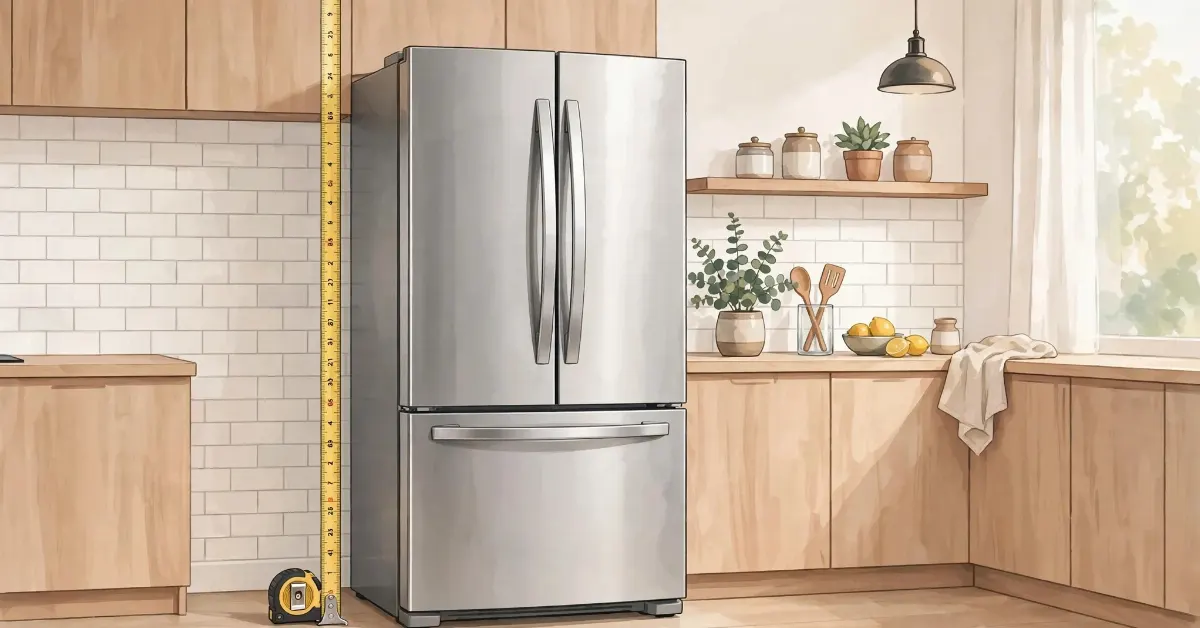
A standard full-size refrigerator is about 65–70 inches tall and 30–36 inches wide. Most models measure 29–35 inches deep, while counter-depth fridges run shallower at roughly 24–30 inches deep so they sit nearly flush with your kitchen cabinets.
Those three numbers — height, width, and depth — decide whether a new fridge glides into your kitchen like it was built for the space or becomes a delivery-day nightmare. Two models can look nearly identical on the showroom floor yet differ by several inches in depth, and half an inch of extra width is all it takes to make a refrigerator impossible to squeeze between two cabinets. Before you fall in love with a finish or an ice dispenser, grab a tape measure and learn exactly how much room you have to work with. This guide breaks down standard refrigerator dimensions by type, shows you how to measure your kitchen, your doorways, and your hallways, and explains the breathing room every fridge needs to run efficiently for a decade or more.
Refrigerator Dimensions at a Glance: Inches to Centimeters
American brands list sizes in inches, while many imported models and specification sheets use centimeters. This quick chart converts the standard ranges so you can compare any two models without doing math in the appliance aisle.
| Dimension | Inches | Centimeters |
|---|---|---|
| Height | 65–70 in | 165–178 cm |
| Width | 30–36 in | 76–91 cm |
| Depth (standard) | 29–35 in | 74–89 cm |
| Depth (counter-depth) | 24–30 in | 61–76 cm |
Treat published dimensions as a starting point rather than the final word. A listed width or depth usually excludes the door handles, and the depth figure normally assumes the doors are closed. A French-door model advertised as 36 inches wide can need closer to 38 inches of real-world clearance once both doors swing open, and chunky handles can add an inch or two of depth. Always pull up the manufacturer’s specification sheet and look for the fine-print figures labeled “with handles,” “doors open 90 degrees,” and “depth with doors removed” before you commit to a model.
1. Standard Refrigerator Size Chart by Type
Walk into any appliance store and you will meet four full-size configurations, each with its own footprint. French-door models pair two narrow refrigerator doors over a wide pull-out freezer drawer. Side-by-sides split the cabinet vertically into a refrigerator column and a freezer column. Top-freezer models keep the classic arrangement with the freezer compartment on top, while bottom-freezer models flip it so your fresh food sits at eye level. Smaller apartment-size and compact models cover rentals, offices, and dorm rooms. Here is how typical dimensions compare across all seven formats.
| Fridge type | Width | Height | Depth | Good to know |
|---|---|---|---|---|
| French-door | 30–36 in | 68–70 in | 29–35 in | Widest shelves; needs door-swing room on both sides |
| Side-by-side | 33–36 in | 68–70 in | 29–35 in | Narrow doors suit galley kitchens and tight walkways |
| Top-freezer | 30–33 in | 65–69 in | 29–33 in | Usually the most affordable full-size option |
| Bottom-freezer | 30–33 in | 67–70 in | 29–33 in | Fresh food at eye level; freezer drawer below |
| Counter-depth French-door | 30–36 in | 68–70 in | 24–30 in | Sits nearly flush with standard kitchen counters |
| Apartment-size | 24–28 in | 60–66 in | 24–28 in | Built for small kitchens and rental units |
| Compact / mini | 18–24 in | 32–36 in | 20–24 in | Dorm rooms, offices, and garages |
French-door. The most popular full-size layout in new kitchens, usually 30–36 inches wide and 68–70 inches tall. The two narrow doors need less clearance in front than a single wide door, but remember that both doors swing outward, so leave a little breathing room on each side.
Side-by-side. With the freezer and refrigerator standing in tall, narrow columns, these models suit galley kitchens and tight walkways because neither door needs much swing space. The trade-off is storage shape: wide items like serving platters and pizza boxes can be awkward to fit.
Top-freezer. The classic layout and usually the most affordable full-size option. These tend to run slightly narrower and shorter than French-door models, which makes them a forgiving choice when your opening is on the snug side.
Bottom-freezer. Flipping the classic layout puts everyday fresh food at eye level and the less-used freezer down low. Widths and heights track closely with top-freezer models, so measure the same way.
Counter-depth. Built to the same widths and heights as standard French-door models but only 24–30 inches deep, these sit nearly flush with your cabinetry for a built-in look. You trade a few cubic feet of interior room for that sleek line, and you will often pay a premium for it.
Apartment-size and compact. Made for rentals, offices, dorm rooms, and garages, these smaller formats can be as narrow as 18 inches. Small kitchens often have the tightest openings and trickiest delivery paths, so measure these installations just as carefully as a full-size model.
2. Counter-Depth vs Standard-Depth: What’s the Difference?
The single most visible difference between two fridges of the same width and height is how far they stick out past your counters. A standard-depth model at 29–35 inches deep will extend several inches beyond typical kitchen countertops, which means the doors and handles live out in your walkway. Some cooks love that pro-kitchen look; others find it interrupts the clean line of their cabinets.
Counter-depth models solve that by holding the cabinet box to about 24–30 inches deep, so the fridge body ends roughly where your counters end. Only the doors and handles project forward, which is exactly how built-in refrigerators look. The catch is capacity: shaving inches off the depth removes interior room, so a counter-depth fridge usually holds noticeably less than a standard-depth model of the same width and height, and it often costs more.
Which should you choose? Pick standard-depth when storage space and budget matter most — growing families and bulk shoppers will appreciate every extra inch. Pick counter-depth when the look of the kitchen matters most and you can live with slightly less room inside, or when a standard-depth fridge would block a walkway or crowd an island. Either way, measure depth from the wall behind the fridge, not from the front edge of the counter, and remember to add the handles to the number on the spec sheet.
Height deserves the same attention as width and depth. At 65–70 inches tall, a standard fridge needs an opening with several inches to spare above it — not just for ventilation, but so you can tilt the unit back onto a dolly during delivery and stand it upright again. Low-hanging cabinets, soffits, and microwave shelves are the usual culprits in kitchens where a taller French-door model will not fit. Measure from the finished floor, not from a rug or mat, and if a ceiling bulkhead leaves you short, a top-freezer model at the shorter end of the range can save the day.
One more nuance: “counter-depth” does not mean the doors sit perfectly flush. Doors still need room to swing, so even a counter-depth model projects an inch or two past the cabinet fronts when closed. If you want a truly flush installation, you are shopping for a built-in refrigerator, which is a different — and much pricier — category.
3. How to Measure Your Space for a New Refrigerator
A tape measure and ten careful minutes will save you from the most common appliance-buying mistake. Work through these steps in order, and write every number down — guessing is how fridges end up stuck in hallways.
- Measure the opening width in three places. Measure across the opening at countertop height, halfway up, and near the top. Walls and cabinets are rarely perfectly straight, so use the smallest of the three numbers — that is your true width.
- Measure the opening height. Run the tape from the finished floor to the underside of the cabinets or soffit above. Watch for trim, crown molding, and light fixtures that dip into the space.
- Measure the opening depth. Measure from the wall to the front edge of the countertop. Your fridge depth plus handles must fit this number with room to spare for the door swing.
- Check the door swing. Open the doors of your current fridge — or swing a yardstick — and note anything they hit: walls, islands, ovens, or pantry doors. French-door models need room on both sides; a single-door model needs a wide arc on one side.
- Measure the delivery path. Walk the route from your front door to the kitchen and measure every doorway, hallway pinch point, and stairwell at its narrowest. If the tightest spot is narrower than the fridge, plan to remove doors or choose a narrower model.
If your tape measure only shows inches and a forest of fractional marks, our guide on how to read a measuring tape will get you up to speed in a few minutes. Accurate to the eighth of an inch is plenty for fridge shopping — just be consistent about which edge of the tape you read from.
When you walk the delivery route, measure the full run of each hallway rather than eyeballing it. A hallway that looks “about 10 feet” long might be nine or eleven, and on delivery day every inch of turning room matters — if you are not sure what 10 feet really looks like, this visual guide will calibrate your estimates.
| What to measure | How to do it right |
|---|---|
| Kitchen opening width | Measure top, middle, and bottom; keep the smallest number |
| Opening height | Floor to underside of cabinets; note trim and molding |
| Opening depth | Wall to front edge of counter; add handle depth |
| Door-swing clearance | Swing a yardstick; note walls, islands, and ovens |
| Ventilation gaps | Plan roughly an inch on the sides and top (see below) |
| Front-door width | Measure the narrowest point, including the door frame |
| Narrowest hallway | Measure every pinch point along the delivery route |
| Tightest turn or stairwell | Check diagonal clearance if the fridge must pivot |
4. Clearance and Ventilation: How Much Room a Fridge Needs to Breathe
A refrigerator is a heat pump: it pulls warmth out of your food and dumps it into your kitchen through coils or vents, usually at the back or underneath. Squeeze a fridge tight into a sealed cavity and that heat has nowhere to go. The compressor runs longer, your energy bills creep up, and the appliance can wear out years earlier than it should.
Most manufacturers recommend roughly an inch of air space on each side, an inch or two behind the unit, and an inch or two above it. Treat those as minimums, not targets — if your opening allows more breathing room, take it. And always follow the specific clearances printed in your model’s installation manual, because built-in and counter-depth designs sometimes ask for different gaps than standard-depth models.
Placement matters as much as gaps. Keep the fridge away from heat sources like ovens, dishwashers, and direct afternoon sun, all of which force the compressor to work harder. Make sure the unit sits level — an unlevel fridge can keep doors from sealing properly, which wastes energy and builds up frost. Finally, vacuum the condenser coils once or twice a year; a blanket of dust insulates the coils and makes the whole system struggle.
If you are replacing a fridge in an older kitchen, check what is directly above the opening too. Some cabinets hang lower than modern standards, and a microwave shelf or soffit can steal the top clearance your new fridge needs. When in doubt, choose the slightly smaller model — nobody ever regretted a fridge that fit with room to spare, but plenty of people have regretted one that scraped the cabinets going in.
5. Delivery Day: Will It Fit Through the Door?
Here is the scenario every appliance store has seen: the fridge fits the kitchen opening perfectly but will not fit through the front door. Compare the narrowest point on your delivery path to the width of the new fridge, and leave yourself a couple of inches of wiggle room. A straight hallway is easy; a tight turn with a door frame on each side is where deliveries get stuck.
If the numbers are close, remember that most refrigerator doors — and often the handles — come off with a few screws, which can buy you a few precious extra inches. Measure the fridge body without doors and compare that to your tightest doorway. For pivoting around a corner, measure diagonally: a fridge that is too wide to go straight through can sometimes angle through with the doors removed.
Protect your floors before the crew arrives — refrigerator dollies and bare metal feet are brutal on hardwood and tile. Clear the path completely, remove interior doors from their hinges if they narrow the route, and keep kids and pets in another room. A smooth delivery takes twenty minutes; a stuck one can eat the whole afternoon.
6. Frequently Asked Questions
What are the standard refrigerator dimensions?
A standard full-size refrigerator is about 65–70 inches tall, 30–36 inches wide, and 29–35 inches deep. Counter-depth models share the same height and width but run shallower at roughly 24–30 inches deep.
How deep is a counter-depth refrigerator?
Counter-depth fridges measure about 24–30 inches deep for the cabinet box, not counting handles. That puts the body nearly flush with standard kitchen counters, with only the doors and handles projecting forward.
How much clearance does a refrigerator need?
Leave roughly an inch of air on each side and an inch or two behind and above the unit so heat can escape from the coils. Always check your model’s installation manual, since some designs specify larger gaps.
Will a 36-inch-wide fridge fit in a 36-inch-wide opening?
No — between the cabinet box, handles, door swing, and ventilation gaps, plan for an opening at least an inch or two wider than the fridge itself. Measure the opening in three places and work from the smallest number.
Final Thoughts
A standard refrigerator stands about 65–70 inches tall, spans 30–36 inches wide, and runs 29–35 inches deep — with counter-depth models trimming that depth to roughly 24–30 inches. But the numbers on the spec sheet only help if you measure your own kitchen first: the opening, the delivery path, and the breathing room around the unit all matter just as much as the fridge itself. Take ten minutes with a tape measure, write every dimension down, and double-check the manufacturer’s “with handles” and “doors open” figures before you buy. The right-size fridge slides in without drama, runs efficiently for years, and gives you one less thing to think about. For more everyday measurement guides, browse our Measurements collection.

I’m Marcus Kane, a measurement content specialist at MeasuresIt.com. I write clear, accurate, and practical articles about measurements, dimensions, conversions, and everyday size comparisons, making complex topics simple and easy to understand.