The short answer is simple: US men’s shoe sizes 6 through 13 correspond to UK 5.5 through 12.5 and EU 38.5 through 47.5, with each UK size sitting exactly half a step below its US twin. Women’s sizes follow the same staircase shifted about a size and a half upward, so a women’s US 8 lines up with roughly a men’s US 6.5 — once you grasp that relationship, converting between any two of the three systems takes seconds.
Below you’ll find the complete men’s and women’s conversion charts, a reliable step-by-step method for measuring your own feet at home, and honest notes on half sizes and wide fits — everything you need so the next pair you order from a US, British, or European store arrives fitting like it was made for you.
Men’s Shoe Size Conversion Chart (US, UK, EU)
This is the chart most shoppers reach for. Read across any row to see one foot length expressed in all three systems: US sizes on the left, the nearly identical UK scale beside them, and the European scale on the right.
| US Men’s | UK | EU |
|---|---|---|
| 6 | 5.5 | 38.5 |
| 7 | 6.5 | 40 |
| 8 | 7.5 | 41.5 |
| 9 | 8.5 | 42.5 |
| 10 | 9.5 | 44 |
| 11 | 10.5 | 45 |
| 12 | 11.5 | 46 |
| 13 | 12.5 | 47.5 |
One honest caveat before you memorize anything: no chart in the world overrides the quirks of an individual brand. Athletic labels, dress-shoe makers, and budget retailers all cut their lasts a little differently, so treat this table as a strong starting point and always check the brand’s own size guide before you buy.
Reading the table is straightforward: find the size you already know in any column, then slide across the row to read off the other two. If you usually wear a men’s US 9, for example, the same row tells you to ask for a UK 8.5 in a British shop and an EU 42.5 in a European one. Shoppers who only know their EU size can work the same trick in reverse — locate your EU number and read left to find the US and UK equivalents.
Women’s Shoe Size Conversion Chart (US, UK, EU)
Women’s sizing uses the same three systems, but the numbers sit higher on the ladder for any given foot length. The simplest rule of thumb: add about one and a half sizes to the men’s US number to land on the women’s US equivalent.
| US Women’s | UK | EU |
|---|---|---|
| 5 | 3 | 35.5 |
| 6 | 3.5 | 36.5 |
| 7 | 4.5 | 37.5 |
| 8 | 5.5 | 38.5 |
| 9 | 6.5 | 39.5 |
| 10 | 7.5 | 40.5 |
| 11 | 8.5 | 42 |
Notice how a women’s US 8 and a men’s US 6.5 share the same UK and EU columns — the systems are aligned by actual foot length, not by the number printed on the box. That is why unisex charts always show the men’s and women’s columns side by side.
1. How the US, UK, and EU Systems Relate
The US and UK scales are close cousins. Both descend from the old shoemaker’s scale built on the barleycorn, which is why a UK size sits a steady half size below its US equivalent all the way from the smallest to the largest sizes — the two scales are offset like the same ruler with its numbers shifted, not stretched or squeezed differently at each end. Once you internalize that fixed half-size gap, the US–UK column of the chart becomes something you can do in your head.
The EU scale is the odd one out. It runs on the Paris point rather than the barleycorn, and its whole and half numbers don’t step in lockstep with US or UK sizes — that is why a single EU number can comfortably cover a small span of US/UK sizes, and why European brands often print a range such as 42–42.5 on the tongue rather than one exact figure. Funnily enough, shoe sizes and the foot as a unit of length share little more than a name; the unit itself has its own long history, which you can explore in our guide to how long a foot really is.
Practically speaking, the US–UK conversion is the easy one: subtract half a size going from US to UK, add half a size coming back. The EU conversion is the one worth bookmarking this page for, because the jumps between EU numbers aren’t as even as shoppers expect, and guessing at them is how most cross-border sizing mistakes happen.
2. How to Measure Your Foot at Home
A chart can only convert the measurement you give it, so an accurate home measurement is the real foundation of a good fit. You need nothing fancy — a sheet of paper, a pen, and a ruler or tape measure. If your tape shows inches rather than centimeters, our guide to reading a measuring tape will help you pull a clean centimeter reading from it.
- Measure late in the day. Feet swell slightly as the hours pass, so an evening measurement captures your foot at its largest and keeps you from buying shoes that fit at breakfast and pinch by dinner.
- Stand, don’t sit. Place the paper on a hard floor — not carpet — stand on it with your full weight, and trace around the foot holding the pen upright. Sitting takes the load off and gives you a shorter tracing than the foot you’ll actually walk in.
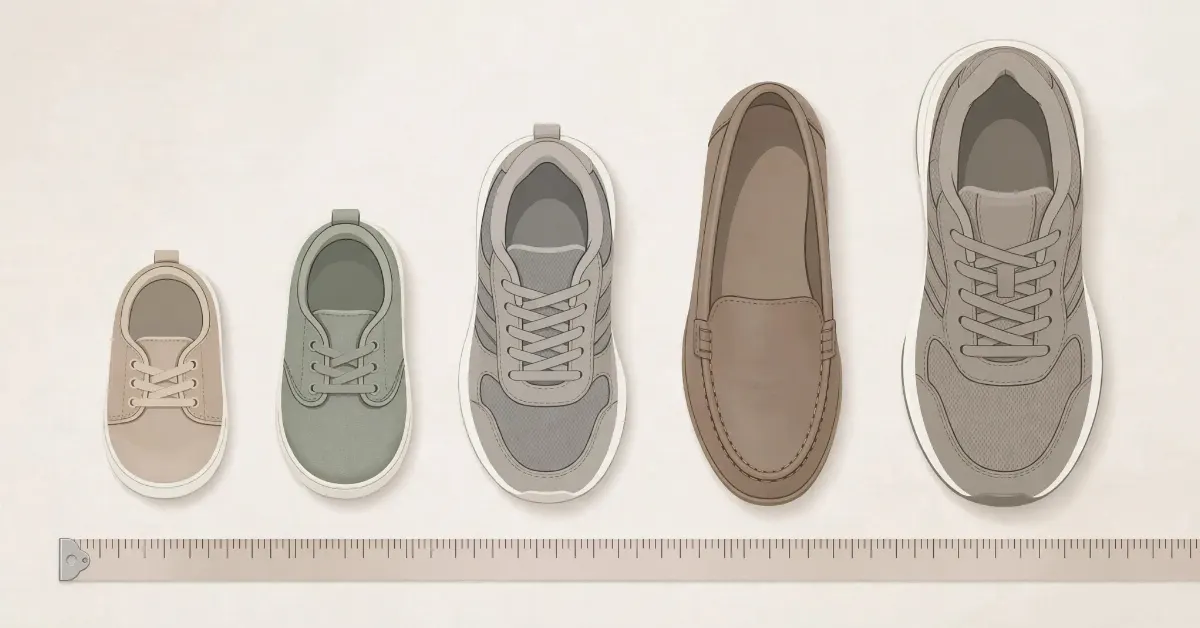
- Measure heel to longest toe. With a ruler or tape, take the straight-line distance from the very back of the heel to the tip of your longest toe in centimeters. Note that the longest toe isn’t always the big toe — measure to whichever one reaches farthest.
- Measure both feet and keep the larger number. Almost everyone has one foot slightly bigger than the other, and shoes are sold in pairs, so the bigger foot sets your size.
- Leave breathing room. Aim for roughly a thumb’s width — about half a centimeter to a centimeter — between your longest toe and the front of the shoe. Toes need space to spread when you walk, and shoes that touch the toes on day one will only feel tighter later.
One more tip: measure while wearing the socks you plan to wear with the shoes. A thick hiking sock adds meaningful volume inside a boot, while barefoot measurements suit sandals and dress shoes. Write both feet’s numbers down and keep them in your phone — your centimeter length never changes between stores, even when the size numbers do.
3. Half Sizes: When They Matter and When They Don’t
A half size is simply the midpoint between two full sizes — a finer length adjustment, not a different width. It exists for the very common situation where a full size feels slightly short and the next full size up feels slightly long. If your measured foot length lands squarely between two rows of the chart, the half size between them is usually your answer, and reaching for it is smarter than squeezing into the smaller full size.
Half sizes matter most in shoes where precision counts: running shoes, cycling shoes, ski boots, and anything with a snug performance fit where a millimeter of slip means blisters. They matter less in roomy designs — winter boots, loose loafers, and open sandals — where going up a full size rarely causes problems. As a rule, if you’re caught between sizes, take the larger one: a slightly roomy shoe can be tuned with thicker socks or an insole, while a shoe that’s too short can’t be fixed at all.
One exception worth knowing: some European brands work mostly in whole sizes, so the half-size option may simply not exist in their lineup. In that case the same rule applies — round up, not down — and let the brand’s own centimeter chart be the tiebreaker rather than your usual size number.
What if only one foot falls between sizes? Buy for the bigger foot — the smaller one can be snugged down with an insole or a tongue pad, but the bigger foot will never forgive a shoe that’s too short. This is also the situation where half sizes earn their keep: they let you fit the larger foot precisely instead of jumping a whole size up on both feet.
4. Wide-Fit Notes: Width Letters and What They Mean
Length is only half the fit story; width is the other half, and it’s where most sizing frustration actually lives. In the US system, men’s standard width is marked D and wide is 2E, while women’s standard is B and wide is D — yes, the same letter means different things depending on the gender column, which is one more reason to read the full label instead of just the number.
British shoes typically use letters like F for a standard men’s fit and G for wide, though makers vary enough that the brand’s own guide is worth a look before you assume. European sizing rarely marks width at all — instead, look for models labeled wide fit or comfort fit. If your forefoot feels squeezed across the ball of the foot even when the length is right, width — not size — is almost certainly the problem, and no amount of converting between US, UK, and EU will fix it.
A practical workaround when your width isn’t offered: trying the half size up buys a little extra room, but it’s a compromise, not a cure. A shoe built on a genuinely wider last will always fit better than a longer narrow one, so treat sizing up as a stopgap and keep hunting for the proper width fitting.
5. Buying Shoes Across Borders Without the Guesswork
When you’re ordering from another country, convert your centimeter measurement — not your usual size. Your foot’s length in centimeters is the same in every store on earth, while size numbers are just local nicknames for it. Find your centimeter row on the retailer’s own chart first, then note which local size sits beside it; that number is the only one that matters for that particular order.
Read a handful of reviews before committing, and look for patterns rather than single complaints: if several buyers say a model runs small, believe the pattern and consider the half size up. Shop with the socks you’ll actually wear, too — the pair that fits in thin dress socks may not fit in the cushioned athletic socks you’ll use for real, and discovering that on arrival day is an avoidable disappointment.
Finally, check the returns policy before you check the size chart. Even with perfect measuring, materials and lasts differ enough that an exchange is sometimes just part of the process — free, painless returns turn a sizing gamble into a fitting session at home, and they remove the last bit of risk from buying shoes you’ve never tried on.
When the box arrives, do your fitting in the evening on a hard floor, wearing the socks you’ll use. Walk around the house for ten minutes: your heel should stay put without the shoe gripping your Achilles, your toes should wiggle freely, and the widest part of your foot should line up with the widest part of the shoe. Any pinching you feel in minute two will be pain by mile two — trust the first impression and exchange while you can.
Frequently Asked Questions
Is a US size 10 the same as a UK size 10?
No — and this is the single most common conversion mistake. A men’s US 10 converts to a UK 9.5, because the UK scale runs half a size lower across the board. Ordering a UK 10 when you meant a US 10 lands you half a size too big, so always double-check which country’s number you’re reading before you click buy.
Do EU sizes run larger than US sizes?
Not exactly — they’re just numbered on a different scale, so the numbers look bigger without the shoes being bigger. An EU 44 is a men’s US 10, not some giant size; the European scale simply starts its count from a different place and steps in different increments. Compare by foot length or by the chart, never by which number looks larger.
Should I size up or down if I’m between sizes?
Size up. Feet need that thumb’s width of space ahead of the longest toe, and shoes rarely gain meaningful length with wear. A slightly roomy shoe can be snugged down with thicker socks or an insole; a shoe that’s too short will punish you on every single step.
Are men’s and women’s shoe sizes the same number?
No. For the same foot length, the women’s US number sits about one and a half sizes above the men’s — so a women’s US 8 and a men’s US 6.5 are close equivalents. Unisex listings usually show the men’s scale by default, so women shopping those listings should convert before assuming the number means the same thing.
Why do two pairs in the same size fit differently?
Because a size number only describes length on a standardized scale — it says nothing about the shape of the last, the depth of the toe box, or how much the materials give. A narrow Italian dress shoe and a roomy American trail runner can share a size number and fit like different planets. That is why the centimeter measurement plus the brand’s own chart beats any universal conversion when precision matters.
Final Thoughts
Shoe size conversion looks intimidating only because three systems insist on numbering the same feet differently. Remember the two relationships that matter: UK runs half a size below US, and women’s US runs about a size and a half above men’s — with the EU scale as the one worth looking up rather than guessing. Measure your feet in centimeters, convert the measurement instead of the size, and treat every brand’s chart as the final word for that brand. Do that, and borders stop mattering: a well-measured foot in centimeters is fluent in every shoe language on earth, and your next pair — wherever it’s made — will fit like it was cut for you. Bookmark this chart for the next time a European sale tempts you.

Hi, I’m Vera Lindqvist, a content writer at MeasuresIt.com, where I turn measurement standards, unit conversions, and precision tools into clear, practical guides. I care about getting the details right so you don’t have to second-guess them.