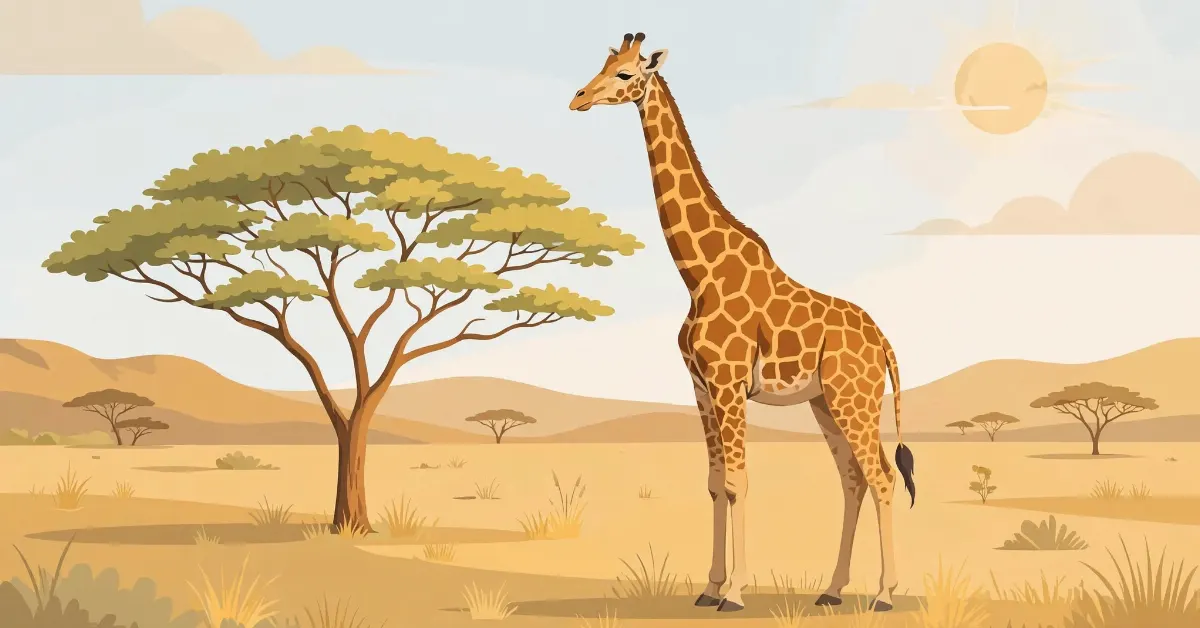
An adult giraffe stands 14 to 19 feet tall, making it the tallest land animal alive. Males typically measure 16 to 19 feet from hoof to horn tip, while females stand 14 to 16 feet, and even a newborn calf is already about 6 feet tall on the day it is born.
They show up on the horizon long before you can make out any detail: a drifting line of impossible silhouettes, all legs and neck, heads bobbing somewhere above the treetops. Then one turns to look your way, and the true scale of the animal finally lands. Photographs flatten giraffes. Standing anywhere near one does not. They are not merely tall for an animal — they are the tallest land animals on Earth, full stop, and every part of their body seems built to press that advantage.
This guide breaks down exactly how tall giraffes get, from record-setting bulls to day-old calves. You will find conversion charts, a male-versus-female breakdown, and the everyday comparisons — elephants, houses, buses — that finally make these numbers feel real.
Giraffe Height Conversion Chart
Here are the headline measurements converted into every unit you are likely to need. If you want to feel these numbers physically, grab a measuring tape and mark 19 feet along a hallway — then imagine an animal filling all of it, standing upright.
| Measurement | Feet | Inches | Centimeters | Meters |
|---|---|---|---|---|
| Adult male | 16–19 ft | 192–228 in | 488–579 cm | 4.9–5.8 m |
| Adult female | 14–16 ft | 168–192 in | 427–488 cm | 4.3–4.9 m |
| Neck length | Up to 6 ft | Up to 72 in | Up to 183 cm | Up to 1.8 m |
| Newborn calf | About 6 ft | About 72 in | About 183 cm | About 1.8 m |
Male vs Female Giraffe Height
Giraffes show one of the most dramatic height gaps between the sexes anywhere in the animal kingdom. Bulls keep growing for longer and end up markedly taller and heavier-framed than cows, which is why any honest answer to “how tall is a giraffe” has to give two numbers instead of one.
| Detail | Measurement |
|---|---|
| Adult male (bull) overall height | 16–19 ft (4.9–5.8 m) |
| Adult female (cow) overall height | 14–16 ft (4.3–4.9 m) |
| Height gap between the sexes | Males stand up to about 3 ft taller |
| Male height in inches | 192–228 in |
| Female height in inches | 168–192 in |
| Neck length (both sexes) | Up to 6 ft (1.8 m) |
| Newborn calf height | About 6 ft (1.8 m) |
| A newborn next to a person | About as tall as a grown man |
How a Giraffe Compares to Familiar Giants
Feet and inches only go so far on their own. Park a giraffe next to things you have actually stood beside, and its height becomes much easier to feel in your bones:
| Familiar object | How a giraffe compares |
|---|---|
| African elephant | A giraffe stands clearly taller than even a big bull elephant — the heavyweight loses on height |
| Two-story house | A large male’s head reaches roughly second-story window height |
| City bus | A giraffe would see clean over the roof without stretching |
| Adult human (6 ft) | About one-third the height of a big male giraffe |
| Standard interior doorway | A giraffe would have to fold itself nearly in half to get through |
| Double-decker bus | Its head would clear the upper-deck roof |
| Full-grown horse | Towers over even the tallest draft horse, with room to spare |
1. Adult Males: 16 to 19 Feet of Giraffe
The bulls are the skyscrapers of the species. A fully grown male giraffe stands between 16 and 19 feet tall, measured from the ground to the tips of the ossicones — those skin-covered knobs on top of the head that look like stubby antlers. The very largest bulls push toward the top of that range, and at 19 feet a male’s head is browsing at a height where the second floor of a house begins. Bulls do not just outgrow the females; they outgrow nearly everything else walking the savanna. Their extra height comes with a heavier frame: a thicker neck, broader shoulders, and ossicones that tend to go bald on top after years of sparring with other males. When two bulls size each other up, they swing those long necks like wrecking balls, and the taller animal usually wins without a real fight. That contest is a big reason males evolved to be so tall in the first place — height is status, and status is everything when competing for mates.
2. Adult Females: 14 to 16 Feet
Female giraffes, or cows, stand 14 to 16 feet tall — shorter than the bulls, but still taller than any other land animal alive. It is worth pausing on that: even the smallest adult female giraffe towers over a rhinoceros, a hippopotamus, or a full-grown elephant. The overlap in the ranges matters too. A large cow at 16 feet stands exactly as tall as a small bull, so sex alone does not tell you which of two giraffes is taller until you look at build. Cows tend to be more slender through the neck and body, with tufted ossicones, and they carry the enormous energetic cost of growing calves that are born already six feet tall. Their slightly smaller stature may actually be an advantage when food is scarce, since a smaller body needs fewer calories to keep going. But make no mistake — a 15-foot female stripping leaves from an acacia tree is still one of the tallest sights in nature.
3. The Neck Alone Measures Up to 6 Feet
The single most famous part of the giraffe is also one of the longest necks in nature: up to 6 feet from shoulders to head. That is roughly the full height of an adult human — imagine a person standing on a giraffe’s shoulders, and their head would land about where the giraffe’s head is. The neck is a muscular, heavy structure, not the delicate stem it appears to be from a distance, and it does far more than reach leaves. Males wield it as a weapon, swinging their heads at rivals in contests whose thuds carry across the savanna. Females use it with surprising delicacy, threading between thorns to strip leaves that other browsers cannot touch. And because the neck holds the head some 16 to 19 feet in the air, it doubles as a watchtower — a giraffe often spots danger long before the shorter animals grazing below it have any idea anything is wrong.
4. Legs: The Stilts Doing the Heavy Lifting
Below the famous neck sits the part of the giraffe people consistently underestimate: the legs. A huge share of the animal’s total height is leg — long, slender, and deceptively powerful. Each leg ends in a single large hoof, and the stride of a galloping giraffe eats up ground in a way that looks almost like slow motion until you realize how much distance every step covers. Those legs are also the giraffe’s first line of defense; a kick from an adult can shatter bone, and lions learn to respect the business end of a giraffe very quickly. Picture a man of about 5 foot 10 standing beside a giraffe’s front leg — his head would barely clear the animal’s knee region, because the leg alone is a landmark. It is an odd evolutionary bargain: stilts that make you the tallest animal alive, but that also force you to splay your front legs wide just to lower your head for a drink.
5. A Heart Built for Height
Getting blood from the heart to a brain sitting at the end of a 6-foot vertical pipe is one of the great engineering problems in nature, and the giraffe solves it with a heart built like an industrial pump. The organ is exceptionally large and muscular for the job, generating the pressure needed to push blood all the way up the neck against gravity. The whole circulatory system is tuned for the vertical commute: thick-walled arteries handle the pressure on the way up, while specialized valves and the drum-tight skin of the lower legs help push blood back upward on the return trip. When a giraffe lowers its head to drink, the system must cope with the sudden reversal — pressure swings that would overwhelm most animals are absorbed by a network of vessels that equalize the flow. It is a reminder that the giraffe’s height is not just a matter of long bones; every internal system had to be redesigned to support it.
6. Newborn Calves Start at 6 Feet Tall
A giraffe calf hits the ground running — almost literally. Newborns stand about 6 feet tall, which means a baby giraffe is already as tall as a grown man within hours of birth. That astonishing head start is a survival strategy: on the savanna, small is vulnerable, so giraffes are born big. The calf grows at a remarkable pace through its first year, shooting upward as it learns to keep pace with the herd. Within a few years, a young male can approach the lower end of the adult range, and the lanky teenager phase — all legs, still filling out — is one of the more endearing sights in the wild. But even at birth, that 6-foot frame tells you everything about the species’ priorities: height first, everything else second.
7. Giraffe vs Elephant: No Contest on Height
People often assume the elephant, being the heaviest land animal, must also be the tallest. It is not — not even close. A giraffe stands clearly taller than even a large bull elephant, whose great bulk is carried low to the ground. The elephant wins on weight by an enormous margin, but height belongs to the giraffe without contest, which is exactly why the giraffe holds the title of tallest land animal alive. Side by side, the comparison is almost comical: the elephant’s back reaches maybe to a giraffe’s chest, and the giraffe looks down — literally down — on an animal that outweighs it several times over. It is a useful reminder that “biggest” and “tallest” are different crowns, and the giraffe wears the tall one undisputed.
8. Giraffe vs House and Bus
For a sense of scale you can check without leaving town, put a giraffe next to buildings and vehicles. A big male’s head reaches roughly the height of a second-story window on a typical house — picture looking out your upstairs window and meeting a giraffe’s gaze at eye level. A city bus, tall as it seems when you are waiting at the stop, would not even reach the animal’s shoulder; the giraffe would see clean over its roof. Even a double-decker bus, the tallest thing on most city streets, would lose: the giraffe’s head clears the upper deck. These comparisons work because houses and buses are some of the few human-made objects that approach giraffe scale — almost everything else we build for daily life, from doorways to delivery vans, sits far below it.
9. How Giraffe Height Is Actually Measured
Published giraffe heights can vary a little from source to source, and the reason is refreshingly simple: it depends where you stop measuring. The standard figure — the 14 to 19 feet used in this guide — runs from the ground to the top of the head, including the ossicones. Shoulder height is considerably lower, since the neck contributes up to 6 feet all by itself. Posture matters too: a giraffe holding its head high versus one browsing at mid-neck can differ by a foot or more. And because males keep growing longer than females, the age and sex of the animal being measured shift the number. So when you see a range rather than a single figure, that is not vagueness — it is honesty about a living animal that does not stand still for the tape measure.
10. Why So Tall? The High-Browsing Advantage
Why evolve to be this tall at all? The classic answer is food. A giraffe’s height gives it exclusive access to a salad bar no competitor can reach — the tender leaves at the tops of acacia and other savanna trees, browsed at heights where no antelope or elephant can follow. During the dry season, when low browse is stripped bare, that private pantry can mean the difference between thriving and merely surviving. Height has defensive perks too: those long legs cover ground efficiently, and a head held 16 to 19 feet up makes a superb lookout post — giraffes often spot lions and other predators while shorter herd animals are still grazing in blissful ignorance. Other grazers even seem to know it, keeping a casual eye on the giraffes as an early-warning system. Extreme height, in other words, is not a quirk. It is a strategy that works.
Frequently Asked Questions
Are male or female giraffes taller?
Males, by a clear margin. Adult males stand 16 to 19 feet tall, while adult females measure 14 to 16 feet. The ranges overlap at 16 feet, so a large female can match a small male — but on average, bulls stand a couple of feet taller, with heavier necks and thicker ossicones to match.
How long is a giraffe’s neck?
Up to 6 feet long — about the height of an adult human. The neck makes up a large share of the animal’s total height and does double duty as a browsing tool, a weapon that males swing at rivals, and a watchtower for spotting predators early.
How tall is a baby giraffe when it is born?
About 6 feet tall — as tall as a grown man. Calves are born big as a survival strategy, since small animals are vulnerable on the savanna, and they grow rapidly through their first year as they learn to keep up with the herd.
What is the tallest land animal in the world?
The giraffe. At 14 to 19 feet tall, no other land animal comes close — not the elephant, which is far heavier but shorter, nor any other living species on Earth.
Final Thoughts
So how tall is a giraffe? Between 14 and 19 feet, depending on sex and the individual — males 16 to 19 feet, females 14 to 16 feet, with up to 6 feet of that in the neck alone and newborns already standing 6 feet tall. It is a height that reorders your sense of scale: taller than an elephant, eye-to-eye with a second-story window, and able to look clean over the roof of a city bus. The next time you see a giraffe — at a zoo, in a documentary, or, if you are lucky, out on the savanna — you will know exactly what you are looking at: the tallest land animal on Earth, an animal that turned height into a way of life.

I’m Elena Cross, a content writer at MeasuresIt.com, where I turn complex measures, units, and mathematical concepts into clear, accurate, and easy-to-read articles. I’m passionate about precision in numbers and in words and I write to help readers actually understand measurements, not just memorize them.