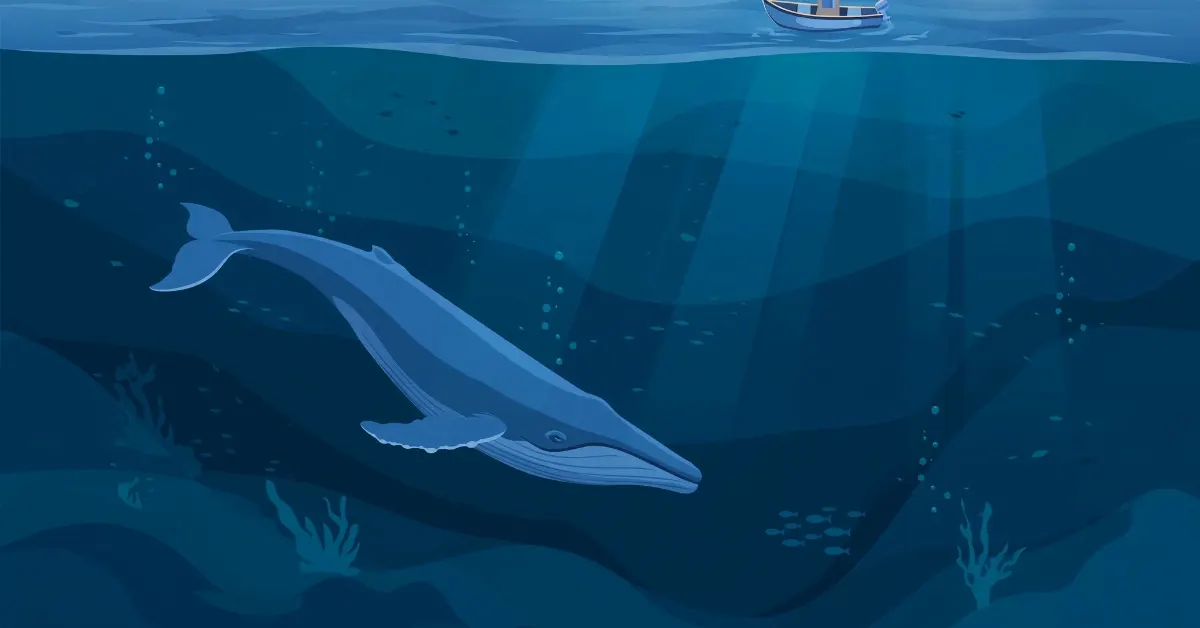
Blue whales reach 80 to 100 feet long (24 to 30 meters), making them the largest animals ever known to have lived on Earth. An adult blue whale’s heart weighs about 400 pounds — roughly the size of a small car — and its tongue weighs about as much as an entire elephant.
It is hard to overstate how big a blue whale really is. Numbers like “100 feet” slide off the mind because almost nothing in daily life approaches that scale — a blue whale is longer than a basketball court, about twice as long as a school bus, and roughly the length of a Boeing 737. Even the animal’s individual organs sound like misprints: a heart the size of a car, a tongue as heavy as an elephant. Yet every one of these measurements is real, and scientists have verified them again and again.
The blue whale (Balaenoptera musculus) earned its title as the largest animal ever known not through myth but through careful measurement — first by whalers with tape measures along the flanks of harvested animals, and today by researchers using drones and laser photogrammetry on living whales. In this guide, we will walk through the verified numbers: the full length range in feet and meters, the astonishing size of the heart and tongue, how calves measure up at birth, and the everyday objects that finally make 100 feet feel real.
Blue Whale Length: Feet to Meters Conversion Chart
The table below converts key points across the blue whale’s length range between feet and meters, so you can reference whichever unit feels most natural.
| Whale size | Feet | Meters |
|---|---|---|
| Smaller adult | 80 ft | 24.4 m |
| Mid-range adult | 85 ft | 25.9 m |
| Large adult | 90 ft | 27.4 m |
| Very large adult | 95 ft | 29.0 m |
| Maximum recorded range | 100 ft | 30.5 m |
1. How Long Is a Blue Whale in Feet?
Adult blue whales typically measure between 80 and 100 feet long from the tip of the snout to the notch of the tail flukes. Females tend to run slightly larger than males — a pattern common in baleen whales — and the very largest individuals ever measured push right up against the 100-foot mark. To put that in perspective, if you are curious about how long a foot is, imagine 80 to 100 of those units laid end to end: that is a single animal.
Length is the headline number, but it only hints at the animal’s true bulk. A blue whale’s body is deepest around the middle, where its girth is enormous, and its tail flukes alone can span 25 feet from tip to tip — wider than many living rooms are long. The head, which makes up nearly a quarter of the total body length, houses a mouth so enormous that roughly 100 people could fit inside it.
The 80-to-100-foot range was not settled overnight. Early figures came from whalers stretching tape measures along carcasses on pitching decks — impressive efforts, but prone to error when a massive, flexible body is involved. Modern drone-based photogrammetry has since confirmed the range on living whales, and researchers now cross-check lengths across populations in different ocean basins, finding the same remarkable span wherever blue whales are studied.
Researchers today measure living whales without touching them. Drones flown above a surfacing whale capture overhead images, and with a laser altimeter recording the drone’s exact height, software converts pixels to feet with remarkable precision. This non-invasive approach has confirmed the classic 80-to-100-foot range and revealed subtle differences between populations in different parts of the world.
2. Blue Whale Length in Meters
In metric terms, the blue whale’s 80-to-100-foot range converts to 24 to 30 meters — roughly the length of three standard city buses parked bumper to bumper, or a full 10-story building laid on its side. The 30-meter upper end is the figure most often quoted in scientific literature, and it is the number that secured the blue whale’s reputation as the largest animal ever known.
Metric measurements dominate modern whale science, since research teams from many countries collaborate on population studies. When you read that a particular whale measured 27 meters, picture about 89 feet — a large but not record-breaking adult. Consistency matters here: because a blue whale’s body flexes as it swims, scientists standardize on the straight-line distance from snout to tail notch measured when the animal is as straight as possible at the surface.
Blue Whale Size at a Glance
| Feature | Measurement | Comparison |
|---|---|---|
| Body length | 80–100 ft (24–30 m) | Largest animal ever known |
| Heart | ~400 lb | About the size of a small car |
| Tongue | Elephant-weight | Weighs about as much as an elephant |
| Eyes | Small relative to body | Surprisingly modest for such a giant |
| Newborn calf | Already enormous | Among the largest babies on Earth |
| Tail flukes | Up to ~25 ft across | Wider than most living rooms are long |
3. Heart, Tongue & Eyes: Anatomy of the Giant
A blue whale’s heart is one of the most staggering organs in the animal kingdom. Weighing about 400 pounds, it is roughly the size of a small car and beats just 4 to 8 times per minute when the whale dives deep, slowing to conserve oxygen on dives that can last 20 minutes or more. At the surface, the heartbeat quickens to around 25 beats per minute. Researchers have even recorded these heartbeats with suction-cup sensors, finding that the heart can slow to just 2 beats per minute during the deepest part of a foraging dive.
The tongue is equally astonishing: it weighs about as much as an elephant. This massive, muscular organ plays a central role in the whale’s lunge-feeding strategy. When a blue whale engulfs a school of krill, its throat pleats expand like a parachute and the tongue — an enormously heavy muscle — inverts to help push hundreds of gallons of water back out through the baleen plates, trapping the tiny crustaceans inside. Without that elephant-heavy tongue, the whole feeding mechanism would fail.
The eyes, by contrast, are a study in restraint. For an animal up to 100 feet long, the blue whale’s eyes are surprisingly small — each one modest in absolute terms and tiny relative to the head that carries it. Vision matters little in the dark, plankton-rich waters where blue whales feed; they navigate and find food primarily through hearing and the sensing of water movement. The small eyes are a reminder that evolution sizes each organ for its job, not for symmetry with the whole.
4. Blue Whale vs School Bus, Boeing 737 & Basketball Court
Raw numbers only go so far. The comparisons below translate the blue whale’s 80-to-100-foot length into objects you can picture instantly — the same technique we use throughout our measurement guides to make big numbers feel concrete.
A standard school bus is about 40 feet long — roughly half the length of a large blue whale. Park two school buses bumper to bumper and you have traced the outline of one adult whale. The Boeing 737, the workhorse passenger jet seen at airports worldwide, stretches roughly the length of a large blue whale from nose to tail; standing the two side by side, the whale’s tail flukes would rise higher than the jet’s tail fin is wide. And a regulation basketball court runs 94 feet from baseline to baseline — so a big blue whale laid along the hardwood would nearly touch both baskets.
The Boeing 737 comparison deserves a second look, because jets and whales share a surprising design logic: both are long, tapered tubes built to move efficiently through a fluid. The jet does it with engines and aluminum; the whale does it with muscle and blubber, cruising at a few miles per hour and sprinting in short bursts when it lunges after krill. When you stand near a 737 at the gate, you are standing near something very close to the length of the largest animal that has ever lived.
| Reference item | Size | How it compares to a blue whale |
|---|---|---|
| School bus | ~40 ft | About half a blue whale; two buses ≈ one whale |
| Boeing 737 | Jetliner length | Roughly the length of a large blue whale |
| Basketball court | 94 ft | About as long as a big blue whale, baseline to baseline |
| 10 feet | 10 ft | A whale spans 8–10 of these — see how big 10 feet is |
| One foot | 12 in | 80–100 of them laid end to end — see how long a foot is |
| Adult human (~6 ft) | ~6 ft | It would take 13–17 people head-to-toe to span one whale |
| Heart (~400 lb) | Car-sized | About the size of a small car |
| Tongue | Elephant-weight | Weighs about as much as an elephant |
| Newborn calf | Already huge | Among the largest babies in the animal kingdom |
The human chain comparison tends to land hardest: picture thirteen to seventeen adults lying head to toe on a beach, and you have roughly the length of one blue whale. It is a visualization that turns an abstract “100 feet” into something you can feel in your bones — and it explains why early whalers, measuring carcasses along the deck, struggled to believe their own tape measures.
5. How Scientists Measure a Blue Whale
Measuring the largest animal on Earth is a genuine logistical challenge. In the whaling era, lengths were taken from carcasses stretched along a deck — accurate for the individual but impossible for living whales. Modern researchers use aerial photogrammetry: a drone hovers directly above a whale at the surface, a laser altimeter records the drone’s precise altitude, and software scales the photograph to calculate the whale’s length in feet or meters.
This technique has done more than confirm the classic 80-to-100-foot range. Repeated drone surveys let scientists track the same individual over seasons and years, measuring growth in calves and changes in body condition in adults. A whale that looks thin from the side might measure perfectly healthy from above, and photogrammetry catches the difference. The method is also completely non-invasive — the whale never knows it has been measured.
The same drone technique that measures adults is now used to track calves, and the results have startled even veteran researchers. A calf measured in its first months and again a year later can show growth that outpaces every other mammal on the planet — the marine equivalent of watching a child outgrow their clothes in weeks rather than years. These repeat measurements are only possible because photogrammetry is harmless; the same whale can be sized up season after season without ever being touched.
Historical records of whales near or beyond 100 feet exist, but scientists treat the extreme upper claims cautiously, since stretched carcasses and estimated measurements introduced error. The well-documented, repeatedly confirmed range remains 80 to 100 feet (24 to 30 meters) — more than enough to secure the blue whale’s crown.
6. How Big Is a Baby Blue Whale?
Blue whale calves begin life already among the largest babies in the animal kingdom. A newborn calf is a fraction of its mother’s length yet still dwarfs nearly every other newborn creature on the planet — longer than a pickup truck and heavier than several cars combined. Within its first year, the calf grows at a pace unmatched by any other mammal, fueled by hundreds of liters of extraordinarily rich milk each day.
This explosive growth is a survival strategy. The open ocean offers calves no shelter, so size itself is protection: the bigger a calf gets, the fewer threats it faces. By the time it is weaned, a young blue whale has already surpassed the adult size of most other whale species — a humbling reminder that in the blue whale’s world, “baby” is a relative term.
7. Blue Whales vs Other Large Animals
The blue whale’s status as the largest animal ever known puts it above every contender, living or extinct. The biggest dinosaurs — the long-necked sauropods often imagined as the ultimate giants — were certainly long, but none matched the blue whale’s combination of length and sheer mass. No land animal could: a body that size simply cannot support its own weight outside the buoyancy of water.
Among living animals, the comparison is not close. The African elephant, the largest land animal, is dwarfed to the point that the whale’s tongue alone weighs about as much as the whole elephant. Even the fin whale, the blue whale’s closest rival and the second-largest animal on Earth, runs noticeably smaller. The blue whale stands alone at the top of the size scale — the undisputed heavyweight champion of all animal life, past and present.
Even the great white shark — the ocean’s most famous heavyweight — looks modest beside a blue whale, reaching roughly a fifth of the whale’s length. And the colossal squid, often cast as the sea’s ultimate giant in stories, is longer than a person but nowhere near the whale’s league. In every direction you look, across every ocean and every era, the blue whale’s dimensions stand alone.
Frequently Asked Questions
How long is a blue whale in feet?
Adult blue whales measure 80 to 100 feet long from snout to tail flukes. Females are typically slightly larger than males, and the biggest verified individuals approach the 100-foot mark.
How long is a blue whale in meters?
In metric units, blue whales range from 24 to 30 meters long. The 30-meter figure is the one most commonly cited in scientific literature describing the species’ maximum size.
How much does a blue whale’s heart weigh?
A blue whale’s heart weighs about 400 pounds — roughly the size of a small car. It is the largest heart of any known animal, beating as slowly as 2 to 8 times per minute during deep dives.
Is the blue whale really the largest animal ever?
Yes. At up to 100 feet (30 meters) long, the blue whale is considered the largest animal ever known to have existed — larger than any dinosaur and larger than any other living animal, including the fin whale, its closest rival.
Final Thoughts
The blue whale stretches the limits of what an animal can be: 80 to 100 feet long, with a 400-pound car-sized heart and a tongue as heavy as an elephant, it remains the largest animal ever known. Yet its true scale only lands when you picture it against familiar things — two school buses end to end, a Boeing 737, a basketball court spanned baseline to baseline. These giants glide through every major ocean, still incompletely understood despite their size. Remember the core numbers — up to 100 feet, up to 30 meters — and the next time you see a school bus or a basketball court, you will be looking at a living yardstick for the greatest animal in Earth’s history.

Hi, I’m Vera Lindqvist, a content writer at MeasuresIt.com, where I turn measurement standards, unit conversions, and precision tools into clear, practical guides. I care about getting the details right so you don’t have to second-guess them.