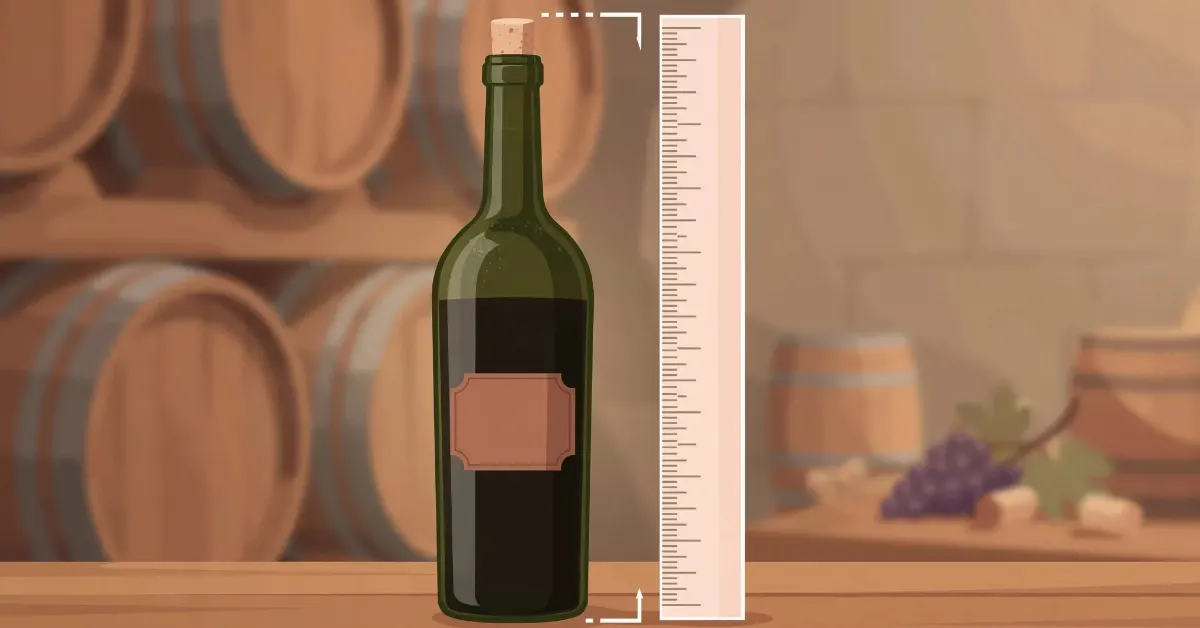
A standard 750 ml wine bottle stands about 11.8 to 12 inches tall and measures roughly 3 inches in diameter. It holds 750 milliliters of wine — about five standard 5-ounce pours — which is why the 750 ml bottle became the universal benchmark for wine bottle dimensions around the world.
If you have ever tried to slide a wine bottle into a kitchen cabinet, a gift bag, or a wine rack, you already know why these measurements matter. That tall, slender silhouette is so consistent from brand to brand that most of us never stop to ask how big a wine bottle actually is — until we need the numbers. Whether you are building a wine rack, packing bottles for a move, ordering a wine fridge, or simply settling a dinner-table debate, this guide covers the exact height, width, and volume of the standard 750 ml bottle, how Bordeaux and Burgundy shapes compare, and how magnums, jeroboams, and cases measure up.
The 750 ml bottle became the global standard through a mix of trade agreements, tradition, and practicality. Its size strikes a sensible balance: enough wine for several glasses across a few evenings, yet light and compact enough to handle, store, and ship easily. Because the standard is so widely adopted, the dimensions below apply to the vast majority of still wine bottles you will encounter, from an everyday table red to a special-occasion Bordeaux.
In this guide you will find precise metric and imperial conversions, side-by-side comparisons of the two classic bottle shapes, a tour of large-format bottles, standard case dimensions, and everyday objects you can use to picture the size at a glance. Let us start with the numbers.
Wine Bottle Dimensions: Quick Conversion Chart
The table below converts the standard 750 ml bottle’s key measurements between the metric and imperial systems, so you can reference whichever units you prefer.
| Measurement | Metric | Imperial |
|---|---|---|
| Height | 30 – 30.5 cm | 11.8 – 12 in |
| Diameter (widest point) | ≈ 7.6 cm | ≈ 3 in |
| Circumference | ≈ 23.9 cm | ≈ 9.4 in |
| Volume | 750 ml (0.75 L) | ≈ 25.4 US fl oz |
| Standard pours per bottle | 5 × 150 ml | 5 × 5 oz |
1. Standard 750 ml Wine Bottle Dimensions
A standard wine bottle measures approximately 11.8 to 12 inches (30 to 30.5 centimeters) tall from the base to the top of the finish, with a body diameter of about 3 inches (7.6 centimeters) at its widest point. The small range exists because glass thickness, the depth of the punt (the indentation in the base), and the producer’s mold all introduce minor variation. Two bottles from different wineries can differ by a fraction of an inch and still both be perfectly standard.
In terms of volume, 750 milliliters equals 0.75 liters or about 25.4 US fluid ounces. Poured in standard 5-ounce servings, a single bottle yields about five glasses of wine — the arithmetic most restaurants and event planners use when estimating how many bottles a dinner party requires. If you need to double-check any of these conversions, our guide to inches walks through metric and imperial conversions step by step.
The bottle’s proportions are deliberately slender. At roughly four times as tall as it is wide, the shape fits comfortably in an adult hand, slides into standard wine-rack openings, and stacks efficiently in shipping cases. The long neck serves a practical purpose too: it limits the wine’s exposure to air once the bottle is opened and gives the cork a snug, consistent seal.
The finish — the very top of the bottle where the cork or cap sits — adds a small but meaningful detail: the lip must be perfectly round and smooth for the cork to seal properly. At the opposite end, the punt (the indentation pushed up into the base) strengthens the glass and gives the bottle extra stability on the table. Neither feature changes the headline numbers — the bottle still measures about 12 inches tall and 3 inches across — but both are reminders that every curve of the design serves a purpose beyond good looks.
2. Bordeaux vs Burgundy Bottle Shapes
The two classic wine bottle shapes — Bordeaux and Burgundy — hold the same 750 ml and stand about the same height, but their silhouettes are easy to tell apart once you know what to look for. The differences are rooted in the wines they were designed to hold, and both shapes are still strongly associated with particular grape varieties today.
The Bordeaux bottle has straight sides, high, sharply defined shoulders, and a relatively short neck. It was designed for the red wines of Bordeaux, which can throw sediment as they age; the pronounced shoulder catches that sediment when the wine is decanted, keeping it out of your glass. You will typically find Cabernet Sauvignon, Merlot, and other Bordeaux-style blends in this shape, and many New World producers use it for the same reason.
The Burgundy bottle, by contrast, has gently sloping shoulders that flow into a wider body and a longer neck. This shape is traditionally associated with Pinot Noir and Chardonnay from Burgundy, and today it is common for those varietals worldwide. The wider body gives the bottle a slightly softer, rounder appearance, though its overall height and diameter remain within the same standard range — about 12 inches tall and 3 inches across.
Beyond the two classics you may also encounter the tall, slender hock (or flute) bottle, traditionally used for Riesling and other aromatic white wines. It shares the same 750 ml capacity and stands within the same general height range, proving once again that the industry’s standard dimensions flex in style but rarely in size.
For practical purposes, the shape rarely changes the numbers that matter. Both styles hold 750 ml, both stand roughly a foot tall, and both fit the same wine racks, gift bags, and case dividers. The choice between them is mostly about tradition and the winemaker’s style rather than dimensions.
3. Magnum, Jeroboam & Large-Format Bottles
Beyond the standard bottle lies a whole family of large formats, each named (with charming inconsistency) after biblical kings. A magnum holds 1.5 liters — exactly double a standard 750 ml bottle — and is the most common large format you will see at celebrations. Larger sizes continue the doubling pattern, as the table below shows.
| Bottle name | Volume | Equivalent 750 ml bottles |
|---|---|---|
| Split (Piccolo) | 187 ml | ¼ bottle |
| Half bottle (Demi) | 375 ml | ½ bottle |
| Standard | 750 ml | 1 bottle (11.8–12 in tall, ~3 in diameter) |
| Magnum | 1.5 L | 2 bottles |
| Double magnum | 3 L | 4 bottles |
| Jeroboam | 3 L | 4 bottles |
Magnums are popular not just for show: wine enthusiasts argue that wine ages more gracefully in larger bottles because the ratio of wine to oxygen (trapped in the neck) is higher. Whether or not you buy the science, a magnum makes an undeniable statement at a holiday table, and its dimensions — roughly twice the volume in a taller, slightly broader package — still fit comfortably in most standard wine coolers.
Double magnums and jeroboams, each holding 3 liters or four standard bottles, step firmly into special-occasion territory. At that scale, bottles become noticeably taller rather than dramatically wider, since producers generally keep the body diameter close to the familiar 3-inch standard so the bottles remain pourable and storable. Anything larger than a jeroboam is rare outside of charity auctions and winery tasting rooms, where the spectacle is the point.
4. Wine Case Dimensions: What 12 Bottles Measure
A standard wine case holds 12 bottles of 750 ml each — 9 liters of wine in total. Cases are the unit of wholesale and collector buying, and their dimensions follow directly from the bottles inside: twelve 3-inch-diameter bottles arranged upright in a grid, usually 4 by 3, separated by cardboard or molded dividers.
Because the bottles stand upright, a case is about as tall as the bottle it contains plus the thickness of the box and dividers — roughly 12 to 13 inches high. The footprint works out to about 12 to 13 inches long by 9 to 10 inches deep once you account for the dividers and the box walls around the 3-inch bottle bodies. These are approximate figures; wood cases, gift boxes, and shipper cartons vary slightly, but any case built for standard 750 ml bottles will land close to these numbers.
Wooden presentation cases add a little extra bulk compared to cardboard shippers, so if you are buying a gift-boxed case, allow an extra inch or two on each side. Cardboard shippers, the workhorses of wine delivery, stay closest to the bottle dimensions themselves and stack most efficiently in a closet or cellar.
That footprint is worth knowing when you plan storage. A case of wine occupies roughly one square foot of floor or shelf space, and stacked two high, cases fit neatly under a standard-height counter. If you are buying by the case for an event, remember the simple math: one case equals twelve bottles, or about sixty 5-ounce glasses.
5. How a Wine Bottle Compares to Everyday Objects
Numbers on a page are one thing; picturing the size is another. The comparisons below anchor the wine bottle’s dimensions to familiar objects so you can estimate its size without reaching for a ruler.
| Reference item | Size | Comparison |
|---|---|---|
| Standard ruler | 12 in | Same height as the bottle, end to end |
| One foot | 12 in | A bottle is almost exactly a foot tall — see how long a foot is |
| US Letter paper (portrait) | 11 in | About an inch shorter than the bottle |
| Soda can | — | A wine bottle stands more than twice as tall — see Coke can dimensions |
| Bottle diameter | ~3 in | Fits comfortably in an adult hand |
| Magnum | 1.5 L | Exactly two standard bottles of wine |
| Wine case | 12 bottles | About a square foot of shelf space |
| Standard pours | 5 × 5 oz | About five glasses per bottle |
| Measuring tape | — | Check it yourself with our guide on how to read a measuring tape |
The ruler comparison is the handiest of all: hold a standard 12-inch ruler next to any wine bottle and the two will line up almost exactly. That is no coincidence — the bottle’s height and the foot-long ruler both descend from the same imperial measuring tradition, which is why the bottle feels so intuitively like “about a foot.”
Wine racks and wine fridges are engineered around these same reference points. Most rack openings and fridge shelves assume a 3-inch-diameter body and roughly 12 inches of height, which is why a standard bottle glides in with a little room to spare while oversized novelty bottles do not. If a bottle feels snug in your rack, it is almost certainly a non-standard shape rather than a true 750 ml classic.
6. Wine Bottle Height vs Wine Glass Height
Set a filled wine glass next to the bottle it came from and the proportions tell the story of the design: the glass typically reaches about two-thirds of the way up the bottle. The bottle’s extra height comes from its long neck and the headspace above the wine, while the glass is built for swirling and sipping rather than storage.
This relationship is useful when setting a table. If a bottle looks comfortably taller than the glasses beside it, you are looking at a standard 750 ml bottle; if the bottle towers dramatically over the glassware, you may be looking at a magnum or larger format. Either way, the pairing is intentional — five pours from one bottle means a standard bottle serves a table of four or five guests with a comfortable margin.
7. How to Measure a Wine Bottle at Home
Measuring a bottle yourself takes less than a minute and settles any doubt. Stand the bottle on a flat surface and run a tape measure from the base straight up to the top of the lip (not the cork or capsule) for the height — you should read between 11.8 and 12 inches. For the diameter, measure across the widest part of the body, usually just above the base; expect about 3 inches. If tape-measure markings still feel cryptic, our guide on how to read a measuring tape breaks down every mark.
Keep the bottle upright while you measure, and measure twice if the bottle has an unusually deep punt, since a deep indentation can make the base sit slightly higher. For gift bags and wine racks, the diameter matters as much as the height: openings and sleeves designed for standard bottles assume that familiar 3-inch body, which is why oversized or novelty bottles sometimes refuse to fit.
Frequently Asked Questions
How tall is a standard wine bottle?
A standard 750 ml wine bottle is about 11.8 to 12 inches (30 to 30.5 cm) tall, measured from the base to the top of the lip. That is almost exactly the length of a standard 12-inch ruler, which makes the ruler a handy visual reference.
How wide is a wine bottle?
A standard wine bottle is about 3 inches (7.6 cm) in diameter at the widest part of its body. This slim profile is why standard bottles fit comfortably in one hand and slide easily into wine racks, gift bags, and case dividers — most rack openings are built around exactly this measurement.
How many glasses of wine are in a 750 ml bottle?
A 750 ml bottle holds about five standard 5-ounce (150 ml) pours. Restaurants and caterers use this five-glasses-per-bottle rule when estimating how many bottles an event will need.
What is a magnum of wine?
A magnum is a 1.5-liter bottle — exactly double the volume of a standard 750 ml bottle, or about ten 5-ounce glasses. It is the most common large-format bottle and a popular choice for celebrations and holiday tables.
Final Thoughts
The standard 750 ml wine bottle — about 12 inches tall and 3 inches wide — earns its place as one of the most consistent objects in everyday life. Whether it wears the straight shoulders of a Bordeaux or the sloping curves of a Burgundy, whether it stands alone or in a case of twelve, its dimensions barely change, which is exactly why racks, fridges, gift bags, and shipping boxes can all be built around it with confidence. Remember the simple benchmarks: a foot tall, a hand’s width across, five glasses inside, and double all of it in a magnum. With those numbers in mind, you will never have to guess at wine bottle dimensions again.

I’m Marcus Kane, a measurement content specialist at MeasuresIt.com. I write clear, accurate, and practical articles about measurements, dimensions, conversions, and everyday size comparisons, making complex topics simple and easy to understand.