How Tall Is an Elephant? Height, Weight & Size Guide & Comparisons
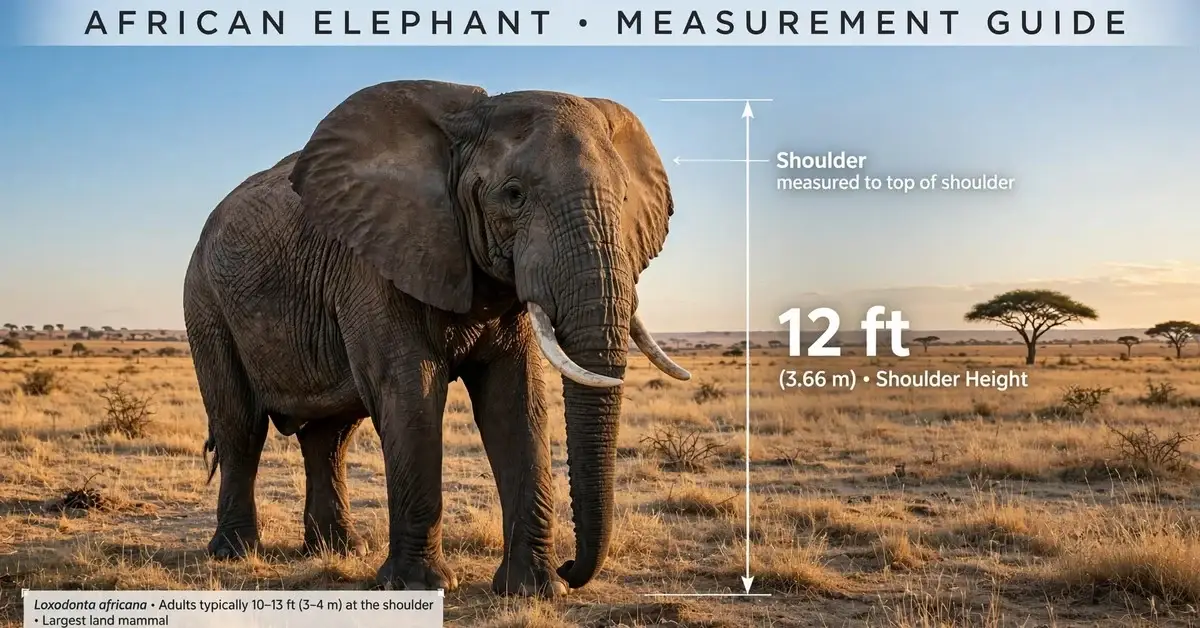
An African bush elephant stands 10 to 13 feet tall at the shoulder, making it the tallest land animal alive. Asian elephants are smaller at 8 to 10 feet, and even a newborn calf stands about 3 feet tall at birth — roughly the height of a kitchen counter. Understanding how elephant height is measured, how the three living species compare, and how an elephant stacks up against familiar objects turns an abstract “big” into something you can genuinely picture.
Elephants are measured at the shoulder, not the head, because the shoulder is a fixed anatomical point that does not move with posture. A bull African bush elephant rearing its head high can look far taller than its measured height, which is why wildlife researchers standardized on the shoulder hump — the highest point of the back when the animal stands squarely. This guide covers exact heights for every elephant species, calves, weight ranges, and comparisons that make the numbers concrete.
Elephant Height Conversion Chart
| Measurement | Feet | Meters | Inches |
|---|---|---|---|
| African bush bull (large) | 12–13 ft | 3.7–4.0 m | 144–156 in |
| African bush cow (average) | 8.5–10 ft | 2.6–3.0 m | 102–120 in |
| Asian elephant bull | 9–10 ft | 2.7–3.0 m | 108–120 in |
| Asian elephant cow | 7.5–8.5 ft | 2.3–2.6 m | 90–102 in |
| African forest elephant | 6–8 ft | 1.8–2.4 m | 72–96 in |
| Newborn calf | ~3 ft | ~0.9 m | ~36 in |
| Trunk length (adult) | 6–7 ft | 1.8–2.1 m | 72–84 in |
Elephant Species Compared
| # | Species | Shoulder height | Weight | Notes |
|---|---|---|---|---|
| 1 | African bush elephant (bull) | 10–13 ft | 10,000–14,000 lb | Largest land animal |
| 2 | African bush elephant (cow) | 8.5–10 ft | 6,000–8,000 lb | Noticeably smaller than bulls |
| 3 | Asian elephant (bull) | 9–10 ft | 8,000–11,000 lb | Twin-domed head, smaller ears |
| 4 | Asian elephant (cow) | 7.5–8.5 ft | 5,000–7,000 lb | No tusks in most cows |
| 5 | African forest elephant (bull) | 7–8 ft | 4,000–7,000 lb | Dense jungle species |
| 6 | African forest elephant (cow) | 6–7 ft | 3,500–5,000 lb | Smallest living elephant |
| 7 | Newborn calf (either species) | ~3 ft | 200–270 lb | Stands within minutes of birth |
Elephant Size in Everyday Context
| # | Comparison | Size | Context |
|---|---|---|---|
| 8 | Standard interior door | 6 ft 8 in | An elephant’s shoulder clears it by 4+ feet |
| 9 | Basketball hoop | 10 ft | A big bull’s shoulder stands above the rim |
| 10 | African elephant footprint | ~18 in across | Trackers age elephants by print size |
| 11 | Elephant ear (African) | ~5 ft top to bottom | Shaped roughly like Africa |
| 12 | Trunk reach overhead | ~19–20 ft total reach | Shoulder height plus trunk and head lift |
| 13 | Two-story house eave | ~16–18 ft | A tall bull reaches the eaves |
| 14 | City bus height | ~10 ft | A cow elephant stands bus-high at the shoulder |
| 15 | Blue whale heart (fun scale) | ~5 ft tall | An elephant calf is shorter than a whale’s heart |
1. African Bush Elephant Bulls: 10 to 13 Feet
The African bush elephant bull is the heavyweight champion of land animals, standing 10 to 13 feet at the shoulder and weighing 10,000 to 14,000 pounds. The very largest bulls on record approached 13 feet, though most mature bulls fall in the 10.5 to 12-foot range. Shoulder height is measured to the top of the shoulder hump, the bony ridge where the powerful neck and trunk muscles anchor. Bulls continue growing into their 30s and 40s, so the oldest males are typically the tallest — age and size track together in a way that makes big old bulls unmistakable.
2. African Bush Elephant Cows: 8.5 to 10 Feet
Female African bush elephants are substantially smaller than bulls, standing 8.5 to 10 feet at the shoulder and weighing 6,000 to 8,000 pounds. The size gap between sexes — called sexual dimorphism — is among the largest of any land mammal. Cows lead the herds and can live 60-plus years, so a matriarch in her 50s may be a full 10 feet tall with decades of accumulated wisdom about water sources and migration routes. When you see a mixed herd, the cows form the protective ring around calves while bulls roam separately or on the periphery.
3. Asian Elephant Bulls: 9 to 10 Feet
Asian elephant bulls stand 9 to 10 feet at the shoulder, a full 2 to 3 feet shorter than the largest African bulls, and weigh 8,000 to 11,000 pounds. They are easy to tell apart beyond size: Asian elephants have smaller, rounded ears, a twin-domed forehead, and only one finger-like lip at the tip of the trunk compared to the African elephant’s two. Only some Asian bulls grow tusks, and cows almost never do. Despite being the smaller species, a 10-foot Asian bull is still an overwhelming presence — picture a small delivery truck standing on legs.
4. Asian Elephant Cows: 7.5 to 8.5 Feet
Female Asian elephants stand 7.5 to 8.5 feet at the shoulder and weigh 5,000 to 7,000 pounds, making them the smallest adult elephants most people will ever encounter in zoos or sanctuaries. Like their African counterparts, Asian cows are the social core of the herd. Their smaller stature is an adaptation to forest and scrub habitats where maneuverability through dense vegetation matters more than the open-savanna bulk of African elephants. A cow Asian elephant at 8 feet is still taller than any NBA player — the scale of even the “small” elephants is hard to overstate.
5. African Forest Elephants: 6 to 8 Feet
The African forest elephant, recognized as a separate species in 2001, is the smallest living elephant: bulls reach 7 to 8 feet and cows 6 to 7 feet at the shoulder. They live in the dense rainforests of the Congo Basin, where a smaller body navigates thick undergrowth more easily. Forest elephants have straighter, downward-pointing tusks and rounder ears than their savanna cousins. Because they are elusive and live in thick cover, their measurements come from a smaller sample of observed animals, so treat the upper end of the range as approximate.
6. Newborn Calves: About 3 Feet Tall
An elephant calf stands about 3 feet tall at the shoulder at birth and weighs 200 to 270 pounds — roughly the weight of a full-grown adult man packed into a waist-high package. Calves can stand within minutes and walk within hours, a necessity for a herd that may need to move quickly. They nurse for two to three years and stay with their mothers for a decade or more. A 3-foot calf beside its 10-foot mother is one of nature’s most striking size contrasts, and the calf will roughly triple its shoulder height before reaching adulthood.
7. How Elephant Height Is Measured
Elephant height is always given at the shoulder, measured vertically from the ground to the highest point of the shoulder hump while the animal stands squarely on level ground. Researchers use rangefinders, photogrammetry, or — for captive animals — a simple measuring stick, the same principle behind reading a measuring tape for everyday objects, just scaled up enormously. Head height is not used because elephants raise and lower their heads constantly, which would make measurements meaningless. Footprint diameter offers a rough field proxy: a front-foot print around 18 inches across suggests a large adult bull.
8. Elephant vs. Standard Door: 6 Feet 8 Inches
A standard interior door stands 6 feet 8 inches tall — standard door sizes top out well below even a small elephant. An average African cow at 9 feet would need a doorway nearly half again as tall as a normal one, and a 13-foot bull would need a door roughly double the standard height. This comparison is why wildlife documentaries so often frame elephants against vehicles or huts: the human built environment is scaled for 6-foot people, and elephants simply exist on a different architectural scale.
9. Elephant vs. Basketball Hoop: 10 Feet
A regulation basketball rim sits exactly 10 feet off the floor, which makes it a perfect mental yardstick for elephants. An average African bull’s shoulder stands 1 to 3 feet above the rim; only the smallest forest elephant cows stand below it. Picture a 12-foot bull next to a hoop and the rim hits the animal mid-shoulder — the head and trunk rise well above the backboard. It is a vivid way to grasp that these animals do not just outweigh us; they look down on the structures we built for our tallest athletes.
10. The Trunk: 6 to 7 Feet of Precision
An adult elephant’s trunk measures 6 to 7 feet long and contains around 40,000 individual muscles with no bone at all. Combined with shoulder height, a large bull can reach roughly 19 to 20 feet into the air — high enough to strip leaves from tall acacias or investigate a second-story window. The trunk’s two finger-like projections (one in Asian elephants) can pick up a single blade of grass or uproot a small tree. When an elephant rears its head and lifts its trunk, the total vertical presence can approach 20 feet, which explains why they look so much taller than their measured shoulder height.
11. Elephant Ears: 5 Feet of Cooling Surface
An African elephant’s ear can measure 5 feet from top to bottom and acts as a giant radiator — flapping ears can lower body temperature significantly by exposing blood vessels to moving air. The ears’ shape roughly mirrors the African continent, a handy identification trick. Asian elephants’ smaller, rounder ears reflect their shadier forest habitat, where overheating is less of a threat. Ear size scales with body size and heat load, which is one reason savanna elephants evolved the largest ears of any living animal.
12. Footprints: 18 Inches Across
A large bull’s front footprint can measure 18 inches across — wider than a dinner plate and a reliable field indicator of the animal’s size. Trackers in the savanna read prints the way a detective reads fingerprints: diameter suggests shoulder height, depth suggests weight, and stride length suggests speed. A print much over 16 inches across almost certainly belongs to a mature bull. For scale, an 18-inch print is roughly the diameter of a standard car tire, pressed into dust by 12,000 pounds of animal.
13. Weight Range: 5,000 to 14,000 Pounds
Elephant weight spans an enormous range: a small forest elephant cow may weigh 3,500 pounds while a prime African bush bull can approach 14,000 pounds — a fourfold difference within the same family. Weight matters because it drives everything from daily food intake (300 to 600 pounds of vegetation) to the famous memory for water sources across drought years. Bulls in musth, their periodic hormonal state, can lose significant weight, while pregnant cows gain steadily over their 22-month gestation, the longest of any land mammal.
14. Elephant vs. City Bus: 10 Feet Tall
A typical city bus stands about 10 feet tall, which puts an average African cow elephant eye-to-roof with public transit. A big bull at 12 to 13 feet stands a full 2 to 3 feet taller than the bus — imagine the animal’s back rising above the vehicle’s roofline. This is the comparison safari guides reach for because nearly everyone has stood next to a bus. It also explains why game-viewing vehicles are built tall and open: you need elevation to see over, not just at, an elephant herd.
15. Growth: Calves Triple Their Height
Elephants grow slowly and for a long time. A 3-foot newborn reaches about 6 feet by age five, 8 to 9 feet by its teens, and full adult height in its 20s — with bulls continuing to bulk up into their 40s. That means a calf will roughly triple its birth height and increase its weight fiftyfold over its lifetime. Females stop growing earlier and smaller than males, which is why the sex difference widens with age. An elephant’s height at any moment is essentially a biography: it records nutrition, drought years, and decades of survival.
FAQs
How tall is an elephant in feet?
An African bush elephant stands 10 to 13 feet tall at the shoulder, with bulls at the top of that range and cows around 8.5 to 10 feet. Asian elephants are smaller at 7.5 to 10 feet depending on sex. Height is always measured at the shoulder, not the head.
What is the tallest elephant ever recorded?
The tallest reliably measured elephants were African bush bulls approaching 13 feet at the shoulder. Historical claims of taller animals exist but lack the standardized shoulder measurement modern researchers require. Most exceptionally large bulls documented in the wild fall between 12 and 13 feet.
How tall is a baby elephant?
A newborn elephant calf stands about 3 feet tall at the shoulder and weighs 200 to 270 pounds. Calves stand within minutes of birth and can walk within hours. They nurse for two to three years and remain dependent on their mothers for a decade or more.
Are African or Asian elephants taller?
African bush elephants are taller: bulls reach 10 to 13 feet versus 9 to 10 feet for Asian bulls. African elephants also have larger ears, a single-domed head, and two trunk “fingers” compared to the Asian elephant’s one. Forest elephants, the third species, are the smallest at 6 to 8 feet.
Final Thoughts
The African bush elephant’s 10 to 13-foot shoulder height makes it the undisputed giant of the land, with Asian elephants a step smaller at 7.5 to 10 feet and forest elephants the most compact at 6 to 8 feet. Remember that height is measured at the shoulder — a fixed point — while the head, trunk, and ears can make an animal look considerably taller. Calves start at 3 feet and roughly triple their height over decades of slow growth, with bulls outpacing cows dramatically. Whether you picture a bull’s shoulder clearing a basketball rim by two feet or a cow standing bus-high, the numbers stop being abstract the moment you anchor them to something you have stood beside. That is the real value of knowing exactly how tall an elephant is: the next time you see one, you will see the measurement, not just the animal.

Hi, I’m Vera Lindqvist, a content writer at MeasuresIt.com, where I turn measurement standards, unit conversions, and precision tools into clear, practical guides. I care about getting the details right so you don’t have to second-guess them.