5-Gallon Bucket Dimensions: Diameter, Height & Volume
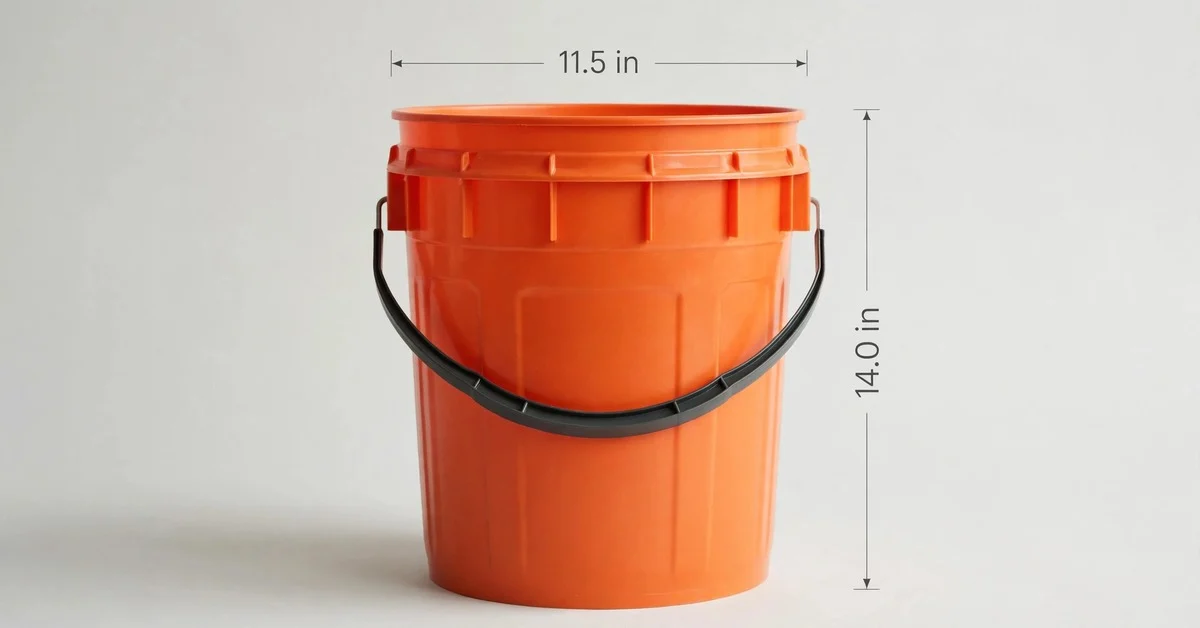
A standard 5-gallon bucket is about 12 inches in diameter at the top and 14.5 inches tall. It holds 5 gallons (640 fluid ounces), weighs about 2 pounds empty, and weighs roughly 42 pounds when filled with water.
Those four numbers cover most questions, but a few details are worth knowing. Buckets taper toward the bottom, so the base is narrower than the rim, and many pails are marked with a fill line slightly below the true brim. The figures below describe the common round HDPE pail — the orange Homer bucket from Home Depot, white food-grade pails, and heavy-duty janitorial buckets. If you are checking whether one will fit under a counter or hold enough water for a wash job, start here.
5-Gallon Bucket Measurement Chart
| Measurement | Imperial | Metric (approximate) |
|---|---|---|
| Top diameter (outside) | ~12 in | ~30.5 cm |
| Bottom diameter (outside) | ~10 in | ~25.4 cm |
| Height | ~14.5 in | ~36.8 cm |
| Nominal capacity | 5 gal | ~18.9 L |
| Capacity in fluid ounces | 640 fl oz | ~18,930 mL |
| Empty weight | ~2 lb | ~0.9 kg |
| Filled with water | ~42 lb | ~19 kg |
The metric values are rounded conversions of the stated imperial figures, not separate manufacturer specs. The fastest way to confirm your own bucket is a tape measure across the rim — knowing how to read a measuring tape keeps the number honest, since the rim lip can add a little if you measure from the outer edge.
How Big Is a 5-Gallon Bucket? Comparison Chart
Here is how a standard 5-gallon bucket compares to smaller everyday containers. All sizes are typical dimensions.
| # | Container | Typical size | Volume vs bucket |
|---|---|---|---|
| 1 | 1-gallon paint can | ~6.6 in wide × 7.5 in tall | About 1/5 |
| 2 | 1-gallon milk jug | ~6 in wide × 10 in tall | About 1/5 |
| 3 | 2-gallon bucket | ~11 in wide × 10 in tall | About 2/5 |
| 4 | 3.5-gallon bucket | ~12 in wide × 12 in tall | About 70% |
| 5 | 6-gallon mop bucket | ~14 in wide × 12 in tall | Slightly larger |
| 6 | 7-gallon fermenting bucket | ~12 in wide × 17 in tall | About 1.4× |
| 7 | 20-gallon trash can | ~19 in wide × 24 in tall | About 4× |
| 8 | 55-gallon drum | ~23 in wide × 35 in tall | About 11× |
1. 1-Gallon Paint Can
A standard 1-gallon paint can is about 6.6 inches in diameter and 7.5 inches tall — noticeably stubby next to a 5-gallon bucket. Its volume is one-fifth of the bucket, and the squat shape sits low and stable on a shelf. Paint cans are usually metal rather than HDPE plastic, and their lids seal tighter than a snap-on pail lid. For touch-ups or small-part storage, the 1-gallon size is often more practical than a full bucket. Handy mental shortcut: five full paint cans equal one full 5-gallon bucket.
2. 1-Gallon Milk Jug
A 1-gallon milk jug is roughly 6 inches across and about 10 inches tall, including the cap. Like the paint can, it holds one-fifth of a 5-gallon bucket’s volume. Its flattened body is shaped for refrigerator shelves and easy pouring — a different design philosophy from the bucket’s tapered cylinder. A gallon jug of water weighs about 8.3 pounds. Milk jugs use the same HDPE plastic family as buckets but with thinner walls, so they flex and dent far more easily.
3. 2-Gallon Bucket
A 2-gallon bucket is about 11 inches wide and 10 inches tall — nearly as wide as the 5-gallon version but much shorter, since it holds two-fifths of the volume. It suits small cleaning jobs, garden watering, and pantry storage of rice or pet food. Filled with water it weighs roughly 18–19 pounds, which adults carry comfortably in one hand. Because buckets taper, the rim width is nearly the same as its bigger sibling; the difference is almost all in the height.
4. 3.5-Gallon Bucket
The 3.5-gallon bucket usually shares the same roughly 12-inch top diameter as the 5-gallon bucket but stands about 12 inches tall, giving it around 70 percent of the larger bucket’s volume. Hardware stores sell them for smaller batches of mortar, grout, or drywall compound. Filled with water, one weighs about 31 pounds — noticeably easier to lift than the 42-pound full 5-gallon version. The identical diameter means lids, gamma seal lids, and dollies that fit 5-gallon buckets fit these too.
5. 6-Gallon Mop Bucket
A typical 6-gallon mop bucket is about 14 inches across and 12 inches tall, with a built-in wringer on one side. It is wider and slightly shorter than a 5-gallon pail, and the wringer means usable water volume is often closer to 5 gallons anyway. The wide mouth lets a mop head move freely, and most are thick polypropylene rather than HDPE, since they get dragged across floors and bumped into baseboards. Wash a car with one and you have used an overgrown, lopsided 5-gallon bucket.
6. 7-Gallon Fermenting Bucket
Home brewers know the 7-gallon fermenting bucket: roughly 12 inches in diameter and about 17 inches tall, with a drilled lid and airlock. It is taller than a 5-gallon bucket rather than wider, because fermentation needs headspace — the foam cap called krausen has to rise somewhere. The volume is about 1.4 times a standard pail, and the taller profile makes it too tall for under-counter spots that would swallow a 14.5-inch bucket. These are typically food-grade HDPE with smooth interior walls.
7. 20-Gallon Trash Can
A standard 20-gallon trash can is about 19 inches in diameter and 24 inches tall — four times a 5-gallon bucket’s volume. This is the classic round galvanized or heavy-duty plastic can used in garages and patios. It is tall enough that a full load usually gets dragged rather than carried, and at roughly 170 pounds filled with water it is far beyond one-person lifting. Contractors use buckets for carryable loads and big cans like this for staging.
8. 55-Gallon Drum
A 55-gallon drum is about 23 inches in diameter and 35 inches tall — eleven times a 5-gallon bucket’s capacity. These are the shipping and industrial containers you see on pallets behind warehouses: rain barrels, burn barrels, and food-grade syrup or oil storage all start as this drum. It stands nearly waist-high and weighs close to 500 pounds when full of water, so it is forklift territory. The 5-gallon bucket is the one-person version of the same simple cylinder.
Larger Storage: Bucket vs Bulk Containers
Now the other direction — how the bucket stacks up against larger household and workshop containers.
| # | Container | Typical size | Capacity vs bucket |
|---|---|---|---|
| 9 | 10-gallon aquarium | ~20 × 10 × 12 in | About 2× |
| 10 | 48-quart chest cooler | ~26 × 14 × 15 in | About 2.4× |
| 11 | 18-gallon storage tote | ~24 × 16 × 15 in | About 3.6× |
| 12 | 32-gallon trash can | ~22 × 27 in | About 6.4× |
| 13 | Standard bathtub | ~60 × 30 in, ~14 in deep | About 8–12× |
| 14 | 55-gallon rain barrel | ~23 × 35 in | About 11× |
| 15 | 275-gallon IBC tote | ~48 × 40 × 46 in | About 55× |
9. 10-Gallon Aquarium
A standard 10-gallon aquarium is about 20 inches long, 10 inches wide, and 12 inches tall — roughly twice a 5-gallon bucket’s capacity in a different shape. The rectangular glass box is long and low, built for fish viewing and surface area rather than stacking or carrying. Set a bucket beside a 10-gallon tank and the bucket looks taller and narrower while the tank sprawls sideways. The aquarium’s shape makes it nearly impossible to carry when full; the bucket’s bail handle makes 42 pounds manageable.
10. 48-Quart Chest Cooler
A 48-quart chest cooler is roughly 26 inches long, 14 inches wide, and 15 inches tall, holding about 2.4 times what a 5-gallon bucket holds. Since a quart is a quarter of a gallon, 48 quarts equals 12 gallons — and for reference, a 5-gallon bucket holds exactly 20 quarts of liquid. The cooler’s insulated walls and drain spout make it a purpose-built beverage container, while the bucket’s thin single wall is purely about cheap, tough containment. Filled with ice and drinks, a 48-quart cooler can easily pass 70–80 pounds.
11. 18-Gallon Storage Tote
An 18-gallon latching storage tote is roughly 24 inches long, 16 inches wide, and 15 inches tall — about 3.6 times a 5-gallon bucket’s capacity in a rectangular package. These stackable bins are the garage and attic standard, with flat lids designed to stack, something round buckets do poorly. The rectangular shape fits room corners and shelving grids more efficiently than a 12-inch circle. Buckets win for liquids and pourables; totes win for flat, stackable, dry storage.
12. 32-Gallon Trash Can
The 32-gallon trash can — about 22 inches in diameter and 27 inches tall — holds roughly 6.4 times a 5-gallon bucket’s volume. This is the tall curbside container many municipalities issue for weekly pickup, often with wheels and a hinged lid. It stands nearly two feet taller than a bucket, making it a staging container rather than a carry container: you fill it from buckets, not the other way around. A 32-gallon can of water would weigh close to 270 pounds.
13. Standard Bathtub
A standard bathtub is about 60 inches long, 30 inches wide, and roughly 14 inches deep at the drain — a full tub holds something like 8 to 12 times a 5-gallon bucket’s volume. For cleaning jobs, the practical question is how many buckets it takes to fill or empty a tub; the answer is in the high single digits to low double digits. The tub’s 60-inch length is also a fun spatial reference: picture four 5-gallon buckets standing in a row and you are close to the tub’s length.
14. 55-Gallon Rain Barrel
A 55-gallon rain barrel shares standard drum dimensions — about 23 inches in diameter and 35 inches tall — and holds eleven times what a 5-gallon bucket holds. It sits under a downspout collecting runoff, with a spigot near the bottom for filling watering cans. Gardeners often track barrel levels in bucketfuls rather than gallons, which is where the 5-gallon reference earns its keep. A full rain barrel weighs over 460 pounds, so it lives exactly where it is placed — the bucket is the thing you actually pick up.
15. 275-Gallon IBC Tote
The 275-gallon intermediate bulk container is the big white plastic tank in a metal cage on pallets at farms and industrial sites — roughly 48 inches long, 40 inches wide, and 46 inches tall. At 55 times a 5-gallon bucket’s volume, it is the largest container here by a wide margin. Farms and workshops fill buckets from the tote’s bottom valve for day-to-day use. A fitting bookend: from the 1-gallon paint can at one-fifth of a bucket up to a tank that swallows fifty-five buckets whole.
What Are 5-Gallon Buckets Made Of?
Almost all 5-gallon buckets are molded from high-density polyethylene, abbreviated HDPE — the same plastic family as milk jugs and detergent bottles, but with much thicker walls, which is why buckets feel rigid while a milk jug flexes. HDPE resists most household chemicals, does not rust, and handles freezing winters and hot storage sheds.
White pails are often sold as food-grade for direct food contact — flour, rice, honey — and sealed with a gamma seal lid, a two-piece screw-top lid that threads into a snap-on ring for an airtight, reusable seal. Orange and blue hardware-store buckets are typically rated for utility use like paint and construction materials. The bail handle is usually steel wire with a plastic grip. The tapered shape lets empty buckets nest for shipping, which is why a stack of ten takes up barely more floor space than one.
Common Uses for a 5-Gallon Bucket
The 5-gallon bucket is everywhere because it hits a sweet spot: big enough to be useful, light enough to carry, cheap enough to own several. Around the house, typical jobs include car washing, mopping, mixing garden soil, hauling mulch, storing pet food, and serving as a portable garage trash bin. On projects it mixes drywall mud and thinset, holds paint for roller work, and carries tools and fasteners.
Food and emergency preparedness is another big category. Food-grade buckets with gamma seal lids are the standard for bulk dry goods — rice, beans, flour, sugar, oats — and a core piece of emergency water storage. Outdoors, the uses multiply: fishing, camping wash stations, garden harvesting, chicken feed, and fire-pit ash. Contractors go through them by the pallet; the bucket is the universal unit of carry on a job site. Three buckets side by side also nearly span the width of a standard door opening, which makes the bucket a handy indoor reference.
How to Measure a Bucket Yourself
Manufacturer specs vary, so measuring your own bucket takes about a minute. Place it on a flat surface and measure the outside diameter across the rim — the widest point — then the outside diameter at the base, which is usually smaller because of the taper. Measure height from the bottom of the base to the top of the rim, not including any lid.
For volume, try the water-and-jug method: fill a known 1-gallon jug and pour it in, counting jugs. Five full jugs should bring a true 5-gallon bucket nearly to the brim, though many have a fill line below the rim for headspace. Keep in mind that listed capacity is brim-full volume; usable working volume is often closer to 4–4.5 gallons. When weight matters, use the filled weight of about 42 pounds per bucket of water as your planning number.
Frequently Asked Questions
How tall is a 5-gallon bucket exactly?
A standard 5-gallon bucket is about 14.5 inches tall, measured from the base to the top of the rim without a lid. The top diameter is about 12 inches, while the tapered base is usually closer to 10 inches across. Individual buckets vary slightly by manufacturer, so measuring your own is the only way to get an exact number.
How much does a full 5-gallon bucket of water weigh?
A 5-gallon bucket filled with water weighs about 42 pounds: roughly 40 pounds of water (5 gallons at about 8.3 pounds per gallon) plus about 2 pounds for the empty bucket. Many people find it easier to make two trips with a half-full bucket than one trip with a full one.
Are all 5-gallon buckets the same size?
Not exactly. Most round HDPE utility pails follow the same roughly 12-inch diameter and 14.5-inch height pattern, but some imported or specialty buckets run slightly smaller, and square buckets use completely different dimensions. If a project depends on the fit, measure the actual bucket rather than trusting the label.
What is a 5-gallon bucket made of?
Most are made from high-density polyethylene (HDPE), a tough, chemical-resistant plastic also used for milk jugs. White buckets are often food-grade for storing dry goods, while colored buckets are typically rated for utility use. The handle is usually steel wire with a plastic grip, and lids snap over the reinforced rim — including airtight gamma seal lids for long-term food storage.
Final Thoughts
The 5-gallon bucket earns its place in almost every garage, workshop, and job site because its dimensions hit a rare balance: about 12 inches across and 14.5 inches tall, it is compact enough to store easily yet large enough to matter. At roughly 42 pounds filled with water, it sits right at the edge of comfortable one-person carrying, which is precisely why it became the standard unit of carry. Whether you are storing bulk food in a food-grade pail with a gamma seal lid, mixing concrete on a job site, or washing a car on a Saturday, the same simple HDPE cylinder does the job. Measure your own bucket before trusting the label, respect the 42-pound working weight, and you will get years of use out of one of the simplest and most useful containers ever made.

I’m Marcus Kane, a measurement content specialist at MeasuresIt.com. I write clear, accurate, and practical articles about measurements, dimensions, conversions, and everyday size comparisons, making complex topics simple and easy to understand.