How Tall Is the Golden Gate Bridge? Tower Height & Span
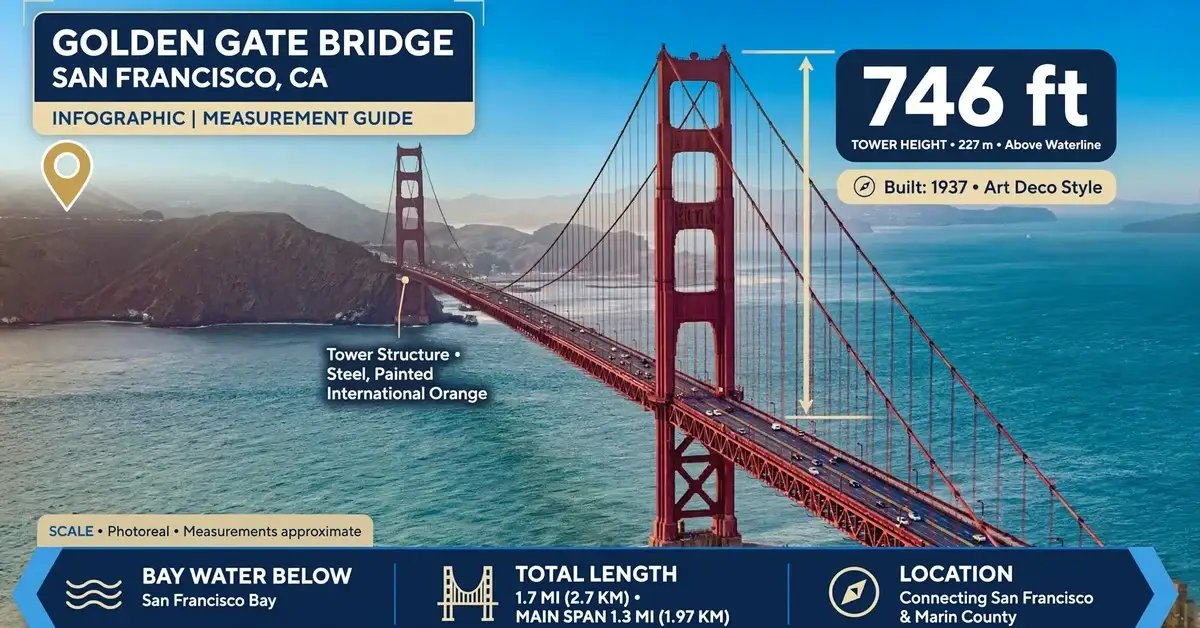
The Golden Gate Bridge’s two towers each rise 746 feet above the water, making them taller than most skyscrapers of their era. The bridge’s main span stretches 4,200 feet between the towers, and its total length runs 8,980 feet from shore to shore. When it opened in 1937, that 4,200-foot span was the longest suspension bridge span in the world.
It is easy to think of the bridge as a single graceful curve, but it is really a collection of enormous parts — cables thicker than a person is tall, anchorages heavier than a battleship, and a deck that hangs high above some of the busiest shipping water in California. The same measuring habit that helps on small projects, like knowing how to read a measuring tape, scales up here: every part of the bridge has a number, and those numbers tell its story. Here are 15 of them.
Key Dimensions Conversion Chart
| Measurement | Feet | Meters | Inches |
|---|---|---|---|
| Tower height above water | 746 | 227 | 8,952 |
| Main span | 4,200 | 1,280 | 50,400 |
| Total length | 8,980 | 2,737 | 107,760 |
| Deck height above water | 245 | 75 | 2,940 |
| Main cable diameter | 3.04 | 0.93 | 36.5 |
| Sidewalk width | 10 | 3.05 | 120 |
| Statue of Liberty (comparison) | 305 | 93 | 3,660 |
Golden Gate Bridge Dimensions at a Glance
| # | Feature | Measurement |
|---|---|---|
| 1 | Tower height above water | 746 ft (227 m) |
| 2 | Main span (tower to tower) | 4,200 ft (1,280 m) |
| 3 | Total length | 8,980 ft (2,737 m) |
| 4 | Deck height above water | ~245 ft |
| 5 | Main cable diameter | 36.5 in |
| 6 | Number of traffic lanes | 6 |
| 7 | Sidewalk width (each side) | ~10 ft |
| 8 | Color | International Orange |
More Bridge Scale Facts
| # | Feature | Measurement |
|---|---|---|
| 9 | Tower leg cross-section | ~33 ft wide |
| 10 | Suspender rope spacing | ~50 ft apart |
| 11 | Anchorage weight (each) | ~60,000 tons |
| 12 | Opened | 1937 |
| 13 | South tower pier depth | ~110 ft below water |
| 14 | Fort Point arch span | ~186 ft |
| 15 | Statue of Liberty comparison | 305 ft (towers ~2.4x taller) |
1. Tower Height: 746 Feet Above the Water
Each of the bridge’s two towers climbs 746 feet above the surface of the Golden Gate strait — roughly the height of a 70-story building. When the bridge was completed in 1937, its towers were among the tallest structures on the West Coast, and they remain the defining vertical element of San Francisco’s skyline.
What makes the 746-foot figure striking is that the towers do double duty: they rise from deep underwater piers, carry the full weight of the main cables, and anchor the bridge’s identity. On foggy days the tower tops vanish into the mist while traffic crosses far below, a reminder that the visible height is only part of the structure. Even the elevator inside each tower, used by maintenance crews, travels a distance comparable to a 60-story office building.
2. Main Span: 4,200 Feet
The main span — the distance the deck hangs between the two towers with no support below — measures 4,200 feet, or about eight-tenths of a mile. When the bridge opened, this was the longest suspension span ever built, a record it held until 1964.
A 4,200-foot unsupported span is difficult to grasp until you walk it. Crossing between the towers takes the average pedestrian the better part of 15 minutes, with open water on both sides the entire way. Engineers of the 1930s considered the strait’s deep water, fierce tides, and high winds, and concluded that only a suspension design could leap the gap. The span is the reason the bridge exists in the form it does.
3. Total Length: 8,980 Feet
From abutment to abutment, the Golden Gate Bridge is 8,980 feet long — about 1.7 miles. That total includes the 4,200-foot main span plus the side spans and approach viaducts that carry the roadway from the San Francisco and Marin shores out to the towers.
The full length matters because the bridge is more than its famous middle. The southern approach sweeps over Fort Point on a graceful steel arch, and the northern approach winds through the Marin Headlands. Walking the entire bridge and back is a 3.4-mile round trip, which is why it doubles as one of the city’s most popular — and windiest — recreational walks.
4. Deck Height: About 245 Feet Above the Water
The roadway deck hangs roughly 245 feet above the water at the center of the main span. That clearance was chosen deliberately: it lets the largest ocean-going ships pass underneath, including the tall-masted vessels and naval ships that use San Francisco Bay.
Two hundred forty-five feet is about the height of a 24-story building, and standing on the sidewalk looking down at a container ship sliding beneath the deck is one of the bridge’s great experiences. The clearance is measured at mean high water, so the actual gap varies slightly with the tides. During construction, the deck’s height also protected the work from the strait’s notorious waves and currents.
5. Main Cable Diameter: 36.5 Inches
Each of the bridge’s two main cables is 36.5 inches in diameter — just over three feet thick, or about the height of a standard interior door laid on its side and cut in half. You could not wrap your arms around one; two adults joining hands would barely encircle it.
These cables are not solid steel but bundles of 27,572 individual wires each, spun in place high above the strait in a process that took months. Together the two cables carry the weight of the entire suspended deck and its traffic. If you stretched out all the wire in both cables end to end, it would circle the Earth several times over.
6. Six Traffic Lanes
The deck carries six traffic lanes, each roughly 11 feet wide, separated by a movable barrier that shifts with commute direction. The lane configuration is famously flexible: during morning rush, four lanes serve San Francisco-bound traffic, and the pattern reverses in the evening.
Six lanes across a 1930s bridge is a reminder of how far ahead of its time the design was. The roadway is only part of the deck’s width, though — the total deck is about 90 feet wide including the sidewalks and the space taken up by the cable housings. The movable barrier, a zipper machine that repositions the divider, was added to cut down on head-on collisions.
7. Sidewalk Width: About 10 Feet Each Side
Each of the bridge’s two sidewalks is about 10 feet wide, which sounds generous until you share it with cyclists, joggers, tourists, and the strait’s sideways wind. The eastern sidewalk is reserved for pedestrians, while the western side is shared with bicycles.
Ten feet of walkway at 245 feet above the water, with nothing but a railing between you and the strait, feels narrower than it sounds. The sidewalks are where most visitors actually experience the bridge’s scale: the towers loom overhead, the cables arc past at arm’s length, and the deck hums faintly underfoot from the traffic and wind.
8. The Color: International Orange
The bridge is painted “International Orange,” a vivid reddish-orange chosen partly for visibility in San Francisco’s famous fog and partly because the steel arrived from the mill coated in a similar red-lead primer that everyone liked. The color has become so iconic that it is inseparable from the bridge’s identity.
Maintaining that color is a full-time job: a dedicated crew of painters works year-round touching up the steel, since the salty marine air corrodes it constantly. The popular myth says the bridge is painted end to end continuously, but in truth the painting is an ongoing maintenance cycle focused on the areas that need it most. Either way, the orange against the blue water and green headlands is one of the most photographed color combinations in the world.
9. Tower Legs: About 33 Feet Wide
Each tower is built as two separate legs connected by horizontal cross-braces, and each leg measures roughly 33 feet across. The legs are stepped — wider at the base and tapering as they rise — which gives the towers their elegant, slightly Art Deco profile.
The two-leg design is structural, not decorative: it lets the tower flex slightly with wind and seismic loads while keeping the cable saddles at the top perfectly aligned. Up close, the scale of a single leg is startling — 33 feet is wider than most city buses are long. The cross-braces between the legs frame the roadway like a series of giant doorways, each one large enough to drive several trucks through side by side.
10. Suspender Ropes: Spaced About 50 Feet Apart
The vertical suspender ropes that hang the deck from the main cables are spaced roughly 50 feet apart along the entire suspended length. Each suspender is a bundle of steel ropes that transfers a slice of the deck’s weight up to the main cable.
Fifty-foot spacing means there are hundreds of suspenders marching down each side of the bridge in a precise rhythm, and that rhythm is part of what makes the bridge beautiful. The spacing was calculated so the deck’s load distributes evenly to the cables without overstressing any single point. During the bridge’s 50th anniversary celebration, the weight of pedestrians packed onto the deck flattened its natural arc — a vivid demonstration of what those suspenders carry every day.
11. Anchorage Weight: About 60,000 Tons Each
At each end of the bridge, the main cables dive into enormous concrete anchorages that each weigh roughly 60,000 tons — about as much as a fully loaded aircraft carrier. These buried blocks of concrete are what keep the entire suspension system from pulling itself apart.
The number is worth pausing on: 60,000 tons of concrete holding each cable end, and the cables pull with millions of pounds of tension. The anchorages work by sheer mass, gripping the cable strands deep inside concrete and steel. They are mostly hidden from view, which is typical of the bridge — its most heroic engineering is often the part nobody sees.
12. Opened in 1937
The Golden Gate Bridge opened to pedestrians on May 27, 1937, and to vehicles the next day. It was completed during the Great Depression, cost about $35 million, and was built in just over four years — an astonishing pace for a structure of its ambition.
The 1937 date puts the bridge’s engineering in context: it was designed with slide rules, built by workers on narrow catwalks high above the strait, and finished without a single computer. Eleven workers lost their lives during construction, a tragically low number for the era thanks to then-novel safety measures including a safety net. The bridge’s survival through decades of earthquakes, including Loma Prieta in 1989, testifies to how well those 1930s engineers understood their craft.
13. South Tower Pier: About 110 Feet Below Water
The south tower stands on a massive concrete pier that extends roughly 110 feet below the water’s surface to reach bedrock. Building it required constructing a giant oval fender wall in the strait’s violent currents, then pumping the water out so crews could work on the dry ocean floor.
The pier’s depth is one of the bridge’s great unsung feats. The Golden Gate strait’s tides rip through at up to 7 knots, and the water at the south tower site is deep and turbulent. Engineers had to invent techniques as they went, including building the fender in sections and towing it into place. The finished pier is so massive that it deflected the currents permanently, reshaping the tidal flow of the strait itself.
14. Fort Point Arch: About a 186-Foot Span
On the San Francisco side, the bridge’s southern approach crosses over historic Fort Point on a steel arch with a span of roughly 186 feet. The arch was a deliberate design choice by chief engineer Joseph Strauss to avoid demolishing the Civil War-era brick fort below.
This single arch shows the care woven into the project: rather than plowing the approach through the fort, the engineers leapt over it. Today visitors can stand on the fort’s roof and watch the bridge’s massive steelwork pass directly overhead — a 19th-century fortress in the shadow of a 20th-century marvel. The 186-foot span is modest next to the 4,200-foot main span, but it may be the most considerate 186 feet in the whole structure.
15. Taller Than the Statue of Liberty — 2.4 Times Over
The Statue of Liberty stands 305 feet tall from ground to torch. The Golden Gate’s towers, at 746 feet, are nearly two and a half times taller. Set Lady Liberty beside a tower and she would reach less than halfway up.
The comparison is useful because the statue is one of America’s most familiar vertical landmarks. Both structures were completed within living memory of each other as symbols — the statue in 1886, the bridge in 1937 — and both were engineering marvels of their day. But the bridge’s towers operate at a different scale entirely: each one is a steel skyscraper standing in the ocean, holding up a roadway that millions of people cross every year.
Frequently Asked Questions
How tall are the Golden Gate Bridge towers?
Each tower rises 746 feet (227 meters) above the water. The towers are the tallest part of the bridge and were among the tallest structures on the West Coast when the bridge opened in 1937.
How long is the Golden Gate Bridge?
The bridge is 8,980 feet (about 1.7 miles) long in total, including its approaches. The famous main span between the two towers is 4,200 feet, which was the longest suspension span in the world from 1937 until 1964.
Can you walk across the Golden Gate Bridge?
Yes. Pedestrians can use the eastern sidewalk, which is about 10 feet wide, and the walk from one end to the other is roughly 1.7 miles. It is famously windy, so bring a jacket even on sunny days.
Why is the Golden Gate Bridge orange?
It is painted “International Orange,” a color chosen for visibility in San Francisco’s fog and because the steel’s original red primer was popular with the public. A dedicated crew repaints and maintains the steel continuously to fight corrosion from the salty marine air.
Final Thoughts
The Golden Gate Bridge rewards measurement: 746-foot towers, a 4,200-foot span, cables three feet thick — each number adds a layer to your appreciation when you finally stand on that windy sidewalk. It was built in the depths of the Depression by people working with slide rules and safety nets, and it still carries tens of thousands of vehicles a day without breaking a sweat. Walk it if you can, look down at the ships passing 245 feet below, and remember that every foot of it was put there on purpose. Pause at mid-span, feel the deck hum under your feet, and take in the strait that made such an audacious leap necessary. Few structures earn their fame as thoroughly as this one.

Hi, I’m Vera Lindqvist, a content writer at MeasuresIt.com, where I turn measurement standards, unit conversions, and precision tools into clear, practical guides. I care about getting the details right so you don’t have to second-guess them.