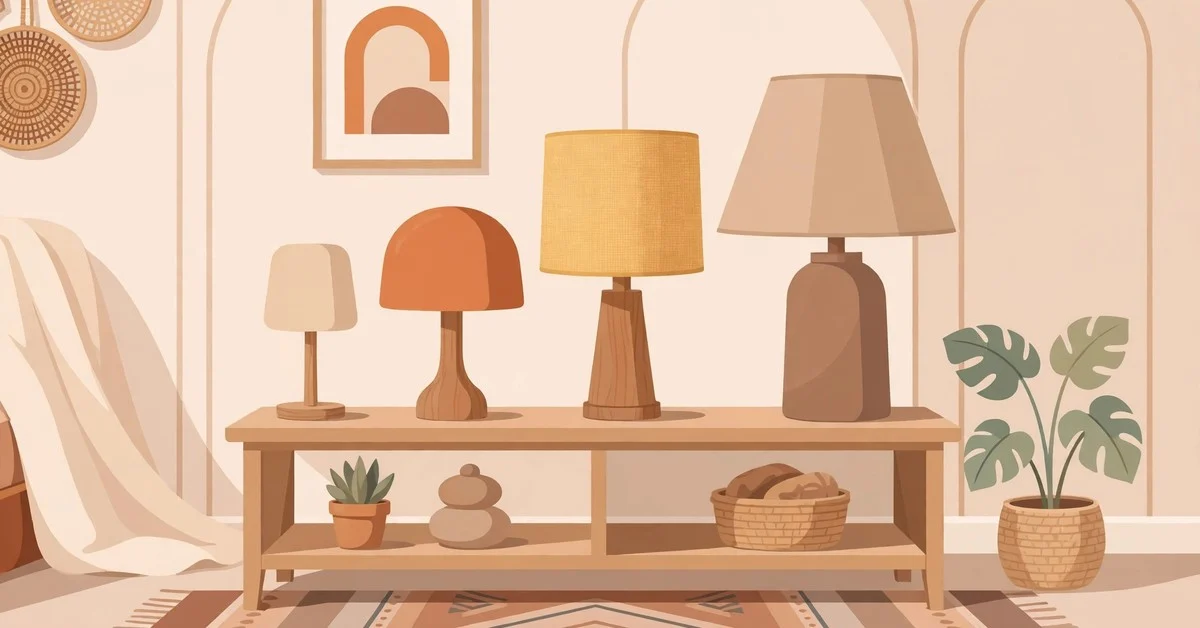
Lampshade Sizes Guide: Diameter, Height & Fitter
Introduction
You bring home a new table lamp and the shade that came with it looks lost, or the one you ordered online swallows the whole nightstand. Standard lampshade sizes run 10 to 16 inches across the bottom, with 12-inch shades fitting most table lamps. That single number, the bottom diameter, decides whether a shade looks balanced or wrong.
The right lampshade size changes how a room feels. A shade that is too wide crowds the lamp base and throws light at the wall instead of the book in your lap. A shade that is too small looks cheap and lets the bulb glare straight into your eyes. This lampshade sizes guide gives you the size chart, the three measurements that matter, the fitter types (spider, uno, and clip-on), and the simple proportion rules decorators use, so the shade you buy fits the first time.
Lampshade Size Chart by Lamp Type
Shades are sized by their bottom diameter first, then height. The four standard bottom diameters are 10, 12, 14, and 16 inches, and each one pairs with a different lamp. All sizes below are bottom diameters in inches.
| Lamp type | Typical bottom diameter | Typical shade height | Typical top diameter |
|---|---|---|---|
| Bedside or accent lamp | 10–12 in (25.4–30.5 cm) | 8–10 in | 8–10 in |
| Standard table lamp | 12–14 in (30.5–35.6 cm) | 10–12 in | 10–12 in |
| Large table or console lamp | 14–16 in (35.6–40.6 cm) | 12–14 in | 11–13 in |
| Floor lamp | 16 in (40.6 cm) | 12–14 in | 12–14 in |
Notice the pattern: as the lamp gets taller, the shade gets wider. A small bedside lamp pairs with a 10-inch shade, while a tall floor lamp needs about 16 inches to look right. The top opening is usually a couple of inches smaller than the bottom, which gives the classic tapered empire shape.
How to Measure a Lampshade
Three numbers describe any shade: the top diameter, the bottom diameter, and the slant height. Measure straight across each opening, edge to edge, with a tape measure or ruler. For the slant height, run the tape along the outside of the shade from the top rim to the bottom rim, following the slope.
Fabric shades bow slightly, so measure at the rim where it meets the air, not where the cloth curves inward. If you are replacing a shade, measure your old one first — its label is long gone, but the tape does not lie. If you have never used one, our guide on how to read a measuring tape walks through reading marks down to the eighth of an inch.
Also check how the shade attaches before you shop. The fitting is just as important as the size, and a 12-inch shade with the wrong fitter will not sit straight on your lamp. The three fitter types are explained below.
Lampshade Fitter Types: Spider, Uno, and Clip-On
A spider fitter is the most common type. Thin metal spokes cross the top of the shade like a spider web, with a ring (called a washer) in the center. That ring drops over the threaded top of the harp — the wire frame that rises around the bulb — and a small cap called a finial screws down on top to hold everything in place. If your lamp has a harp and a finial, you need a spider fitter.
An uno fitter skips the harp entirely. Its ring is sized to slide down over the lamp socket itself, so the shade rests directly on the socket and threads below the bulb. Uno shades are common on down-bridge arm lamps, swing-arm lamps, and many European designs. The key detail: an uno shade sits lower, which changes how the light falls.
A clip-on fitter is exactly what it sounds like. Two spring clips grip the bulb itself, so there is no harp and no socket ring. These fit small accent shades, chandelier shades, and candelabra bulbs. Clip-on shades are the smallest of the three, often 4 to 8 inches across, and they are not part of the standard 10-to-16-inch range.
Common Objects About the Size of a Standard Lampshade
The table below lines up everyday items with the four standard shade diameters, so you can picture each lampshade size without a ruler.
| Item | Approximate Size |
|---|---|
| 1. Vinyl LP record | 12 in across |
| 2. Large dinner plate | 10.5 in across |
| 3. Large pizza | 16 in across |
| 4. Standard wall clock | 12 in across |
| 5. Car steering wheel | 14.5 in across |
| 6. Standard Frisbee | 10.5 in across |
| 7. Printer paper (tall side) | 11 in tall |
| 8. Standard ruler | 12 in long |
More Everyday Items Around 10–16 Inches
Seven more references for when the first table does not have the shape you need.
| Item | Approximate Size |
|---|---|
| 9. Basketball | 9.6 in across |
| 10. Soccer ball | 8.7 in across |
| 11. Bowling ball | 8.6 in across |
| 12. Standard bucket opening | 11 in across |
| 13. Shoebox (long side) | 13 in long |
| 14. 16-inch throw pillow | 16 in across |
| 15. 15.6-inch laptop (width) | 14.5 in wide |
How Big Is a Lampshade, Really?
A lampshade is wider than most people picture. Hold your hands about a foot apart — that is a standard table-lamp shade. A 16-inch floor-lamp shade dominates a corner if the lamp underneath is too short. The 10-inch bedside shade is the modest one: about the width of a dinner plate, it tucks neatly onto a nightstand without crowding the alarm clock.
Two proportion rules keep you out of trouble. First, the shade height should be roughly two-thirds of the lamp base height. A 24-inch lamp base pairs with a shade about 16 inches tall — though in practice the standard 12-inch-tall shade fits most bases in that range. Second, the bottom diameter of the shade should be roughly equal to the height of the lamp base. A lamp base that stands 14 inches tall takes a 14-inch shade nicely.
Material matters for light, not for size. Linen, cotton, and silk shades glow softly and spread light in all directions. Dark or opaque shades push light up and down instead of through the sides, which makes a room feel moodier. A shade that fits perfectly but uses the wrong fabric can still read as wrong, so pick the material for the mood you want.
Easy ways to estimate lampshade sizes in everyday life
- Use your forearm. The distance from your wrist to your elbow is about 10 inches for most adults — a perfect stand-in for a bedside shade.
- Use a dinner plate. Large dinner plates run about 10.5 inches, which matches the smallest standard shade.
- Use a vinyl record. The 12-inch LP is an exact match for the most common table-lamp shade.
- Use your spread hand. A stretched hand from thumb to pinky is roughly 8 to 9 inches; add a couple of finger widths and you are near 12.
- Use a pizza box. A large pizza is 16 inches across, the classic floor-lamp shade width.
- Use a laptop. A 15.6-inch laptop is about 14.5 inches wide, close to a large table-lamp shade.
1. A Vinyl LP Record
A vinyl LP record is exactly 12 inches in diameter, an exact match for the most common table-lamp shade size. If you still own records, pull one out and hold it where the shade would sit: that circle is what a 12-inch shade looks like from above. Records earned their size back when album art needed a big canvas, which is why the format settled on 12 inches and stayed there. Use this reference when shopping for a standard table lamp — if the shade opening is record-sized, it will look right.
2. A Large Dinner Plate
A large dinner plate measures about 10.5 inches across, which lines up with a 10-inch bedside shade. This is the smallest standard lampshade size, and the plate shows why it works on a nightstand: it is wide enough to hide the bulb but small enough to leave room for a book and a glass of water. Charger plates run a bit bigger, so use the plate you actually eat from for a truer picture. When a bedside shade feels dainty, the dinner plate reminds you that 10 inches is bigger than it sounds.
3. A Large Pizza
A large pizza is 16 inches across, matching the standard floor-lamp shade. Picture the pizza sitting where the shade would go and you will see why floor lamps need tall ceilings and open corners: that is a wide circle of fabric hovering at head height. The match also explains a common mistake — putting a 16-inch shade on a short table lamp. It would look as odd as serving that pizza on a teacup saucer. Keep 16-inch shades on lamps built to carry them.
4. A Standard Wall Clock
A standard wall clock is about 12 inches in diameter, another exact stand-in for the classic table-lamp shade. Most homes have one hanging in a kitchen or hallway, which makes it a reference you can check without buying anything. The clock face also shows the tapered shape well: a 12-inch shade narrows to about a 10-inch top opening, just as a clock’s printed ring sits inside its frame. If you are torn between 12 and 14 inches, the clock settles it — 12 inches is bigger than many people expect.
5. A Car Steering Wheel
A car steering wheel is roughly 14 to 15 inches across, close to the large end of the table-lamp shade range. Sit in the driver’s seat and look at the wheel: a 14-inch shade is about that wide. This reference helps with proportion, because a steering wheel looks big until it sits in front of the dashboard. Shades work the same way: 14 inches can look bulky on a thin stem but balanced on a wide ceramic base.
6. A Standard Frisbee
A standard Frisbee is about 10.5 inches across, which makes it a fun stand-in for a 10-inch bedside shade. Toss one in the yard and notice how small it looks mid-flight; then imagine it as a lampshade and you will understand why bedside shades feel neat rather than grand. The Frisbee’s curved lip even mimics a shade’s rolled edge. This is a good reference for kids’ rooms, where a 10-inch shade keeps the lamp compact and the nightstand clear.
7. A Sheet of Printer Paper
A sheet of printer paper stands 11 inches tall, which sits right between the 10- and 12-inch shade sizes. Hold the paper upright next to your lamp and you get a rough read on the shade’s height, not its width — most shades are 8 to 12 inches tall, and the paper covers that whole range. Because paper is in every home and office, this is the fastest check before you leave for the store. If the paper’s height looks right against the lamp base, a 10- or 12-inch shade will too.
8. A Standard Ruler
A standard ruler is exactly 12 inches long, and it doubles as the simplest shade-measuring tool you own. Lay it across the top and bottom openings of your old shade to read both diameters, then measure the slant along the side. The ruler also makes a great in-store check: hold it up to a display shade and you can confirm a 12-inch bottom diameter in seconds. Every lampshade sizes guide assumes you can measure, and the humble ruler is accurate enough for the job.
9. A Basketball
A basketball is about 9.6 inches across, just under the smallest standard shade. This makes it a useful “slightly smaller” anchor: a 10-inch bedside shade is a touch wider than a ball you can palm. The sphere also shows why shade shape matters — a basketball is round in every direction, while a shade is wide but short. When a shade feels too small in the store, compare it to a basketball in your mind; anything clearly wider than the ball is at least 10 inches.
10. A Soccer Ball
A soccer ball is about 8.7 inches in diameter, noticeably smaller than every standard shade size. That gap is the point: if the shade you are considering looks about soccer-ball sized, it is too small for any standard lamp and is probably a clip-on accent shade. The soccer ball is a good reality check for scale, because most people know exactly how big one is from playing or watching. Use it to rule out shades, not to pick them.
11. A Bowling Ball
A bowling ball measures about 8.6 inches across, another “slightly smaller” reference like the soccer ball. The weight of a bowling ball makes the comparison memorable — it feels dense and serious, which is how an undersized shade feels on a lamp: wrong in a way you notice immediately. Choosing between 10 and 12 inches? The 10-inch option is still a full inch and a half wider than a bowling ball. Small numbers on paper become visible differences on the lamp.
12. A Standard Bucket Opening
A standard bucket opening is roughly 10 to 12 inches across, right in the bedside and table shade range. Look down into a household bucket and you are looking at a cylinder close to a small shade’s proportions. The opening is a circle, like a shade seen from above, which makes the visual match stronger than with flat references. If you keep a bucket in the garage, it doubles as a quick size check before you drive to the lighting store.
13. A Shoebox
A shoebox is about 13 inches long, landing between the 12- and 14-inch shade sizes. The length gives you a straight-line reference, which works better than round objects when you are judging whether a shade will clear the wall behind the lamp. Hold the shoebox where the shade would sit and check the clearance on each side. This is the reference to use when fit is tight, since a shade that is an inch too wide can bump a wall or a headboard.
14. A 16-Inch Throw Pillow
A 16-inch throw pillow is exactly 16 inches across, an exact match for the standard floor-lamp shade. Pull a square throw pillow off your couch and you are holding the width of the biggest standard shade. The pillow also shows the scale problem: 16 inches is a generous throw pillow, and as a shade it is a lot of fabric. That is why floor lamps carry 16-inch shades on tall, sturdy bases — the width needs visual support underneath it.
15. A 15.6-Inch Laptop
A 15.6-inch laptop is about 14.5 inches wide, close to the large table-lamp shade size. That number on the box is the screen diagonal, but the laptop’s width is what matters here — and it sits right at the 14-inch shade mark. Almost everyone has measured a laptop against a bag, so the width is familiar. If a 14-inch shade sounds huge, open your laptop and look at its width: that is the circle of light a large table shade spreads across the room.
Frequently Asked Questions
What is the most common lampshade size?
The 12-inch bottom diameter is the most common, made for standard table lamps. It pairs with shades about 10 inches tall with a 10-inch top opening, and it suits lamp bases roughly 12 to 14 inches tall.
How do I know if my shade needs a spider, uno, or clip-on fitter?
Check the lamp, not the shade. A harp (wire frame) with a finial on top means a spider fitter. A bare socket with no harp usually takes an uno fitter that slides over the socket. A small shade that grips the bulb itself is clip-on.
Can I put a bigger shade on my lamp?
You can go one size up if the fitter matches and the harp is tall enough, but check the proportions first. A shade much wider than the lamp base looks top-heavy, and it can wobble or catch on nearby furniture. Stick close to the rule that the bottom diameter roughly equals the lamp base height.
Does shade shape change which size I need?
Shape changes the look more than the size. Drum shades have equal top and bottom diameters, empire shades taper, and bell shades curve — but all three use the same bottom-diameter sizing. Pick the diameter for your lamp first, then choose the shape for style.
Final Thoughts
Lampshade sizes come down to one number: the bottom diameter, and the standard choices are 10, 12, 14, and 16 inches. Match 10 to bedside lamps, 12 or 14 to table lamps, and 16 to floor lamps. Measure the lamp base first, pick the matching shade diameter, and confirm the fitter type — three small steps that take five minutes and save a return trip. Check the fitter before you buy — spider for harped lamps, uno for socket-mounted ones, clip-on for bulbs — because the wrong fitting will not sit straight no matter how good the size is. And when the tape measure is in another room, the dinner plate, the vinyl record, and the large pizza on this list will get you close. Once you know the handful of standard lampshade sizes, picking a shade stops being guesswork.

Hi, I’m Vera Lindqvist, a content writer at MeasuresIt.com, where I turn measurement standards, unit conversions, and precision tools into clear, practical guides. I care about getting the details right so you don’t have to second-guess them.