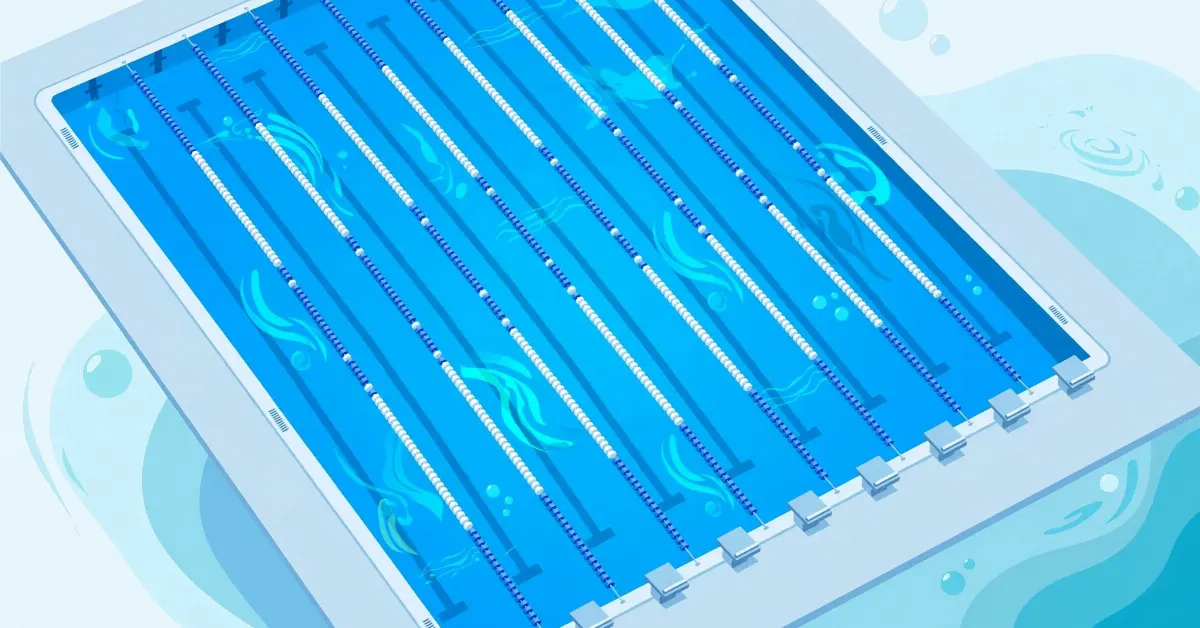
An Olympic swimming pool is exactly 50 meters long, 25 meters wide, and at least 2 meters deep. It is divided into 10 lanes that are each 2.5 meters wide, and it holds roughly 2.5 million liters of water.
Those four numbers are the backbone of every Olympic swimming pool built for top-level competition. When a commentator says a race covers “two lengths of the pool,” they mean 100 meters — one length down, one length back. When architects design an aquatics center, the 50-by-25-meter rectangle is the starting point for everything from the concrete shell to the filtration plant humming away in the basement.
This guide puts every official dimension in one place: the exact length, width, and depth, the lane count and lane width, the water volume, and an honest comparison with the pool sitting in a typical backyard. You will also find metric-to-imperial conversions throughout, so the numbers make sense whether you think in meters or feet.
Quick conversion chart (metric to imperial):
| Measurement | Metric | Imperial (approx.) |
|---|---|---|
| Pool length | 50 m | 164 ft |
| Pool width | 25 m | 82 ft |
| Minimum depth | 2 m | 6.6 ft |
| Lane width | 2.5 m | 8.2 ft |
| Number of lanes | 10 | 10 |
| Water volume | about 2.5 million liters | about 660,000 US gallons |
1. Exact Olympic Pool Dimensions
The headline figure is 50 meters. Measured from one end wall to the other, this is the racing length of a long-course pool — the format used at the Olympic Games. The 25-meter width gives the pool its familiar rectangular footprint: 50 meters long by 25 meters wide, or 1,250 square meters of water surface. If you have ever stood on the deck of a competition pool, that sheet of water looks enormous, and the numbers explain exactly why.
Here are all the core measurements in a single table:
| Measurement | Value | Notes |
|---|---|---|
| Length | 50 m | Racing length, wall to wall |
| Width | 25 m | Across all 10 lanes |
| Surface area | 1,250 m² | 50 × 25 meters |
| Perimeter | 150 m | One lap around the water’s edge |
| Minimum depth | 2 m | Applies across the pool |
| Lanes | 10 | Each 2.5 m wide |
| Lane width | 2.5 m | Per lane |
| Water volume | about 2.5 million liters | At the minimum depth |
For readers who think in feet and inches, 50 meters works out to about 164 feet long and 82 feet wide. The 2-meter minimum depth is about 6 feet 7 inches, and each 2.5-meter lane is roughly 8 feet 2 inches across. If you ever need to move between metric and imperial units on the fly, a measurement conversion guide keeps the math straight without a calculator.
The word “Olympic” gets used loosely. Hotels and gyms sometimes advertise an “Olympic-size” pool that is simply large. A true Olympic pool meets the full 50 × 25 meter standard with the depth and lane specifications covered below. Anything smaller might be a lovely pool, but it is not an Olympic pool.
There is also something psychological about the 50-meter length. Swimmers describe the first length as a sprint and the swim back as a test of nerve — the far wall looks impossibly distant when you are breathing hard at the turn. Coaches love the format because it exposes technique: with fewer walls to lean on, there is nowhere to hide a sloppy stroke. That is a big part of why long-course times are considered the purest measure of a swimmer’s ability.
2. Lanes and Lane Width
An Olympic pool is divided into 10 lanes, and each lane is 2.5 meters — about 8.2 feet — wide. That width gives every swimmer enough room to race without their wake spilling heavily into the neighboring lane, and it leaves space for the floating lane ropes that mark the boundaries between lanes.
You might wonder why there are 10 lanes when televised finals only show eight swimmers racing. The two outer lanes sit closest to the pool walls, where water bounces off the concrete and comes back choppy and uneven. Keeping the middle of the pool for racing while the outer lanes absorb that reflected turbulence gives every finalist fairer, calmer water. It is a quiet piece of design that makes a real difference when medals are decided by hundredths of a second.
The lane ropes themselves deserve a mention. Those long strings of brightly colored floats stretch the full 50-meter length of the pool, and they do much more than mark boundaries. Each float is designed to swallow wave energy, so one swimmer’s wake does not travel across the pool and become another swimmer’s problem. Without them, a 50-meter pool would be a washing machine by the final lap.
Two and a half meters is also a friendly number for anyone doing pool math. Five lanes side by side measure 12.5 meters, and the full ten add up to exactly 25 meters — the width of the pool. If you ever find yourself measuring lane width with a tape at your local pool, a quick refresher on how to read a measuring tape makes the job far less error-prone, especially when you are stretching the tape across a wet deck.
3. Depth Requirements
An Olympic pool must be at least 2 meters deep — about 6 feet 7 inches — and that minimum applies across the whole pool. Depth matters for several practical reasons. Racing starts send swimmers knifing into the water at speed, and they need enough water beneath them to stay safe. Turns at the wall push waves downward as well as outward, and deep water gives those waves somewhere to go instead of bouncing straight back into the swimmers.
Shallow water, by contrast, feels fast in the worst way: choppy, unpredictable, and tiring. Experienced swimmers can feel the difference immediately. A properly deep pool keeps the surface calm even when ten athletes are churning through it at full effort, which is exactly what you want when races are won and lost by a fingertip.
Two meters is the minimum rather than the target. Many competition pools are built deeper than the requirement, and extra depth is never a disadvantage for racing — it only makes the water calmer and the starts safer. What you will not find at the top level is a pool shallower than 2 meters hosting a major championship race.
To picture 2 meters without a tape measure, think of it as just over six and a half feet — a little taller than a tall adult standing in the shallow end with water well over their head. In inches, it works out to about 79 inches. If inches are the unit you think in, our guide to how long an inch is can help you build that mental picture with everyday objects.
4. Water Volume: About 2.5 Million Liters
Here is the number that stops people mid-sentence: an Olympic pool holds roughly 2.5 million liters of water. In US gallons, that works out to about 660,000 — the exact figure shifts a little with the precise depth, which is why you will always see the word “about” attached to it. Either way, it is an almost unimaginable amount of water sitting in a single concrete box.
Why does the volume matter beyond trivia night? A huge body of water holds its temperature far more steadily than a small one. Two and a half million liters does not swing from chilly to bathtub-warm between morning and afternoon the way a small backyard pool can; it shrugs off a cool night or a hot afternoon with barely a degree of change. That thermal stability is part of what makes competition pools feel so consistent from one session to the next.
The volume also explains the industrial-scale equipment hiding behind the scenes. Filtering 2.5 million liters means powerful pumps running around the clock, pushing the entire contents of the pool through filters again and again. Heating that much water, treating it, and keeping it crystal clear is a full-time operation — one more reason an Olympic pool is a serious piece of infrastructure, not just a big hole full of water.
And if you have ever wondered why filling one takes so long: even with large-diameter pipes, moving two and a half million liters is the work of many hours, not minutes. Pool operators plan fills the way airports plan fueling — carefully, and with the clock in mind.
Keeping that volume swimmable is a daily science. Sanitizer must be dosed precisely — too little and the water turns, too much and swimmers’ eyes pay the price. The pH is checked constantly, because two and a half million liters of slightly-off water is a much bigger problem than a slightly-off backyard pool. Lifeguards watch the swimmers; technicians watch the water itself.
5. Olympic Pool vs. Backyard Pool
So how does all of this compare with the pool behind someone’s house? The short answer is that there is no contest. A typical backyard pool is shorter, narrower, and shallower in every dimension — built for cooling off and weekend fun, not for 50-meter sprints. Where an Olympic pool gives each swimmer a full 2.5-meter lane, a home pool might barely fit two casual swimmers side by side.
The difference is easiest to feel in the length. Fifty meters is a long way to swim without stopping; most backyard pools are a fraction of that, which means constant turning instead of a steady rhythm. Depth tells a similar story: the Olympic minimum of 2 meters is deeper than the deep end of many home pools, which are often designed so adults can stand comfortably throughout.
Here is how the main pool types stack up:
| Pool type | Typical length | Lanes | How it compares |
|---|---|---|---|
| Olympic long-course | 50 m | 10 × 2.5 m | The competition standard |
| Olympic short-course | 25 m | Varies | Exactly half the Olympic length |
| Typical backyard pool | Much shorter | None marked | Built for leisure, not racing |
| Above-ground home pool | Much smaller | None | Compact and shallow by design |
| Hotel or resort pool | Varies | Rarely marked | Designed for relaxation |
| Community lap pool | Often 25 m | Fewer than 10 | Training-friendly, not Olympic width |
| Home endless/lap pool | Narrow and long | Single lane | One swimmer training against a current |
None of this is a knock on backyard pools — they are wonderful things. It is simply a reminder of scale. An Olympic pool is a sports arena that happens to be filled with water; a backyard pool is a garden feature that happens to be swimmable. Both are great at what they are built for.
If you swim laps at a local 25-meter pool, you are already training in water that echoes the Olympic format in miniature: your pool is half as long, but the lane ropes, the turns, and the rhythm of lap swimming are the same. Double your usual session and you have covered the Olympic length in spirit, even if the wall arrives twice as often. It is a fun way to connect an ordinary workout to the biggest stage in the sport.
6. Short-Course (25 m) Pools: A Quick Note
Not every serious competition pool is 50 meters long. A short-course pool measures exactly 25 meters — precisely half the Olympic length — and it hosts plenty of major competitions in its own right. The racing is the same sport, but the rhythm changes: swimmers reach the wall twice as often, which means more turns, more push-offs, and a different kind of racecraft.
Because a turn lets a swimmer push off the wall and glide, short-course races tend to reward strong turn technique, while long-course racing rewards sustained swimming. Times set in the two formats are recorded separately for exactly this reason — a 25-meter pool and a 50-meter pool are different arenas, even when the stroke looks the same on television.
If you train in a 25-meter pool, here is a handy way to think about it: two lengths of your pool equal one length of an Olympic pool. It is the same water; you just visit the walls more often.
Frequently Asked Questions
How long is an Olympic swimming pool in feet?
An Olympic pool is 50 meters long, which converts to about 164 feet. Its 25-meter width is about 82 feet, the 2-meter minimum depth is about 6.6 feet, and each 2.5-meter lane is about 8.2 feet wide.
How many gallons of water are in an Olympic pool?
About 660,000 US gallons, which is roughly 2.5 million liters. The exact figure depends on the precise depth of the pool, since pools built deeper than the 2-meter minimum hold a little more.
How deep does an Olympic pool have to be?
At least 2 meters (about 6 feet 7 inches) deep across the whole pool. Many competition pools are built deeper, which makes the water calmer and racing starts safer.
What is the difference between long-course and short-course pools?
A long-course pool is 50 meters long — the Olympic standard — while a short-course pool is exactly 25 meters, or half the length. Swimmers turn twice as often in short-course racing, so records are kept separately for the two formats.
Final Thoughts
Fifty meters long, 25 meters wide, 2 meters deep, 10 lanes of 2.5 meters, and about 2.5 million liters of water: those are the numbers that define an Olympic swimming pool, and they have defined it for generations of swimmers. They are simple on paper and staggering in person — the first time you stand at one end and squint at the far wall, the scale of the thing finally clicks. Whether you are training for a race, comparing your backyard pool, or just satisfying curiosity, those five measurements tell the whole story. And the next time someone drops the 2.5-million-liters fact at a barbecue, you will know exactly what sits behind it. It is a sporting arena measured to the centimeter, built to be fair, and designed to let the fastest swimmers on earth show exactly what they can do.

Hi, I’m Vera Lindqvist, a content writer at MeasuresIt.com, where I turn measurement standards, unit conversions, and precision tools into clear, practical guides. I care about getting the details right so you don’t have to second-guess them.