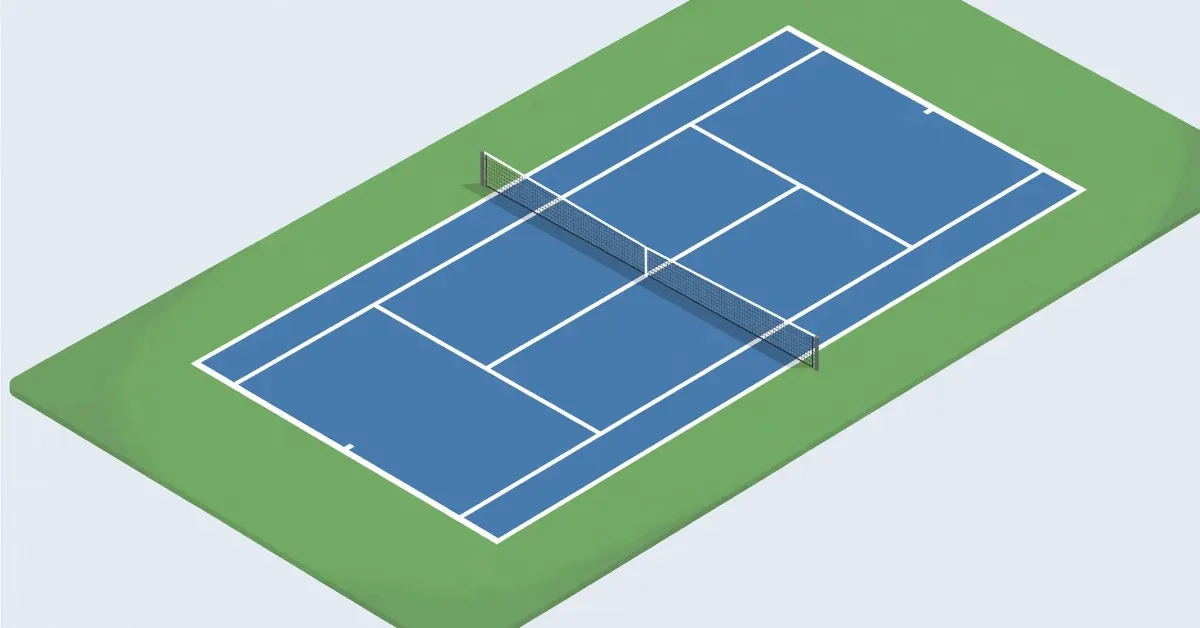
A doubles tennis court measures 78 feet long by 36 feet wide, while a singles court uses the same 78-foot length with a narrower 27-foot width. The net stands 3 feet high at the center and 3.5 feet high at the posts, and the service line sits 21 feet from the net on each side.
Whether you are lining a backyard court, settling a debate at the club, or just trying to picture how much space a real court takes up, tennis court dimensions are refreshingly standardized. Every regulation court in the world, from neighborhood parks to the show courts of the Grand Slams, follows the same official measurements. The playing rectangle never changes; only the space around it and the surface under your feet vary from place to place.
In this guide, we walk through the complete set of tennis court dimensions in feet: the full doubles and singles layouts, net and post heights, the service boxes, the lines themselves, how much run-off room a court needs, and how clay, hard, and grass surfaces compare. If you are measuring one out yourself, it helps to be comfortable with a foot as a unit and to know how to read a measuring tape before you start.
Tennis Court Dimensions: Quick-Reference Chart
Here are the headline numbers every player and court builder should know. Everything below is the official regulation measurement used worldwide.
| Dimension | Measurement |
|---|---|
| Court length (singles and doubles) | 78 feet |
| Court width, doubles | 36 feet |
| Court width, singles | 27 feet |
| Doubles alley width (each side) | 4.5 feet |
| Net height at center | 3 feet |
| Net height at the posts | 3.5 feet |
| Service line distance from the net | 21 feet |
| Total doubles court area | 2,808 square feet |
1. Full Court Length and Width
The single most important number in tennis is the length of the court: 78 feet from baseline to baseline. That figure is universal. It does not change between singles and doubles, between men and women, or between junior and professional play. Every rally starts and ends inside that 78-foot corridor, and the entire geometry of the game, from serve placement to baseline positioning, is built around it.
The width is where singles and doubles diverge. A doubles court stretches 36 feet across, marked by the outer doubles sidelines. When two players take the court for singles, the playable width shrinks to 27 feet, marked by the inner singles sidelines. The nine-foot difference is split evenly into two doubles alleys, each 4.5 feet wide, running the full length of the court on either side. Those alleys are fully in play during doubles but count as out of bounds in singles, which is why the doubles game rewards sharp angles and the singles game rewards depth.
It helps to picture the sheer size of the playing rectangle. A doubles court covers 2,808 square feet, while the singles court inside it covers 2,106 square feet. That is a meaningful difference in coverage responsibility: in singles, one player patrols the full 78-foot length and 27 feet of width alone, while doubles partners divide the wider 36-foot court between them. If you ever stand on a baseline and look across 78 feet of court to the far baseline, the distance feels even longer than the number suggests, which is exactly why serving and returning from behind the line take such clean timing.
2. Singles vs Doubles: The Alley Difference
New players often ask whether a singles court is simply a narrower court. The answer is yes, with one nuance: it is the same court, just played within narrower boundaries. The outer doubles sidelines become irrelevant in singles, and any ball landing in the alleys is called out. The net, the service boxes, the baselines, and the center marks are identical in both formats.
The comparison below makes the differences easy to scan:
| Feature | Singles | Doubles |
|---|---|---|
| Court length | 78 feet | 78 feet |
| Court width | 27 feet | 36 feet |
| Sidelines used | Inner singles sidelines | Outer doubles sidelines |
| Doubles alleys | Out of bounds | Fully in play |
| Service boxes | Same size and position | Same size and position |
| Net height and posts | 3 ft center, 3.5 ft at posts | 3 ft center, 3.5 ft at posts |
| Court area in play | 2,106 square feet | 2,808 square feet |
Strategically, the alley difference changes everything. In doubles, the extra 4.5 feet on each side opens up sharper crosscourt angles and makes serve-and-volley patterns viable, because there is more court to defend and more room to create. In singles, the narrower width means rallies run more north-south than east-west, and depth control becomes the dominant skill. Court builders sometimes paint only the doubles lines on a multi-use court and add the singles sidelines as a second color, which is a practical way to host both formats on one surface.
3. Net Height, Posts, and the Center Strap
The net is the one part of the court whose height changes along its span. At the center, a strap holds the net down so that it measures exactly 3 feet off the ground. At the posts, which stand just outside the doubles sidelines, the net rises to 3.5 feet. That six-inch dip from post to center is deliberate: it shapes the geometry of every serve and every rally ball that crosses the middle of the court.
Because the center is lower, serves aimed down the middle (down the “T”) travel over the lowest part of the net, which is one reason the T serve is such a popular target. Groundstrokes hit crosscourt also benefit, since the ball crosses the net closer to its center where the height is a full half-foot lower than at the posts. When you watch professionals aim for the deep corners, they are playing the percentages against that 3-foot center height without necessarily thinking about the number.
The posts themselves are part of the measurement system. They hold the net at 3.5 feet, and they are positioned outside the doubles sidelines so that a ball hit down the doubles sideline never has to clear a post inside the court. If you are setting up a net for casual play, the two numbers to check with your tape are the 3-foot center and the 3.5-foot posts. Getting the center strap tension right matters more than most casual players realize: a sagging net plays lower than regulation, and an over-tightened one can creep above 3 feet at the middle, changing how the court plays.
4. Service Boxes and the Service Line
The service line runs parallel to the net, 21 feet from it on each side. It divides the area between the net and the baselines into the service boxes, the targets every serve must land in. Each service box is 21 feet long and 13.5 feet wide, bounded by the net, the service line, one sideline, and the center service line. There are four service boxes in total, two on each side of the net.
That 21-foot measurement is worth pausing on. A serve must travel at least the distance from the baseline to the service line, 21 feet plus the server’s position behind the baseline, and land inside a box that is only 21 feet deep and 13.5 feet wide. The narrowness of the target explains why the serve is the hardest shot in tennis to master: the margin for error is small, and the penalty for missing is immediate.
The center service line, which splits the two boxes on each side, runs from the net to the service line and continues as the center mark on the baseline. During the serve, it is the left-right divider: serves from the deuce side must land in the diagonally opposite box on the receiver’s deuce side, and vice versa for the ad side. Once the point is underway, the service lines lose their special meaning and the full court, alleys included in doubles, becomes the playing area.
5. The Baseline, Sidelines, and Line Widths
Every line on a tennis court is part of the playing area it bounds, which means a ball touching any part of a line is in. The baselines run the width of the court at each end of the 78-foot length and are drawn wider than the other lines, up to the maximum width the rules allow. The extra width gives servers and returners a slightly larger target on the most contested shots of the match. All the remaining lines, the sidelines, service lines, and the center service line, are drawn at a narrower, uniform width.
The center mark is a small but important detail: a short line drawn inside the court at the middle of each baseline, extending back from the baseline into the court. It marks the dividing point between the deuce and ad service positions. Servers stand to one side of it or the other depending on the score, and receivers use it as a reference for positioning. When you see a court diagram, the center mark looks like a tiny notch in the baseline, but it governs where every single serve of the match begins.
Painting or taping lines to the right dimensions takes patience. Because a ball that clips a line counts as in, line edges must be crisp and the lines must sit exactly where the measurements say they belong. Temporary courts laid out with tape for a weekend event can play surprisingly well as long as the 78-foot length, the correct width, and the 21-foot service line position are honored. Permanent courts use painted lines that hold up to weather and play, but the underlying geometry is identical either way.
6. Run-Off Space Around the Court
The 78-by-36-foot rectangle is only the playing surface. Around it, every real court includes clear run-off space so players can chase wide balls, follow through on serves, and decelerate safely after sprinting. Tournament venues provide generous clearances behind the baselines and along the sidelines, with the most room reserved behind the baseline where deep returns and defensive lobs carry players. Recreational courts need the same idea on a smaller footprint: enough clear, level ground beyond each baseline and sideline for a player to run, slide, and stop without hitting a fence or wall.
When you plan a court, measure the total footprint, not just the playing lines. A good rule of thumb for a home or club court is to add several feet of clear space on all four sides of the 78-by-36 rectangle, with extra depth behind the baselines, since serves and groundstrokes pull players several strides past the line. Fences should sit outside that buffer, and the surface of the run-off area should match the court itself so footing never changes mid-sprint. Lighting poles, benches, and ball carts all belong beyond the clear zone.
Indoor facilities follow the same principle with walls set back from the lines. The key insight is that run-off is not wasted space: it is where a huge share of real tennis happens. Returns of big serves, stretched-out wide forehands, and emergency defensive shots all take place partly or entirely in the run-off zone, so skimping on it changes the character of the game more than any other compromise a court builder can make.
7. Court Surface Types: Clay, Hard, and Grass
The dimensions of a tennis court never change with the surface, but the surface changes how those dimensions play. Clay, hard, and grass courts all measure 78 by 36 feet with the same net heights and service boxes, yet each one rewards different movement, shot selection, and strategy. Understanding the three main surfaces helps you read the game at every level, from your local park to the professional tour.
Clay courts, built from crushed brick, shale, or stone, are the slowest of the three. The loose top layer grips the ball and the player’s shoes, producing high, heavy bounces and long rallies. Sliding into shots is not just possible on clay but essential, and points tend to be constructed patiently from the baseline. Because the surface is granular, foot faults and ball marks are visible, and players routinely check marks on close line calls. Clay demands the most maintenance of any surface: daily watering, rolling, and brushing keep it playable, which is why clay courts cluster in warm climates where they can stay open year-round.
Hard courts, typically asphalt or concrete layered with acrylic coating, sit in the middle for speed and offer the most consistent, predictable bounce. They are the most common surface in the world, especially in North America and at schools and public parks, because they handle weather well and need relatively little upkeep. The bounce is true and medium-paced, which suits all-court games: big servers, aggressive baseliners, and net rushers can all thrive. Hard courts are also the firmest underfoot, so they transmit more impact to knees and ankles than clay or grass, a trade-off players manage with good shoes and scheduling.
Grass courts are the fastest and the rarest. The ball skids low and quick off a well-kept lawn, keeping rallies short and rewarding serve-and-volley tennis, crisp returns, and soft hands at the net. Bad bounces are part of the charm and the challenge: an uneven tuft can send a ball anywhere. Grass is expensive and labor-intensive to maintain, needing constant mowing, watering, and rest periods, which is why the professional grass season is short and centered on the most famous tournament in the sport. For the full picture of how court measurements translate across sports and surfaces, our measurement guides cover the details sport by sport.
Tennis Court Dimensions: Frequently Asked Questions
How long is a tennis court in feet?
A regulation tennis court is 78 feet long from baseline to baseline. The length is the same for singles and doubles, at every level of the game.
How wide is a tennis court for singles and doubles?
A doubles court is 36 feet wide, while a singles court is 27 feet wide. The 4.5-foot alleys on each side are in play for doubles and out of bounds for singles.
How high is a tennis net?
The net is 3 feet high at the center, held down by a center strap, and 3.5 feet high at the posts. The dip in the middle is part of the official specification.
How far is the service line from the net?
The service line sits 21 feet from the net on each side. It marks the back edge of the service boxes, which are 21 feet deep and 13.5 feet wide.
Final Thoughts
Tennis court dimensions in feet are simple enough to memorize in a minute: 78 feet long, 36 feet wide for doubles and 27 for singles, a net at 3 feet in the center rising to 3.5 feet at the posts, and a service line 21 feet from the net. Yet those five numbers shape every tactic in the sport, from the sharp doubles angles the alleys create to the low skids over the center strap that decide break points. Whether you are painting lines for a home court, checking a venue before a match, or just deepening your appreciation of the game, knowing the measurements turns the court from a green rectangle into a readable, strategic space. Grab a tape, walk the 78 feet yourself, and the scale of professional tennis suddenly makes perfect sense.

Hi, I’m Vera Lindqvist, a content writer at MeasuresIt.com, where I turn measurement standards, unit conversions, and precision tools into clear, practical guides. I care about getting the details right so you don’t have to second-guess them.