Standard Washing Machine Dimensions: Top-Load & Front-Load
Introduction
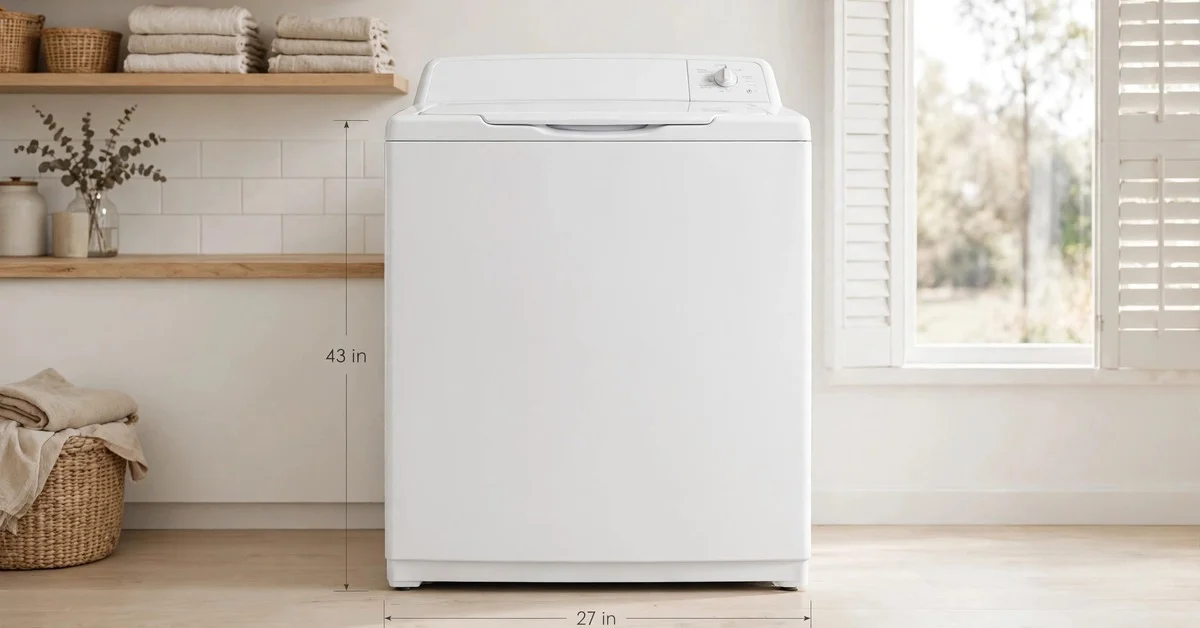
Planning a laundry room, squeezing a washer into a closet, or buying a replacement? A standard top-load washer is about 27 inches wide, 27 inches deep, and 42 to 44 inches tall. That is roughly 68.6 cm wide and deep, and about 106 to 112 cm tall.
Knowing the exact footprint matters more than most people expect. A washer that is one inch too wide will not slide between the wall and the dryer. A lid that cannot open fully because the top is blocked by a shelf turns laundry day into a chore. These standard washer sizes also matter when you remodel, stack a dryer, or order online and cannot stand next to the machine first. Below you will find the standard sizes for top-load, front-load, compact, and portable washers, plus real objects that share those measurements so you can picture the fit before delivery day.
Washing Machine Size Conversion Chart
| Dimension | Inches | Centimeters | Feet |
|---|---|---|---|
| Top-load width | 27 in | ≈ 68.6 cm | 2.25 ft |
| Top-load depth | 27 in | ≈ 68.6 cm | 2.25 ft |
| Top-load height | 42–44 in | ≈ 106.7–111.8 cm | 3.5–3.67 ft |
| Front-load width | 27 in | ≈ 68.6 cm | 2.25 ft |
| Front-load depth | 27 in | ≈ 68.6 cm | 2.25 ft |
| Front-load height | 39 in | ≈ 99.1 cm | 3.25 ft |
These figures reflect the machine itself, not the space around it. Hoses, power cords, and the gap for airflow add inches on every side, so always measure the opening and the doorways along the delivery path.
Common Objects That Are About the Same Size as a Washing Machine
| Object | Approximate Size |
|---|---|
| Front-load dryer | 27 in wide × 27 in deep × 39 in tall |
| Full-size kitchen range | 30 in wide |
| Two-drawer filing cabinet | About 26 in wide |
| Standard bathtub | 30 in wide |
| Bar-height kitchen counter | About 42 in tall |
| Standard interior door | 30 in wide |
| Nightstand | About 26–28 in wide |
| Standard dishwasher | 24 in wide |
More Everyday Items Around the Same Size
| Object | Approximate Size |
|---|---|
| 42-inch flat-screen TV | 42 in measured diagonally |
| Compact mini fridge | About 20 in wide × 30 in tall |
| Laundry basket | About 24 in tall |
| Kitchen countertop | 36 in tall |
| Full-size refrigerator | About 36 in wide × 68 in tall |
| Yardstick | 36 in long |
| Washer pedestal riser | About 27 in × 27 in footprint, 15 in tall |
1. Front-Load Dryer
The front-load dryer is the closest match of all. A standard front-load dryer measures about 27 inches wide, 27 inches deep, and roughly 39 inches tall. Manufacturers design dryers and front-load washers as a pair, so they line up side by side in the same laundry room and share the exact same footprint. Place the two next to each other and the pair occupies about 54 inches of wall space. That is why matching sets look so neat: the tops sit almost level, with the dryer a few inches shorter than a top-load washer.
2. Full-Size Kitchen Range
A full-size kitchen range is almost always 30 inches wide. Stand a washer next to a stove and the washer looks a touch narrower, since three inches separate them. The range also runs about 25 to 28 inches deep, so the two appliances sit at roughly the same depth as well. Heights differ more: most ranges stand 36 inches tall at the cooking surface, while a top-load washer rises another six to eight inches above that. This comparison helps when a laundry area sits near the kitchen, since the range is a familiar reference point.
3. Two-Drawer Filing Cabinet
The classic two-drawer filing cabinet in an office runs about 26 inches wide. Set it beside a washer and the cabinet looks just a hair slimmer. Depth tells a different story, though. A filing cabinet is only about 28 inches deep from front to back, nearly the same as the washer’s 27-inch depth, so they feel similar in bulk. Many home-office setups use one under a window or against a wall, and that gives a decent mental picture of how much floor space a washer claims.
4. Standard Bathtub
A standard bathtub measures about 30 inches wide. Lay a washer next to the end of a tub and the tub edge sticks out just a few inches wider. Bathtubs are built into the alcove of most bathrooms at 60 inches long, so only the width compares. The tub wall rises only 14 to 16 inches, so the washer towers over it. Still, if your laundry closet sits off the bathroom, the tub width is a handy real-world gauge of whether the washer will pass through the space.
5. Bar-Height Kitchen Counter
Bar-height counters stand about 42 inches tall. That height matches the top of a standard top-load washer almost exactly. If you have a bar or raised breakfast counter in your kitchen, run your hand along its edge: the washer lid area reaches the same height. This makes the counter a perfect visual stand-in when you want to know how high a washer will reach against a wall. Many people also rest a laundry basket on a washer, and at 42 inches that basket lands right at comfortable working height.
6. Standard Interior Door
A standard interior door measures 30 inches wide. This matters because every washer must pass through a door on delivery day. With a 27-inch-wide washer and a 30-inch door frame, the machine clears the opening with about three inches to spare once the door is removed. Builders set standard door sizes so that large appliances can move through, and this is exactly why. Measure the narrowest doorway on the delivery path, not just the laundry room entrance, since a tight hallway corner can stop the delivery team.
7. Nightstand
A typical nightstand runs about 26 to 28 inches wide. Put a nightstand next to a washer and the two look close in width, though the nightstand ends far lower at 24 to 28 inches tall. Nightstands also tend to be 16 to 20 inches deep, noticeably shallower than the washer’s 27-inch depth. Most bedrooms have one beside the bed, so it works well as a rough width reference when you are shopping for a washer and cannot picture 27 inches on a store floor.
8. Standard Dishwasher
The standard dishwasher built into a kitchen cabinet measures about 24 inches wide. A washer is a few inches wider, and you can feel that difference when you stand in front of each. Dishwashers also stand only 34 to 36 inches tall because they tuck under the counter, while the washer rises well above that. The depth is similar at 24 inches plus the door, so the washer projects a little further into the room. Anyone remodeling a kitchen knows the dishwasher cutout, which makes it a useful comparison for laundry planning.
9. 42-Inch Flat-Screen TV
A 42-inch flat-screen TV measures 42 inches diagonally across the screen. That diagonal equals the height of a standard top-load washer, which is a fun and easy comparison. Picture a 42-inch television stood upright on the floor: the top edge lands exactly where the washer’s lid would sit. The TV itself is much wider than it is tall, about 37 inches across, so the match is only in that one dimension. Even so, the number sticks in memory. If you want to explore how screens scale up, larger sets like a 55-inch TV grow wider and taller from that same diagonal starting point.
10. Compact Mini Fridge
A compact mini fridge, the kind found in dorm rooms and offices, measures about 20 inches wide and 30 inches tall. The washer is wider by roughly seven inches and much taller, since a top-load machine rises another foot above the mini fridge’s top. The mini fridge is also shallower at around 18 to 20 inches deep. Put the two side by side in your mind and the washer looks like the mini fridge’s bigger sibling. This helps when a laundry corner is small, because most people have seen exactly how much space a dorm fridge needs.
11. Laundry Basket
The average laundry basket stands about 24 inches tall and 18 to 20 inches wide. A top-load washer at 42 to 44 inches tall reaches nearly twice the height of the basket sitting beside it. That relationship matters in practice: you lift a full basket up and over the rim of the washer to load it. The opening of a top-load washer sits right around 42 inches, which is a comfortable height for most adults. If you drop a basket into the tub of the washer, the tub is deep enough to swallow it almost entirely.
12. Kitchen Countertop
Standard kitchen countertops stand 36 inches tall. A top-load washer rises about six to eight inches above that line, so the difference is easy to see when the two sit in the same home. The counter is a familiar reference because almost every kitchen has one at that exact height. Front-load washers, at 39 inches tall, sit just three inches above the counter, and that is no accident: front-load machines are designed to slide under a counter or fold into a kitchen layout. Top-load washers, with their lids, need that extra clearance above.
13. Full-Size Refrigerator
A full-size refrigerator measures about 36 inches wide and 66 to 70 inches tall. The washer is narrower by about nine inches and far shorter, reaching only about two-thirds of the fridge’s height. This is the “slightly larger” reference that puts the washer in context among the biggest appliances in the house. The refrigerator is the one appliance most people can picture instantly, so comparing the washer to it gives a quick sense of scale. Widths of both land in the same neighborhood, which is why laundry rooms and kitchens feel similar in how the appliances dominate the walls.
14. Yardstick
A yardstick measures exactly 36 inches long. Lay it on the floor next to a washer and the washer is narrower than the yardstick is long, since 27 inches falls nine inches short. Stand the yardstick upright against the washer and it reaches only to the machine’s midsection on a top-load model, with another six to eight inches of washer above it. The yardstick is one of the few measuring tools that stays the same everywhere, so it works as a reliable stand-in when you want to visualize the washer’s 42 to 44-inch height without a tape measure.
15. Washer Pedestal Riser
Many brands sell a washer pedestal riser that lifts a front-load machine off the floor. The pedestal matches the washer’s footprint at about 27 inches wide and 27 inches deep, and it adds roughly 12 to 15 inches of height. Put a front-load washer on a pedestal and the total height climbs to about 51 to 54 inches, which brings the door opening up to a comfortable level. The pedestal also includes a storage drawer for detergent. Measure carefully if you plan to use one, because the added height can block a shelf or cabinet mounted above the machine.
How Much Space Does a Washing Machine Need?
The machine’s listed size is only the start. Installation guides call for about 1 inch of clearance on each side, about 1 inch in front for the door on front-load models, and about 6 inches behind the machine for the water hoses, drain hose, and power cord. A top-load washer also needs enough open space above for the lid to swing fully, which can add another 20 inches of required height in tight closets.
Before delivery, measure every doorway, hallway turn, and stairwell the machine must pass through. A measuring tape makes this quick, and a few minutes with it can save a failed delivery. Write down the narrowest point, subtract an inch for safety, and confirm the washer’s depth fits with the door closed. Remember that hoses and plugs stick out behind the machine, so the true installed depth runs a few inches beyond the spec sheet number.
Frequently Asked Questions
Are front-load and top-load washers the same width?
Yes, both usually measure about 27 inches wide and 27 inches deep. The main difference is height: top-load washers stand about 42 to 44 inches tall, while front-load washers are about 39 inches tall. Compact models are smaller in every dimension, usually around 24 inches wide.
How much clearance space do I need around a washing machine?
Allow about 1 inch on each side, about 1 inch at the front for front-load doors, and about 6 inches behind the machine for hoses and cords. Top-load washers also need free space above so the lid can open fully. These gaps keep the machine stable, let hoses connect without kinks, and make future service visits possible.
Will a standard washer fit through a 30-inch doorway?
Yes, in most cases. A 27-inch-wide washer passes through a 30-inch door frame with about 3 inches to spare once the door is removed from its hinges. Measure the narrowest point on the whole delivery path, including hallway corners and stairwells, because a tight turn can block a machine that fits through every door.
Do pedestal risers change washing machine dimensions?
Yes. A pedestal riser adds about 12 to 15 inches of height under a front-load washer, bringing the total to roughly 51 to 54 inches. It does not change the width or depth. Check that shelves, cabinets, or countertops above the machine still leave enough room after the pedestal is added.
Final Thoughts
Standard washing machine dimensions are simple to remember: about 27 inches wide, 27 inches deep, and 42 to 44 inches tall for top-load models. Front-load washers share the same footprint but stand a little shorter at 39 inches, while compact and portable machines shrink the numbers further for small homes. The numbers on the spec sheet are only part of the story, since hoses, doors, and lid clearance all claim extra inches around the machine.
When you plan the space, picture the washer against objects you already know: a 30-inch door it must pass through, a 42-inch bar counter that matches its height, or the 27-inch dryer that will stand beside it. Measure the room, the doorways, and the delivery path before you buy, and add the recommended clearances. A few minutes with a tape measure turns a stressful delivery into a smooth one.

I’m Elena Cross, a content writer at MeasuresIt.com, where I turn complex measures, units, and mathematical concepts into clear, accurate, and easy-to-read articles. I’m passionate about precision in numbers and in words and I write to help readers actually understand measurements, not just memorize them.