Battery Sizes Chart: AA, AAA, C, D & 9V Dimensions
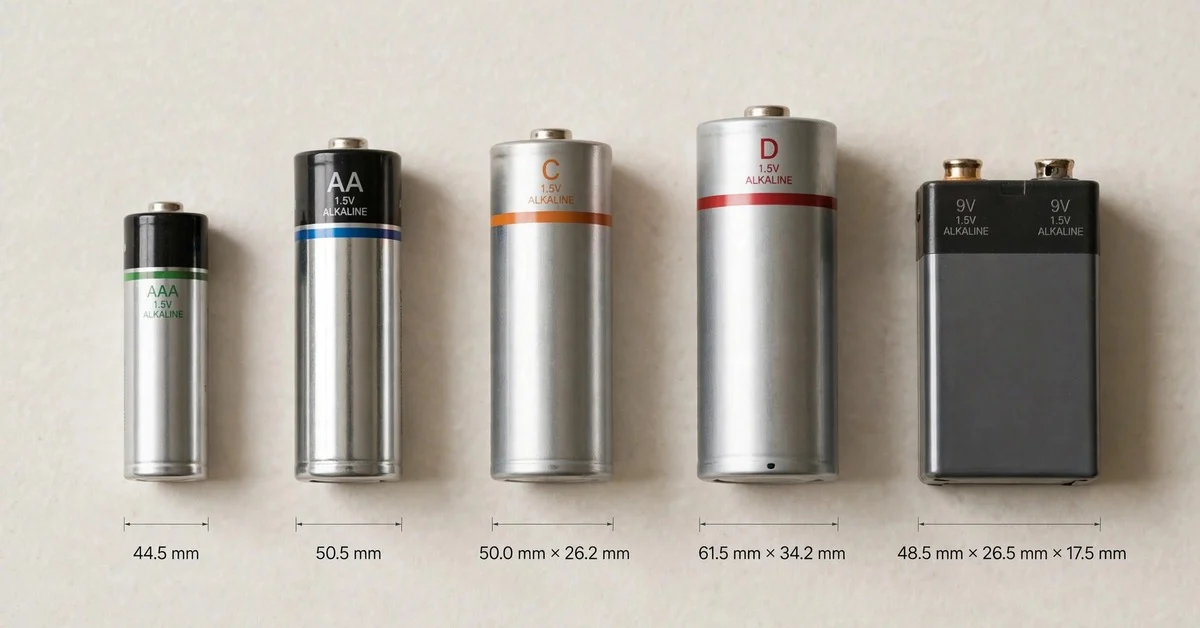
An AA battery measures 50.5 mm long and 14.5 mm in diameter, while a AAA battery is 44.5 mm long and 10.5 mm in diameter. These two cylindrical sizes power the great majority of everyday household devices, from TV remotes and wireless mice to toys, flashlights, and clocks. Knowing exact battery dimensions helps when buying organizers, replacing compartment holders, or planning DIY electronics projects.
Battery sizes are standardized internationally by the International Electrotechnical Commission (IEC), which assigns each size a code: alkaline AA cells are LR6, AAA cells are LR03, C cells are LR14, and D cells are LR20. Because of this standardization, an AA from any reputable brand is physically identical to any other, even though capacity and shelf life vary. Below is the full battery size chart, detailed breakdowns of every common size, and answers to the most common questions about battery dimensions.
Battery Size Conversion Chart (mm and Inches)
| Battery Type | Length (mm) | Length (in) | Diameter (mm) | Diameter (in) |
|---|---|---|---|---|
| AA | 50.5 | 1.99 | 14.5 | 0.57 |
| AAA | 44.5 | 1.75 | 10.5 | 0.41 |
| C | 50 | 1.97 | 26.2 | 1.03 |
| D | 61.5 | 2.42 | 34.2 | 1.35 |
| 9V | 48.5 (height) | 1.91 | 26.5 x 17.5 (base) | 1.04 x 0.69 |
| CR2032 | 20 (diameter) | 0.79 | 3.2 (thickness) | 0.13 |
The 9V is rectangular, so its “length” is its height and the diameter column shows its base footprint. The CR2032 is a coin cell, so its diameter is the wide face and its thickness is the small number. Inch figures are rounded to two decimals from the metric standard.
8 Common Battery Types Compared
The table below summarizes the eight battery types covered in sections 1 through 8, with their standard dimensions and typical uses.
| # | Battery Type | Dimensions (mm) | IEC Code | Typical Voltage |
|---|---|---|---|---|
| 1 | AA | 50.5 x 14.5 | LR6 | 1.5 V |
| 2 | AAA | 44.5 x 10.5 | LR03 | 1.5 V |
| 3 | AAAA | about 42.5 x 8.3 | LR61 | 1.5 V |
| 4 | C | 50 x 26.2 | LR14 | 1.5 V |
| 5 | D | 61.5 x 34.2 | LR20 | 1.5 V |
| 6 | 9V | 48.5 x 26.5 x 17.5 | 6LR61 | 9 V |
| 7 | CR2032 | 20 x 3.2 | CR2032 | 3 V |
| 8 | CR2016 | about 20 x 1.6 | CR2016 | 3 V |
1. AA Battery (LR6)
The AA is the most common battery size in the world, measuring 50.5 mm long and 14.5 mm in diameter. Its alkaline IEC code is LR6, and it delivers a nominal 1.5 volts — the same voltage as AAA, C, and D cells, which differ only in how much energy they store. AA cells power TV remotes, wireless mice and keyboards, game controllers, flashlights, toys, and wall clocks. Rechargeable NiMH and lithium AA batteries are built to the exact same 50.5 x 14.5 mm dimensions, so they fit any device designed for disposable AAs. To verify a cell yourself, a ruler is enough — and our guide on how to read a measuring tape keeps millimeter readings accurate.
2. AAA Battery (LR03)
The AAA measures 44.5 mm long and 10.5 mm in diameter — roughly half the internal volume of an AA. Its alkaline IEC code is LR03 and it delivers the same nominal 1.5 volts. The trade-off is capacity: a typical alkaline AAA holds around 1,000 to 1,200 mAh versus roughly 2,000 to 3,000 mAh for an AA, so AAA devices need fresh cells sooner under equal load. AAA batteries dominate compact electronics: most TV remotes, including the remote for a typical 55-inch TV, plus computer mice, small flashlights, electric toothbrushes, and LED candles. Rechargeable NiMH AAA cells share the same 44.5 x 10.5 mm size, and low-self-discharge versions hold charge for months.
3. AAAA Battery (LR61)
The AAAA is the slim, often-overlooked member of the cylindrical family at about 42.5 mm long and 8.3 mm in diameter. Its alkaline IEC code is LR61. It is shorter and noticeably thinner than a AAA, and it is far less common at retail — you may need to order online or visit an electronics supplier. AAAA cells power many pen-style digital styluses, some laser pointers, LED penlights, and glucose meters. Notably, a 9V battery contains six AAAA-sized cells wired in series inside its rectangular case. Like the other cylindrical sizes, the AAAA delivers a nominal 1.5 volts in alkaline chemistry.
4. C Battery (LR14)
The C battery measures 50 mm long and 26.2 mm in diameter — the same length as an AA with a much wider body. Its alkaline IEC code is LR14. That extra girth means capacity: a typical alkaline C cell stores roughly 7,000 to 8,000 mAh, several times the energy of an AA. Classic uses include medium and large flashlights, portable radios, children’s ride-on toys, and lanterns where long runtime matters more than compact size. Adapters exist that let a C-powered device run on AA cells, though runtime drops sharply. Rechargeable NiMH C batteries match the same 50 x 26.2 mm dimensions and are cost-effective for flashlights and toys that burn through disposables.
5. D Battery (LR20)
The D is the largest standard cylindrical consumer cell at 61.5 mm long and 34.2 mm in diameter. Its alkaline IEC code is LR20, and it typically stores around 12,000 to 18,000 mAh — the highest capacity of any common 1.5-volt cylindrical battery. D batteries power large flashlights and lanterns, boomboxes, portable fans, big motorized toys, and many emergency radios where maximum runtime between changes is the priority. NiMH rechargeable D cells exist but are less common in households. Substituting smaller cells with adapters is possible but usually impractical, since the entire point of the D size is its long-lasting energy reserve.
6. 9V Battery (6LR61)
The 9V is the rectangular block familiar from smoke detectors, measuring 48.5 mm tall with a 26.5 x 17.5 mm base. Its alkaline IEC code is 6LR61, which describes its construction: six LR61 (AAAA-size) cells wired in series to produce 9 volts. The two snap terminals on top — one smaller positive, one larger negative — make it instantly recognizable. Nine-volt batteries power smoke alarms, carbon monoxide detectors, guitar effects pedals, some wireless microphones, and multimeters. Lithium 9V batteries are popular for smoke detectors because they last for years and handle temperature extremes well. Rechargeable 9V cells exist in NiMH and lithium-ion chemistries.
7. CR2032 Button Cell
The CR2032 is the most widely used lithium coin cell at 20 mm in diameter and 3.2 mm thick. Its name is a code: “CR” indicates lithium manganese dioxide chemistry, “20” means 20 mm diameter, and “32” means 3.2 mm thick. It delivers a nominal 3 volts and is not rechargeable in standard form. CR2032 cells power car key fobs, motherboard CMOS memory, watches, calculators, kitchen scales, LED tea lights, and fitness trackers. Their flat shape and shelf life of often up to ten years suit devices that sip power slowly. At 20 mm across, a CR2032 is less than half the width of a standard credit card. Store coin cells out of children’s reach.
8. CR2016 Button Cell
The CR2016 is the thinner sibling of the CR2032 at about 20 mm in diameter and 1.6 mm thick — exactly half the thickness, so two stacked CR2016 cells equal one CR2032 in height. The naming code works the same way, with a nominal 3-volt output in lithium manganese dioxide chemistry. CR2016 batteries appear in car key fobs, small LED lights, pedometers, some watches, and slim remotes where space is tight. The two are not always interchangeable: a CR2032 holds roughly twice the capacity, so a 2016 swapped into a 2032 device dies sooner, and a 2032 often will not fit a compartment molded for a 2016. Match the code stamped on the old cell.
7 Quick Battery Size Facts
Sections 9 through 15 answer the most common follow-up questions about battery dimensions, codes, and capacities.
| # | Question | Short Answer |
|---|---|---|
| 9 | How much smaller is AAA than AA? | AAA is about 6 mm shorter and 4 mm thinner |
| 10 | What does LR6 mean? | L = alkaline, R = round, 6 = size code for AA |
| 11 | CR2032 vs CR2025 — what’s the difference? | Same 20 mm diameter; 3.2 mm vs 2.5 mm thick |
| 12 | Why is it called a 9V battery? | Six 1.5 V cells in series inside one case |
| 13 | Do rechargeables match disposable sizes? | Yes — NiMH AA/AAA/C/D match exactly |
| 14 | Which size holds the most energy? | D (roughly 12,000–18,000 mAh alkaline) |
| 15 | Are button cell codes standardized? | Yes — diameter and thickness in the name |
9. How Much Smaller Is AAA Than AA?
A AAA is 44.5 mm long versus 50.5 mm for AA — exactly 6 mm shorter — and at 10.5 mm in diameter it is 4 mm slimmer. That cuts internal volume to roughly half, which is why AAA cells hold noticeably less energy. In practical terms, an AA is about the length of an adult thumb’s top two joints, while a AAA is closer to just the top joint. The gap drives device design: slim remotes and compact flashlights choose AAA because an AA would force a thicker product, while game controllers and larger flashlights accept AA bulk for longer runtime. Compartments are machined to tight tolerances, which is why a AAA rattles in an AA slot and an AA cannot fit a AAA compartment.
10. What Does LR6 Mean?
LR6 is the IEC code for an alkaline AA battery, and each character carries meaning. The “L” designates alkaline chemistry, the “R” indicates a round or cylindrical shape, and the “6” is the size number assigned to AA dimensions — “alkaline, round, size 6.” The same logic applies across the family: LR03 is an alkaline AAA, LR14 an alkaline C, and LR20 an alkaline D. Lithium cylindrical cells use different prefixes, such as FR6 for a lithium AA, while coin cells like the CR2032 use “C” for lithium manganese dioxide followed by dimensions. These codes matter most when ordering from industrial suppliers or reading device manuals that specify cells by IEC code.
11. CR2032 vs CR2025 — What’s the Difference?
The CR2032 and CR2025 share the same 20 mm diameter and chemistry but differ in thickness: 3.2 mm versus 2.5 mm. That 0.7 mm gives the CR2032 roughly 220 mAh of capacity compared to about 160 mAh for the CR2025, so the thicker cell lasts noticeably longer. Interchangeability depends on the compartment. A CR2025 usually works in a device built for a CR2032 since the spring contact takes up the slack, but expect shorter life. Going the other direction is riskier: a CR2032 often will not fit a compartment molded for the thinner CR2025, and forcing it can damage the contacts. Replace like with like and match the code on the old cell.
12. Why Is It Called a 9V Battery?
A 9V battery contains six individual 1.5-volt cells wired in series, and 6 × 1.5 equals 9 volts. In the alkaline version (6LR61), those six cells are AAAA-sized cylinders stacked inside the rectangular case; in cheaper carbon-zinc versions they are flat plates, but the arithmetic is the same. This explains the shape and the snap terminals: the rectangular case is the most compact way to package six small cells, and the two press-studs connect to the ends of the series chain. It also explains the price — you are effectively buying six cells in one package. Rechargeable lithium-ion 9V batteries instead use lithium cells with built-in regulation circuitry.
13. Do Rechargeable Batteries Match Disposable Sizes?
Yes. Rechargeable AA, AAA, C, and D batteries in nickel-metal hydride (NiMH) chemistry are manufactured to the exact same dimensions as disposable alkalines — 50.5 x 14.5 mm for AA, 44.5 x 10.5 mm for AAA, 50 x 26.2 mm for C, and 61.5 x 34.2 mm for D. The standards exist so any cell labeled AA fits any device built for AA, regardless of chemistry. Two caveats: NiMH cells deliver a nominal 1.2 volts rather than 1.5, which can trigger early low-battery warnings in some devices, and they run slightly heavier. Low-self-discharge NiMH batteries hold most of their charge for months, making them ideal for remotes and clocks.
14. Which Battery Size Holds the Most Energy?
Among common consumer sizes, the D battery holds the most energy at around 12,000 to 18,000 mAh in alkaline chemistry. Capacity follows physical size almost exactly: D at the top, then C at roughly 7,000 to 8,000 mAh, then AA at about 2,000 to 3,000 mAh, then AAA at around 1,000 to 1,200 mAh, and finally AAAA at roughly 500 to 600 mAh. All are nominal 1.5-volt alkaline cells, so the only variable is how much chemical energy fits inside the can. This is why a lantern built for D cells gets D cells — adapter sleeves that let you use AA cells in C or D compartments solve the fit problem but deliver a fraction of the designed runtime.
15. Are Button Cell Codes Standardized?
Yes. Button and coin cell codes follow an international system where letters describe chemistry and numbers describe dimensions. “CR” means lithium manganese dioxide, “SR” means silver oxide, and “LR” means alkaline. The digits give diameter and thickness: in CR2032, “20” is the 20 mm diameter and “32” is the 3.2 mm thickness. Silver oxide adds a useful twist: an SR44 is the silver-oxide equivalent of the alkaline LR44, with identical dimensions but a flatter discharge curve that watches prefer. Equivalent codes exist across brands — a DL2032 or ECR2032 is the same physical cell as a CR2032, the prefix merely identifying the manufacturer.
Frequently Asked Questions
Are all AA batteries the same size?
Yes. Every battery sold as AA — alkaline, lithium, NiMH rechargeable, or carbon-zinc — is built to the same 50.5 x 14.5 mm standard. Brands differ in capacity, shelf life, and price, but physical dimensions are fixed by international standard, so any AA fits any AA compartment.
Can I use AAA batteries instead of AA batteries?
Not directly. A AAA is 6 mm shorter and 4 mm thinner than an AA, so it will not make proper contact in an AA compartment. Adapter sleeves exist that bulk a AAA up to AA dimensions, but the smaller cell holds roughly half the energy, so runtime drops significantly.
How long do batteries last in storage?
It depends on chemistry. Alkaline AA, AAA, C, D, and 9V batteries typically carry a shelf life of about 5 to 10 years depending on brand. Lithium coin cells like the CR2032 often last up to 10 years on the shelf. Store all batteries in a cool, dry place at room temperature for best results.
What is the difference between mAh and voltage?
Voltage measures electrical pressure — nearly all cylindrical consumer batteries deliver a nominal 1.5 volts, while 9V and coin cells deliver 9 and 3 volts. Capacity in milliamp-hours (mAh) measures total stored energy. Two batteries can share the same voltage while holding very different amounts of energy, which is exactly the relationship between AA and D cells.
Final Thoughts
Battery sizes look confusing until you learn that every common cell follows one international standard, and the numbers on the label tell you exactly what you are holding. An AA is always 50.5 mm by 14.5 mm, a AAA is always 44.5 mm by 10.5 mm, and the IEC codes like LR6 and CR2032 encode chemistry and dimensions in plain sight. Matching the right size to your device is mostly a matter of reading the compartment or the manual and buying the same code you took out. For high-drain gadgets like flashlights and toys, rechargeable NiMH cells in the standard sizes pay for themselves quickly, while lithium coin cells and 9V batteries are best bought by exact code. Keep a small stock of AA, AAA, and CR2032 cells at home and you will cover the great majority of battery needs.

I’m Elena Cross, a content writer at MeasuresIt.com, where I turn complex measures, units, and mathematical concepts into clear, accurate, and easy-to-read articles. I’m passionate about precision in numbers and in words and I write to help readers actually understand measurements, not just memorize them.