How to Read Tire Size: P215/65R15 Numbers Explained
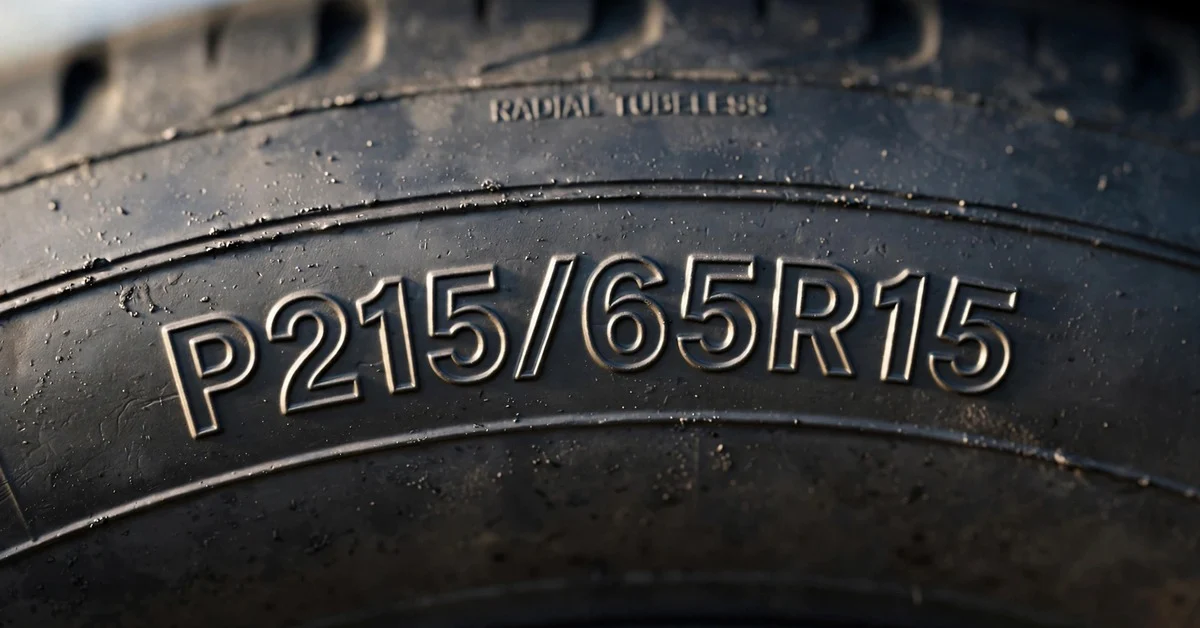
To read a tire size like P215/65R15: P means passenger vehicle, 215 is the section width in millimeters, 65 means the sidewall height is 65% of the width, R stands for radial construction, and 15 is the wheel rim diameter in inches. Every marking on the tire sidewall follows this pattern, and once you learn the code, you can decode any tire size in seconds.
Look at any car tire’s sidewall and you will find a raised string like P215/65R15 96H. It looks like a part number, but it is really a compact specification sheet: vehicle class, tire width, sidewall height, construction type, and the wheel it fits — plus a load index and speed rating for weight capacity and maximum speed.
Tire Size Marking Quick-Reference Chart
| Marking | Meaning | Example values |
|---|---|---|
| Leading letter | Service type (vehicle class) | P = passenger, LT = light truck, ST = trailer, T = temporary spare |
| First number | Section width in millimeters | 185, 195, 205, 215, 225, 235, 245 |
| Slash number | Aspect ratio — sidewall height as % of width | 45, 55, 60, 65, 70, 75 |
| Middle letter | Construction type | R = radial, D = diagonal (bias-ply) |
| Last number | Rim diameter in inches | 14, 15, 16, 17, 18, 20, 22 |
| Load index | Max weight capacity code | 91, 96 |
| Speed rating | Max safe speed code | S = 112 mph, H = 130 mph, V = 149 mph |
In P215/65R15, 215 is the width in millimeters, 65 is the aspect ratio, and 15 is the rim diameter in inches — a load index and speed rating usually follow to complete the specification.
What the “P” Means: Passenger Vehicle Tires
The leading letter is the service type — the vehicle class the tire was built for. P stands for passenger, covering cars, minivans, crossovers, and small SUVs. You will also see LT for light truck, ST for special trailer, and T for temporary spares. Some tires, often European brands, skip the letter; a size like 205/55R16 is a metric tire that usually functions like a P-metric one. Match the service type to your vehicle, because an LT tire has a stiffer, heavier carcass than a P tire, so swapping them changes ride and load capacity.
What “215” Means: Section Width in Millimeters
The first number is the section width — the tire’s widest point from sidewall to sidewall — in millimeters. In P215/65R15, 215 means the tire is 215 millimeters wide, about 8.46 inches. For a sense of scale, a standard credit card is 85.6 mm wide (see the exact specs in our credit-card dimensions guide), so a 215 mm tire is roughly two and a half credit cards across. Wider generally means more grip but slightly more rolling resistance.
What “65” Means: Aspect Ratio (Sidewall Height)
The number after the slash is the aspect ratio: the sidewall height as a percentage of the section width. In P215/65R15, 65 means the sidewall is 65% of 215 mm, about 139.75 mm (roughly 5.5 inches) from rim edge to tread. A higher number means a taller, cushier sidewall; a lower number like 45 means a short, stiff sidewall typical of sporty low-profile tires. Aspect ratio is a ratio, not a fixed height — it is why two tires with the same width can be very different heights.
What “R” Means: Radial Construction
The letter before the final number describes the internal cord layout. R stands for radial, meaning the ply cords run at roughly 90 degrees to the direction of travel. Nearly every passenger tire on the road today is radial, since radial construction gives better tread life, fuel economy, and handling than the older diagonal (D, bias-ply) design. You may still find D on trailer or motorcycle tires, but for cars, R is the standard.
What “15” Means: Rim Diameter in Inches
The last number is the wheel rim diameter the tire fits, in inches. In P215/65R15, 15 means the tire mounts on a 15-inch wheel — and nothing else. This measurement must match your wheels exactly; a 15-inch tire cannot seat on a 14- or 16-inch rim. The width is metric while the rim is in inches simply because that is how the industry standard evolved.
Load Index and Speed Rating
After the rim number you will usually see a load index and speed rating, such as 96H. The load index codes the maximum weight each tire can support (96 corresponds to about 1,565 pounds); the speed rating letters the maximum sustained speed (H corresponds to 130 mph). Never replace a tire with one rated for a lower load index than the original. Your vehicle’s recommended values are on the driver’s door jamb placard — always check it before buying.
More Markings: DOT, UTQG, and M+S
Beyond the size code, the sidewall carries more information. The DOT code ends with a four-digit manufacture date (3225 means the 32nd week of 2025). UTQG grades show treadwear, traction, and temperature — a treadwear of 400 versus 200 roughly suggests double the tread life. M+S marks mud-and-snow capability, and the three-peak mountain snowflake symbol marks a true winter tire. Maximum inflation pressure is also molded in, though for daily driving you should follow the door placard, not the tire’s maximum.
Common Tire Sizes Compared
| Tire size | Overall diameter | Section width | Typical vehicles |
|---|---|---|---|
| P185/65R15 | ~24.5 in | 185 mm (~7.3 in) | Compact cars, older sedans |
| P195/65R15 | ~25.0 in | 195 mm (~7.7 in) | Compact sedans, small hatchbacks |
| P205/55R16 | ~24.9 in | 205 mm (~8.1 in) | Midsize sedans, sporty compacts |
| P215/65R15 | ~26.0 in | 215 mm (~8.5 in) | Small crossovers, compact SUVs |
| P215/60R16 | ~26.1 in | 215 mm (~8.5 in) | Midsize sedans, crossovers |
| P225/65R17 | ~28.5 in | 225 mm (~8.9 in) | Midsize crossovers, small SUVs |
| P235/55R18 | ~28.2 in | 235 mm (~9.3 in) | Midsize SUVs, performance sedans |
| LT245/75R16 | ~30.5 in | 245 mm (~9.6 in) | Pickup trucks, large SUVs |
Rim Diameters and What They Fit
| Rim diameter | Overall feel | Where you usually find it |
|---|---|---|
| 14-inch | Smallest common size | Older compact cars |
| 15-inch | Balanced comfort | Compact cars, small crossovers |
| 16-inch | All-round standard | Midsize sedans, crossovers |
| 17-inch | Sportier stance | Crossovers, midsize SUVs |
| 18-inch | Low-profile look | Midsize SUVs, performance cars |
| 20-inch | Large and bold | Full-size SUVs, trucks |
| 22-inch | Largest common factory size | Large SUVs, pickup trucks |
1. P185/65R15 (~24.5 inches overall)
The P185/65R15 pairs a 185 mm width with a 65 aspect ratio, giving a sidewall about 120 mm tall and an overall diameter of roughly 24.5 inches. This size was common on compact cars and older economy sedans, where the tall sidewall delivers a soft ride over rough pavement. The narrower tread also tends to cut through rain with less hydroplaning risk than a very wide tire, and as a long-running standard size, replacements are widely available and usually modestly priced.
2. P195/65R15 (~25.0 inches overall)
The P195/65R15 is a workhorse of the compact-sedan world: 195 mm wide, a 65-series sidewall of about 127 mm, and roughly 25 inches of overall diameter. Countless popular cars have worn this size, so replacement options are wide and prices stay competitive. The tall sidewall keeps the ride comfortable while the moderate width balances grip and fuel efficiency. If you are learning how to read tire size, this may be the example on your own car — check the door jamb placard to confirm.
3. P205/55R16 (~24.9 inches overall)
The P205/55R16 combines a wider 205 mm tread with a shorter 55-series sidewall and a 16-inch rim, landing at about 24.9 inches overall — nearly identical to the taller 15-inch sizes above. That is plus-sizing in action: a bigger wheel with a shorter sidewall keeps the rolling diameter the same. This size suits midsize sedans and sporty compacts with sharper steering response, at the cost of a firmer ride since there is less sidewall to absorb bumps.
4. P215/65R15 (~26.0 inches overall)
This is our headline size: P215/65R15 reads as P for passenger, 215 mm section width, 65 meaning the sidewall is 65% of the width, R for radial, and 15 for the rim inches — a load index and speed rating follow to complete the spec. Overall diameter is roughly 26 inches. This size is a favorite for small crossovers and compact SUVs, where the tall 139.75 mm sidewall adds ground clearance and cushioning. To verify the width yourself, our tape measure guide shows how to read metric graduations — just measure across the tire’s widest point.
5. P215/60R16 (~26.1 inches overall)
The P215/60R16 keeps the 215 mm width but drops to a 60 aspect ratio on a 16-inch rim, for an overall diameter of about 26.1 inches — almost identical to the P215/65R15. Automakers often offer both as equivalent factory options, since matching overall diameter keeps the speedometer accurate and gearing unchanged. The 60-series version looks slightly sportier with its shorter sidewall and larger wheel. Comparing aspect ratios is the quickest way to tell whether two same-width tires are really the same height.
6. P225/65R17 (~28.5 inches overall)
The P225/65R17 combines a 225 mm width, a tall 65-series sidewall of about 146 mm, and a 17-inch rim for roughly 28.5 inches overall — about two and a half inches taller than the 26-inch sizes above, a difference you feel in ground clearance and ride height. This size is extremely common on midsize crossovers and small SUVs. Replacements are easy to find, and the generous sidewall works well in all-season and light winter duty.
7. P235/55R18 (~28.2 inches overall)
The P235/55R18 is a classic plus-size setup: 235 mm wide with a 55-series sidewall on an 18-inch rim, totaling roughly 28.2 inches — close to the P225/65R17 despite the much larger wheel, because the lower aspect ratio balances the height. You will find it on midsize SUVs and performance sedans that want a wide footprint and crisp handling. The shorter sidewall means a firmer ride and more vulnerability to pothole damage, worth knowing if your roads are rough.
8. LT245/75R16 (~30.5 inches overall)
The LT245/75R16 is built for work: LT marks a light-truck tire with a heavier-duty carcass for pickups and large SUVs. Its 245 mm width and tall 75-series sidewall on a 16-inch rim yield about 30.5 inches overall — the tallest in our comparison. That height gives real ground clearance and an air volume that handles heavy loads well. LT tires run higher pressures and ride more firmly than P tires, so never substitute one for the other unless your vehicle’s placard allows it.
9. 14-Inch Rims
Fourteen-inch rims are the smallest common factory size still in regular use, mostly on older compact cars and past-decade economy models. Tires here are usually narrow with tall sidewalls — think 175/70R14 — which makes for a soft ride and cheap replacements, though new cars rarely use them as brake sizes have grown. A tire size ending in 14 belongs to a small, light car where comfort and economy matter most.
10. 15-Inch Rims
Fifteen-inch rims are the sweet spot for compact cars and small crossovers: affordable tires and a comfortable ride. A 15-inch wheel with a 65-series tire gives a tall sidewall that shrugs off potholes, and these tires are among the cheapest to replace. Sizes like P195/65R15 and P215/65R15 dominate this category. For drivers who prioritize low running costs and ride comfort over appearance, 15-inch wheels remain one of the smartest choices.
11. 16-Inch Rims
Sixteen-inch rims are the all-round standard for midsize sedans and crossovers, balancing looks, comfort, and cost. Typical pairings like P205/55R16 and P215/60R16 keep overall diameter in the 25–26 inch range. The slightly larger wheel allows bigger brakes than a 15-inch setup, while the 60-series sidewall still cushions decently. Because so many vehicles use 16-inch wheels, tire selection is enormous and competition keeps prices reasonable.
12. 17-Inch Rims
Seventeen-inch rims step into sportier territory, common on crossovers, midsize SUVs, and upper-trim sedans. With tires like P225/65R17, the wheel fills the wheel well more aggressively while the 65-series sidewall preserves a comfortable ride. Many drivers consider 17 inches the visual sweet spot: noticeably larger than 16s without the harshness or cost penalty of 18s and up. Replacement tires are widely available, though prices start climbing over smaller sizes.
13. 18-Inch Rims
Eighteen-inch rims deliver the low-profile look, typically paired with 55- or 60-series tires such as P235/55R18. They are standard on many midsize SUVs and performance sedans, where the shorter sidewall sharpens steering response and fills out the wheel arches. The downside is real: less sidewall means a firmer ride, a higher risk of wheel damage from potholes, and noticeably more expensive replacements. A size ending in 18 looks sporty but rides with less forgiveness.
14. 20-Inch Rims
Twenty-inch rims are the bold choice for full-size SUVs and trucks, where the massive wheel is part of the vehicle’s presence. Tires for 20-inch wheels usually run 50- to 55-series sidewalls to keep overall diameter sensible, with wide treads (often 265 mm and up) to match the vehicle’s weight. Everything costs more: tires, wheels, and repairs on rough roads. Drivers accept the trade-off for the look and the handling stability a wide, short-sidewall tire gives a heavy vehicle.
15. 22-Inch Rims
Twenty-two-inch rims are the largest common factory size, found on top-trim large SUVs and pickup trucks. The tires are wide with low aspect ratios, and they represent the extreme end of the comfort-versus-style trade-off: minimal sidewall cushioning, maximum pothole exposure, and premium replacement prices. For scale, a 22-inch rim alone is nearly half the diagonal of a 55-inch TV screen — with the tire mounted, the assembly can exceed 33 inches tall. A size ending in 22 means maximum visual impact with minimum ride forgiveness.
Frequently Asked Questions
What does the R mean in a tire size?
The R stands for radial, describing how the tire’s internal ply cords are arranged — at roughly 90 degrees to the direction of travel. Nearly all modern passenger tires use radial construction because it delivers better tread life, fuel efficiency, and handling than the older diagonal (bias-ply) design, which is marked with a D instead.
Can I put a different tire size on my car?
You can, within limits: the rim diameter must match your wheels exactly, and the overall diameter should stay within about 3% of the original so the speedometer and gearing stay accurate. Never use a tire with a lower load index than your vehicle’s placard specifies, and when in doubt, check the door jamb sticker or ask a tire professional.
How do I find the right tire size for my vehicle?
Check the driver’s door jamb placard first — it lists the manufacturer’s recommended size, load index, and speed rating. The owner’s manual has the same information, and the size molded into your current tires’ sidewalls confirms what is actually fitted. These three sources should always agree.
What do the numbers after the rim size mean?
The load index and speed rating follow the rim number, such as 96H in P215/65R15 96H. The load index (96) is a code for the maximum weight each tire can carry, and the speed rating (H) is a letter code for the maximum sustained speed. Both must meet or exceed your vehicle’s original specifications for safe operation.
Final Thoughts
Reading a tire size is simply a matter of knowing the code: P for passenger, 215 mm of section width, 65 meaning the sidewall stands 65% as tall as the tire is wide, R for radial construction, and 15 inches of rim diameter, with a load index and speed rating to finish the specification. Once that pattern clicks, every sidewall becomes readable at a glance, and you can compare sizes, rim diameters, and aspect ratios with confidence. Whether you are replacing worn tires, shopping for winter rubber, or just curious about the numbers on your own car, this knowledge helps you make safer, better-informed choices. Keep your door jamb placard as the final authority, and the sidewall will never look like a secret code again.

I’m Marcus Kane, a measurement content specialist at MeasuresIt.com. I write clear, accurate, and practical articles about measurements, dimensions, conversions, and everyday size comparisons, making complex topics simple and easy to understand.