Curtain Sizes Chart: 63, 84 & 96 Inch Panel Lengths Explained
Shopping for curtains gets much simpler once you know the standard numbers: standard curtain panels come in 63, 84, 96 and 108 inch lengths, and each panel is usually 40 to 54 inches wide. That one line answers most of the confusion, but picking the right size is really about three things: the panel length, where you hang the rod, and how full the fabric looks when drawn.
Ready-made window treatments are built around these standard sizes because they fit the way most homes are built. An 84-inch panel, for example, lands just right on a room with roughly 8-foot ceilings when the rod is mounted the standard way. Before you buy anything, grab a tape measure — and if the markings confuse you, this guide to how to read a measuring tape will get you up to speed. Measure your window’s width, then multiply by 1.5 to 2 times to get the combined panel width for a full, gathered look. That 1.5–2x rule is the most useful sizing guideline in window treatments: it keeps curtains from looking stretched flat when closed.
The sizing rules worth memorizing are simple. Mount the curtain rod 4–6 inches above the window frame, and choose a rod that is 8–12 inches wider than the window itself. Panels should total 1.5–2x the window width for a proper gathered look. These four numbers — lengths 63/84/96/108 inches, widths 40–54 inches per panel, rod height 4–6 inches above the frame, rod width 8–12 inches beyond the window, and 1.5–2x fullness — cover nearly every standard curtain decision.
Quick Curtain Size Conversion Chart: Inches to Centimeters
Curtain shopping sometimes mixes inches and centimeters, especially with online retailers. Here are the standard lengths converted exactly:
| Length (inches) | Length (cm) | Typical use |
|---|---|---|
| 63 in | 160.0 cm | Sill or apron length |
| 84 in | 213.4 cm | Floor length, standard ceilings |
| 96 in | 243.8 cm | Floor length, taller ceilings |
| 108 in | 274.3 cm | Tall windows or puddled length |
For widths: 40 in = 101.6 cm and 54 in = 137.2 cm, so a standard panel runs about 101.6–137.2 cm wide. Rod placement converts too: 4–6 inches above the frame is roughly 10.2–15.2 cm, and 8–12 inches wider than the window is about 20.3–30.5 cm.
How to Measure Your Window for Curtains
Start with the rod, not the window. Decide where the rod will sit — typically 4–6 inches above the window frame and 8–12 inches wider than the frame on each side — then measure from that rod position down to where you want the hem to fall: the sill, the apron below it, or the floor. That top-to-bottom number is your target panel length, and you simply round to the nearest standard size (63, 84, 96 or 108 inches).
For width, measure the window frame and multiply by 1.5–2x. A 40-inch window therefore wants roughly 60–80 inches of combined panel width, which usually means two 40-inch panels. Terms like sill (the ledge at the bottom of the window), apron (the trim beneath the sill), rod pocket, grommet and blackout lining describe how a curtain hangs or blocks light, but they don’t change the sizing math.
Standard Curtain Lengths at a Glance
| # | Length | Where it hangs | Works best for |
|---|---|---|---|
| 1 | 63 in | Sill or apron | Kitchens, bathrooms, kids’ rooms |
| 2 | 84 in | Just off the floor | Standard rooms, ~8-ft ceilings |
| 3 | 96 in | Just off the floor | Taller ceilings, living rooms |
| 4 | 108 in | Floor or puddled | Grand windows, ~10-ft ceilings |
| 5 | Café, ~36 in | Bottom half of window | Kitchens, farmhouse style |
| 6 | Tier, ~45 in | Sill length, paired | Kitchen and bath privacy |
| 7 | Valance, ~18–20 in | Across the top | Layering over blinds |
| 8 | Puddle, ~108+ in | 2–4 in pooling on floor | Formal living and dining rooms |
Curtain Panel Widths at a Glance
| # | Panel width | Covers a window up to ~ | Best use |
|---|---|---|---|
| 9 | 40 in (narrow) | 25–27 in | Small or narrow windows |
| 10 | 52 in (standard) | 35–40 in | Typical single windows |
| 11 | 54 in (wide) | 36–40 in | Standard double windows |
| 12 | 100+ in (extra wide) | 65–70 in | Sliders, picture windows |
| 13 | Pair (two panels) | 54–72 in combined | Most standard windows |
| 14 | Single panel | Narrow side windows | Decorative or one-side hanging |
| 15 | Custom width | Tailored to fit | Odd-sized or arched windows |
1. 63-Inch Panels (Sill and Apron Length)
Sixty-three inches is the classic short curtain length. With the rod mounted the usual 4–6 inches above the frame, the hem lands right at the window sill or just below it on the apron trim — which is exactly why this length is sometimes called apron length. It is the practical choice wherever long fabric would get in the way: kitchens, bathrooms, laundry rooms, children’s rooms, and anywhere a curtain would drape across a radiator or furniture. Because the panels end above the floor, 63-inch curtains also stay cleaner in busy areas.
2. 84-Inch Panels (The Standard Floor Length)
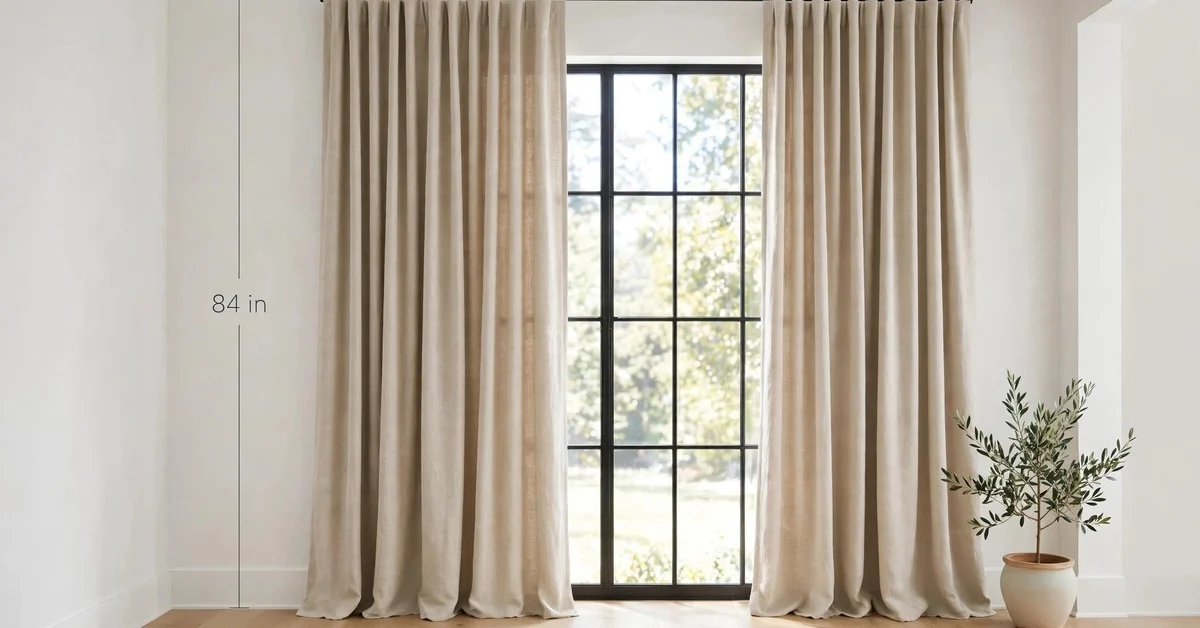
Eighty-four inches is the workhorse of curtain lengths and the size most people mean when they say “floor-length curtains.” For a quick sense of scale, a standard interior door is about 80 inches tall — see standard door sizes for reference — so an 84-inch panel is only slightly taller than a doorway. With the rod 4–6 inches above the frame, 84 inches reaches the floor in rooms with roughly 8-foot ceilings, which describes a huge share of homes. If your ceilings are a standard height and you want the classic look of curtains that just kiss the floor, 84 inches is almost certainly your answer. It is also the easiest length to shop for, since nearly every ready-made line stocks it.
3. 96-Inch Panels (Floor Length for Taller Ceilings)
When 84 inches leaves an awkward gap above the floor, 96-inch panels are the next step up. They give you floor-length coverage in rooms with taller ceilings — roughly 9 feet — or simply when you want the rod mounted a little higher for a grander look. Hanging the rod closer to the ceiling and using 96-inch panels is a well-known way to make windows and rooms feel taller, because the eye follows the long vertical line. Choose whether the hem just brushes the floor, breaks slightly with a small fold, or ends about half an inch above it; each gives a slightly different mood.
4. 108-Inch Panels (Tall Windows and Dramatic Length)
One hundred eight inches is the longest common ready-made length, made for tall windows, rooms with ceilings around 10 feet, and anyone who wants a dramatic floor-to-ceiling effect. Mount the rod high — still roughly 4–6 inches above the frame, or higher for tall walls — and the long panels create an unbroken vertical sweep that can make a room feel noticeably grander. On standard-height walls, 108-inch panels also double as the easiest way to get a puddle length: instead of buying custom fabric, you let the extra inches pool softly on the floor.
5. Café Curtains (~36 Inches, Bottom-Half Coverage)
Café curtains typically run around 24–45 inches long, with about 36 inches being the most common, and they cover only the lower half of the window. Hung on a tension or café rod at about the window’s midpoint, they give privacy at eye level while leaving the top half open for daylight — the classic kitchen and farmhouse look. Because they are short, café curtains usually come in narrower widths and lighter fabrics, and the fullness rule still matters: you want enough gathered width that the lower half doesn’t look skimpy. They are one of the few curtain types where measuring to the window’s middle, rather than to the floor, is the whole point.
6. Tier Curtains (~45 Inches, Layered Pairs)
Tier curtains are the close cousin of café curtains: short panels, usually around 45 inches, sold as overlapping pairs that dress the lower portion of the window. The difference is mostly in styling — tiers often come as two panels that meet in the middle and may pair with a matching valance on top, while café curtains are frequently a single panel on a mid-window rod. Tiers are popular in kitchens and bathrooms where privacy matters but light is welcome. Two overlapping panels need a bit more combined width than one — aim for the full 1.5–2x coverage so the overlap looks intentional rather than stretched.
7. Valances (~18–20 Inches, Top-Only Treatment)
Valances are short decorative treatments, usually around 18–20 inches long, that span only the top of the window. They hide hardware, soften the top line of blinds or shades, and add a finished look without committing to full-length fabric. A valance is often layered over blinds, roller shades or even another set of curtains, which is why its sizing is forgiving — it just needs to be wide enough to cover the rod and a little beyond, roughly the window width plus the standard 8–12 inches of rod overhang. Because they never reach the sill, valances work in every room and pair naturally with café or tier curtains below.
8. Puddle Length (~108+ Inches, Fabric Pooling on the Floor)
Puddle length means the curtain is intentionally 2–4 inches longer than the floor measurement, so the fabric pools softly on the ground. It is a formal, romantic look suited to living rooms and dining rooms with minimal foot traffic — anywhere the pooled fabric won’t be stepped on constantly. On standard ceilings, reaching a true puddle usually takes 108-inch panels or longer; shorter standard lengths simply can’t spare the extra inches. Use lighter fabrics if you want a gentle spill, and keep the 1.5–2x width rule in mind, because a skimpy panel looks even thinner when it puddles.
9. 40-Inch Narrow Panels
Forty inches is about as narrow as standard curtain panels get, and these slim panels exist for small windows, narrow sidelights and tight spaces where a full-width panel would overwhelm the wall. They are also handy as outer side panels flanking a wider treatment — for example, a narrow 40-inch panel on each side of a picture window can frame it without adding bulk. With the 1.5–2x rule, a single 40-inch panel covers a window of roughly 25–27 inches wide, so most standard windows need two.
10. 52-Inch Standard Panels
Fifty-two inches is the most common ready-made panel width you’ll see on store shelves — the default that most curtain lines are built around. A single 52-inch panel covers a window up to about 35–40 inches wide with proper fullness, which handles a typical single window nicely. For a standard double window of roughly 60–70 inches, two 52-inch panels give you about 104 inches of fabric — right in the 1.5–2x sweet spot.
11. 54-Inch Wide Panels
At 54 inches, you’re at the wide end of the standard per-panel range (40–54 inches), and these panels give noticeably more coverage than the 52-inch default. To picture the size, a 55-inch TV is about 48 inches wide overall — you can check 55-inch TV dimensions for the exact reference — so one 54-inch panel is roughly as wide as a large television. Two wide panels combine to about 108 inches of fabric, which dresses windows up to roughly 70 inches wide with full, luxurious gathers. Wide panels are a smart pick when you want fewer panels overall or a richer look on a prominent window.
12. 100-Inch Extra-Wide Panels
When a window stretches past what pairs of standard panels can cover — think sliding glass doors, wide picture windows or wall-to-wall glass — 100-inch and wider panels take over. A single 100-inch panel covers a window roughly 65–70 inches wide at full 1.5–2x fullness; most very wide windows need two of these panels. For scale, one extra-wide panel spans noticeably wider than a king bed, which is only about 76 inches wide — see bed sizes in inches for the comparison.
13. Curtain Pairs (Two Panels)
Most ready-made curtains are sold as pairs — two panels packaged together — because two panels are what most windows actually need. A pair of 54-inch panels gives you 108 inches of fabric, which covers windows roughly 54–72 inches wide at the standard 1.5–2x fullness. Pairs also solve the symmetry problem: one panel per side frames the window evenly and lets you draw the curtains from either direction. When a listing says “pair,” the width quoted is usually per panel, not combined, so double-check — a “54-inch pair” means two 54-inch panels.
14. Single Panels
Single panels are sold individually and suit situations where symmetry isn’t the goal. A narrow window beside a door, a small bathroom window, or a decorative panel hung to one side of a window all work fine with one panel. Singles are also the standard format for extra-wide panels and many specialty treatments. The sizing math doesn’t change: the single panel still needs to hit 1.5–2x of whatever window area it covers, or it will look flat and stretched.
15. Custom-Width Panels
When windows fall outside standard sizes — very narrow, extra wide, arched, or an unusual height — custom-width panels fill the gap. Custom orders let you specify exact width and length, so you can hit the 1.5–2x fullness rule precisely instead of compromising between ready-made sizes. The trade-off is cost and lead time: custom panels typically cost noticeably more than ready-made and can take weeks to arrive.
FAQs
What curtain length do I need for an 8-foot ceiling?
With the rod mounted 4–6 inches above the frame, an 84-inch panel reaches the floor in rooms with roughly 8-foot ceilings. Prefer the rod closer to the ceiling for a taller look? Step up to 96-inch panels.
How far above the window frame should I hang the curtain rod?
Mount the rod 4–6 inches above the window frame, and choose a rod 8–12 inches wider than the window. This placement makes the window look larger and gives the panels room to stack neatly on the sides when open.
How wide should my curtains be?
Your combined panel width should be 1.5–2x the width of your window. A 50-inch window therefore needs about 75–100 inches of fabric — typically two 40 or 52-inch panels. Skimping on width is the most common curtain sizing mistake.
Should curtains touch the floor?
A “kiss” — the hem just brushing the floor — is the classic tidy choice. A slight “break” with a small fold looks relaxed, while a 2–4 inch “puddle” is formal and dramatic. Ending about half an inch above the floor works best in high-traffic or dusty rooms.
Final Thoughts
Curtain sizing comes down to a handful of reliable numbers: lengths of 63, 84, 96 or 108 inches, panels 40–54 inches wide each, the rod 4–6 inches above the frame and 8–12 inches wider than the window, and 1.5–2x fullness for a proper gathered look. Measure from your planned rod position — not from the window frame — and round to the nearest standard length. Most homes with standard ceilings will land on 84-inch panels, taller rooms on 96, and grand windows on 108, with café curtains or tiers handling kitchens and other short-window spots. Buy pairs for symmetry, keep the width generous rather than exact, and decide on the hem style — kiss, break or puddle — before you measure. Get these basics right and your curtains will look tailored and intentional rather than improvised.

I’m Marcus Kane, a measurement content specialist at MeasuresIt.com. I write clear, accurate, and practical articles about measurements, dimensions, conversions, and everyday size comparisons, making complex topics simple and easy to understand.