Standard Dining Table Size: Seats, Dimensions & Spacing
Introduction
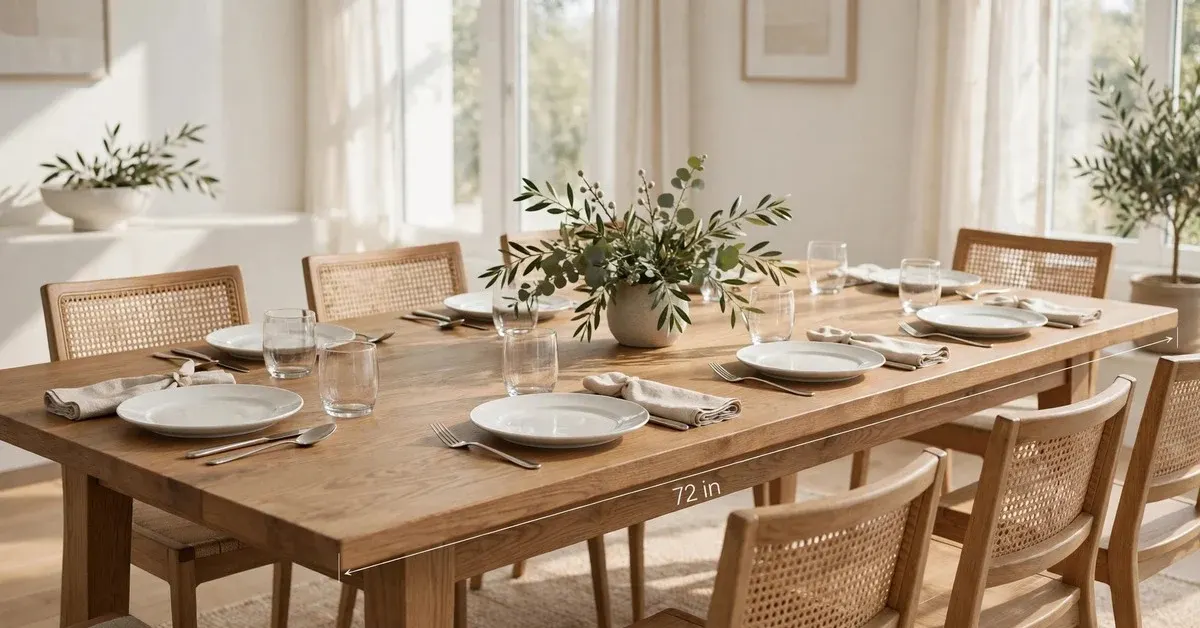
Buying a dining table that is too big for the room is one of the most common furniture mistakes people make. A standard 6-seat dining table measures about 72 inches long and 36 inches wide, stands 30 inches tall, and needs roughly 24 inches of table width per person. That single set of numbers answers most dining table size questions before you ever pull out a tape measure.
The standard dining table size has stayed nearly the same for decades because it is built around the human body. Elbows need room, knees need clearance, and chairs need space to pull out. Once you know the standard dining table dimensions for 4, 6, and 8 seats, plus the spacing rules around them, you can size any dining room, kitchen nook, or open-plan space with confidence. This guide walks through every common size, compares them to everyday objects, and ends with quick ways to estimate space without any tools at all.
Standard Dining Table Size Chart
| Seats | Length | Width | Height | Metric (L × W) |
|---|---|---|---|---|
| 4 | 48 in | 30 in | 30 in | ≈122 × 76 cm |
| 6 | 72 in | 36 in | 30 in | ≈183 × 91 cm |
| 8 | 96 in | 40 in | 30 in | ≈244 × 102 cm |
| 6 (round) | 48 in diameter | — | 30 in | ≈122 cm diameter |
A few spacing numbers matter just as much as the table itself. Plan on about 24 inches of table edge per diner, roughly 36 inches of clearance behind chairs for walking and pulling seats out, and a standard table height of 30 inches. In metric terms, that is about 61 cm per person, 91 cm of clearance, and 76 cm of height.
Common Objects That Are About Dining Table Dimensions
| Object | Approximate Size |
|---|---|
| 1. A 55-inch TV (width) | ≈48 in — same as a 4-seat table’s length |
| 2. A standard bathtub (length) | ≈60 in — a bit shorter than a 6-seat table |
| 3. A queen bed (width) | ≈60 in — between 4-seat and 6-seat table lengths |
| 4. A standard interior door (height) | ≈80 in — a little longer than a 6-seat table |
| 5. A kitchen counter (height) | ≈36 in — same as a 6-seat table’s width |
| 6. A standard office desk (height) | ≈30 in — same as dining table height |
| 7. A counter stool (seat height) | ≈24 in — same as the width given per diner |
| 8. A yardstick | 36 in — same as the clearance behind chairs |
More Everyday Items Around Dining Table Sizes
| Object | Approximate Size |
|---|---|
| 9. A ping-pong table (width) | ≈60 in — close to a 6-seat table’s length |
| 10. An 8-foot pool table (length) | ≈100 in — just over an 8-seat table’s length |
| 11. A dinner plate (diameter) | ≈10–11 in — fits easily in a 24-in place setting |
| 12. A standard placemat | ≈12 × 18 in — three fit across a 36-in table width |
| 13. A dining chair (seat height) | ≈18 in — about 12 in below the tabletop |
| 14. An acoustic guitar (length) | ≈40 in — same as an 8-seat table’s width |
| 15. A standard dishwasher (width) | 24 in — same as the space planned per diner |
How Big Is a Standard Dining Table?
Picture a 6-seat dining table in an empty room. At 72 inches long, it stretches a full 6 feet, which is about the height of a tall adult lying down. The 36-inch width gives each side of the table 18 inches of depth per diner, enough for a dinner plate, a glass, and a little elbow room without anyone’s plate hanging off the edge.
To feel the difference between sizes, compare a 4-seat table with an 8-seat one. A 4-seat table at 48 inches long is a full 2 feet shorter than the 6-seat standard, which makes it fit neatly into small kitchens and apartment dining nooks. An 8-seat table at 96 inches long is a full 8 feet, slightly longer than a standard interior door is tall, and it needs a genuinely large dining room to breathe.
Easy ways to estimate dining table space in everyday life:
- Your stride: An average adult step covers about 30 inches, so two and a half steps is roughly a 6-seat table’s length.
- A yardstick: Three yardsticks laid end to end make 108 inches, close to an 8-seat table’s 96-inch length.
- Floor tiles: Standard 12-inch tiles are perfect gauges — six tiles equal a 72-inch table.
- Your arm span: Most adults span about 66 to 72 inches fingertip to fingertip, almost exactly a 6-seat table’s length.
- A doorway: Standard interior doorways are about 36 inches wide, matching a 6-seat table’s width and the recommended clearance behind chairs.
- Sheet of paper: A standard sheet is 11 inches long, so about six and a half sheets span a 72-inch table.
1. A 55-Inch TV Is About 48 Inches Wide
A 55-inch TV measures roughly 48 inches wide without its stand, which is almost exactly the length of a standard 4-seat dining table. If you have ever wall-mounted or unboxed one of these televisions, you already have a feel for how long 48 inches is. That length seats two people per side comfortably, with each diner getting the recommended 24 inches of elbow room. Picturing your TV on its side is a quick way to judge a 4-seat table’s footprint.
2. A Standard Bathtub Is About 60 Inches Long
Most alcove bathtubs measure about 60 inches long, which sits neatly between a 4-seat table’s 48 inches and a 6-seat table’s 72 inches. If you can picture your bathtub, you can picture the jump from a small table to a medium one. The tub is a foot longer than a 4-seat table and a foot shorter than a 6-seat table, so it works as a mental midpoint. This is handy when you are deciding whether your room can handle the next size up — imagine adding a foot to each end of your bathtub.
3. A Queen Bed Is About 60 Inches Wide
A queen-size mattress is about 60 inches wide and 80 inches long, making its width another useful stand-in for the middle of the dining table range. Sixty inches is exactly 5 feet, a round number that is easy to visualize if you have ever moved a mattress through a hallway. Compared with dining tables, a queen bed’s width is a foot wider than a 4-seat table and a foot narrower than a 6-seat table.
4. A Standard Interior Door Is About 80 Inches Tall
Interior doors in most homes stand about 80 inches tall, which is just 8 inches longer than a 6-seat dining table laid on its side. Doors are something everyone walks through daily, so the height is deeply familiar even if you have never measured one. If a 6-seat table feels abstract, picture a door lying flat and trim a little off each end. Door widths matter too — a standard 36-inch doorway matches both the width of a 6-seat table and the clearance recommended behind dining chairs, which you can read more about in our guide to standard door size.
5. A Kitchen Counter Is About 36 Inches High
Standard kitchen counters stand about 36 inches off the floor, the exact same number as the width of a 6-seat dining table. Next time you are in the kitchen, look at the counter edge and imagine that height lying flat — that is your table’s width. This also explains why 36 inches of clearance behind dining chairs feels right: it is a full counter-height of walking space, enough for someone to pass behind a seated diner without squeezing. The number 36 shows up everywhere in dining room planning because it works so well for human bodies.
6. A Standard Office Desk Is About 30 Inches Tall
Most office desks and writing tables stand about 30 inches high, identical to the standard dining table height. That shared height is no accident — 30 inches puts the work surface at a comfortable level for a seated adult, whether they are typing or eating. If you already own a desk, sit at it and notice where your elbows rest; a dining table will feel exactly the same. Counter-height tables exist at 36 inches, but the classic dining table sticks with 30 because it pairs with standard 18-inch dining chair seats.
7. A Counter Stool Seat Is About 24 Inches High
A typical counter-height stool has a seat about 24 inches off the floor, matching the 24 inches of table edge recommended per diner. It is a coincidence that makes the number easy to remember: the height you sit at for a casual kitchen counter equals the width of space you get at a proper dining table. Twenty-four inches per person is the minimum for comfort — any less and elbows start colliding over the mashed potatoes. When a table claims to seat six, check that it actually offers six times 24 inches of usable edge.
8. A Yardstick Is Exactly 36 Inches Long
A yardstick gives you the clearance number for free, since it measures exactly 36 inches. Hold one behind a dining chair and you are looking at the minimum walking space recommended between the table and the wall. Furniture stores love round numbers, and this one earns its place: with 36 inches behind every chair, people can push back, stand up, and walk past without a choreographed shuffle. If your dining room cannot spare a yardstick of space on each side, a smaller table or a bench on one side may serve you better.
9. A Ping-Pong Table Is About 60 Inches Wide
A regulation ping-pong table is 9 feet long and 5 feet wide, so its 60-inch width lands right in the middle of the dining table range. Many families already know this measurement because ping-pong tables often double as improvised dining surfaces during big gatherings. At 60 inches wide, it is a foot short of a 6-seat table’s length, which tells you how much room six real place settings actually need.
10. An 8-Foot Pool Table Is About 100 Inches Long
A standard 8-foot pool table measures about 100 inches long on the outside, just 4 inches more than an 8-seat dining table’s 96 inches. Pool halls make the scale obvious — an 8-foot table dominates a room, and an 8-seat dining table does the same in a home. Both need generous clearance around all sides, which is why designers suggest large, dedicated rooms for either one. If you have ever played pool, you know exactly how much floor space a 100-inch table demands, and an 8-seat dining setup asks for nearly the same.
11. A Dinner Plate Is About 10 to 11 Inches Across
Standard dinner plates measure roughly 10 to 11 inches in diameter, which is why the 24-inches-per-diner rule works so well. One plate takes up about 11 inches, leaving around 13 inches for glasses, shared dishes, and elbow room on each side. On a 36-inch-wide table, a plate on each side leaves about 14 inches of shared space down the middle for serving bowls. Thinking in plates is practical: lay out your actual plates on the floor to test whether a table’s stated seating capacity feels honest before you buy.
12. A Standard Placemat Is About 12 by 18 Inches
Placemats typically measure around 12 inches deep and 18 inches wide, and the math lines up neatly with standard table widths. Three 12-inch-deep placemats placed end to end cover exactly 36 inches — the full width of a 6-seat table. Two placemats side by side span 36 inches of length, which is why a 48-inch 4-seat table holds two settings per side with a little room to spare at each end.
13. A Dining Chair Seat Is About 18 Inches High
Dining chair seats usually sit about 18 inches off the floor, leaving roughly 12 inches of knee clearance under a 30-inch tabletop. That 12-inch gap is the comfort zone — enough room to cross your legs without bumping the table apron, but low enough that the table feels properly scaled. When chair and table heights drift apart, meals get awkward fast: too little clearance cramps knees, too much makes the table feel like a bar. If you are mixing chairs and tables from different sets, the 18-and-30 pairing is the combination to protect.
14. An Acoustic Guitar Is About 40 Inches Long
A full-size acoustic guitar stretches about 40 inches from end to end, matching the 40-inch width of an 8-seat dining table. It is a vivid comparison because almost everyone has seen a guitar leaning in a corner and registered its length. That 40-inch width is what lets an 8-seat table serve two people across from each other with real serving space down the middle. If a guitar looks long to you, an 8-seat table will look — and feel — substantial in your dining room, so measure twice.
15. A Standard Dishwasher Is 24 Inches Wide
Most built-in dishwashers are 24 inches wide, giving you a kitchen appliance that embodies the per-diner rule. Open your dishwasher and look at its width: that is the minimum table edge each seated person should get. Six dishwasher-widths side by side make 144 inches, which is exactly the usable edge of a 72-by-36-inch table serving three people per side.
How to Measure Your Space for a Dining Table
Before choosing a size, measure the room itself. A tape measure is the only tool you need: record the room’s length and width, then subtract 72 inches (36 inches of clearance on two sides) from each dimension to find the largest table that fits. For a 6-seat table, that means a room at least 12 feet long and 9 feet wide. If the numbers feel abstract, our 55-inch TV dimensions guide is a good reminder of how big 48 inches looks on a wall — the same length as a 4-seat table. Mark the table’s footprint on the floor with painter’s tape and live with it for a day before you commit.
Frequently Asked Questions
What is the standard dining table size for 6 people?
A standard 6-seat dining table is about 72 inches long, 36 inches wide, and 30 inches high. Allow roughly 24 inches of table edge per person and 36 inches of clearance behind the chairs on all sides.
How much space do you need behind dining chairs?
Plan for about 36 inches of clearance between the table edge and the wall or nearby furniture. This gives seated diners room to push back their chairs and lets others walk behind them comfortably.
What is the standard height of a dining table?
The standard dining table height is 30 inches from floor to tabletop. This pairs with dining chairs that have an 18-inch seat height, leaving about 12 inches of knee clearance underneath.
Can a 48-inch round table really seat 6 people?
Yes, a 48-inch round table can seat six, though it will feel cozy. Round tables use space efficiently since there are no corners, but each diner gets slightly less than the ideal 24 inches of edge — closer to 25 inches of circumference each, with tighter elbow room.
Final Thoughts
The standard dining table size comes down to a handful of numbers worth memorizing: 72 by 36 inches for six seats, 30 inches tall, 24 inches per diner, and 36 inches of clearance behind the chairs. With those figures in your head, you can judge any table in a showroom without pulling out a tape measure — picture a doorway lying flat for the length, a kitchen counter for the width, and a yardstick behind every chair. These dimensions have survived decades of furniture trends because they fit real bodies and real rooms. Measure your space, mark it with tape, trust the standards, and the table you bring home will fit the way it should from the very first meal. Keep this guide’s size chart handy, and sizing your next table becomes a five-minute job instead of a weekend of second-guessing.

I’m Marcus Kane, a measurement content specialist at MeasuresIt.com. I write clear, accurate, and practical articles about measurements, dimensions, conversions, and everyday size comparisons, making complex topics simple and easy to understand.