Frying Pan Sizes: 8, 10 & 12 Inch Skillets Explained
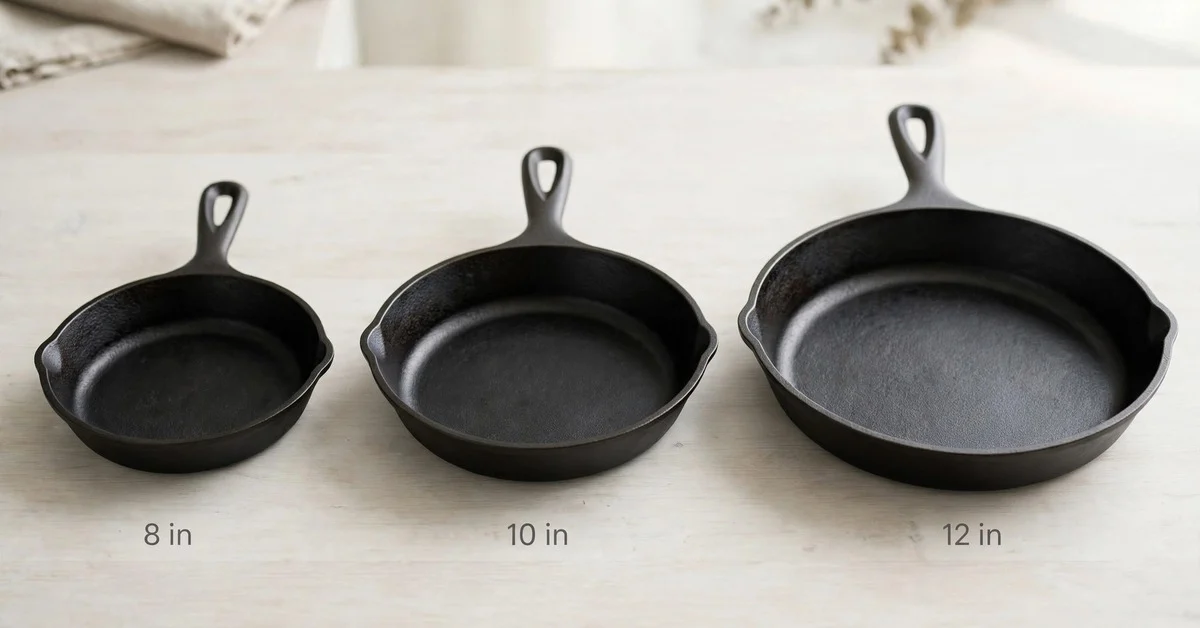
The 10-inch skillet is the most versatile frying pan size for everyday cooking. An 8-inch pan suits eggs and single servings, while a 12-inch skillet handles family meals — and those three sizes cover nearly every home cook’s needs.
Frying pan sizes can be confusing because the number on the box describes the diameter across the top rim, not the flat cooking surface where your food actually sits. Sloped sides — common on nonstick and stainless steel skillets — can shrink the usable area by an inch or two, so a 10-inch pan often gives you roughly 8 inches of flat searing space. That gap matters when you match a pan to a recipe, because overcrowding is the enemy of a good sear. Give ingredients breathing room and they brown; crowd them and they steam.
Most home kitchens thrive with three skillets: the small 8-inch for solo breakfasts, the mid-size 10-inch as the daily workhorse, and the large 12-inch for feeding a crowd. Beyond that core trio, mini 6-inch pans and oversized 14-inch models fill niche roles, while deep-sided sauté pans bridge the gap between a skillet and a pot.
Frying Pan Size Conversion Chart
| Nominal diameter | Diameter (cm) | Flat cooking surface (approx) | Best use |
|---|---|---|---|
| 8 in | ~20 cm | about 6 in (~15 cm) | eggs, single servings |
| 10 in | ~25 cm | about 8 in (~20 cm) | most versatile — everyday meals |
| 12 in | ~30 cm | about 10 in (~25 cm) | family meals |
| 14 in | ~35 cm | about 12 in (~30 cm) | large-batch cooking |
How Frying Pan Sizes Are Measured
Pan diameters are measured straight across the top rim, edge to edge — not across the base. That is why two pans labeled 10 inches can feel different: one with steeply sloped sides offers less flat space than one with nearly vertical walls. If you want to double-check a pan at home, lay a tape measure across the rim and read the distance edge to edge; if you are rusty on the markings, our guide on how to read a measuring tape walks through it step by step.
Depth matters too. Most skillet sides run 1.5-2.5 in deep, which keeps splatter contained while letting moisture escape so food can brown. Deeper sauté pans, with straighter and taller walls, hold sauces and braises that would overflow a shallow skillet.
Dish by Dish: Which Pan Size to Grab
| # | Dish | Best pan size | Why it fits |
|---|---|---|---|
| 1 | Fried eggs | 8 in | whites stay compact and set evenly |
| 2 | Grilled cheese | 8–10 in | bread fits snugly for even browning |
| 3 | Omelettes | 8 in | tight curve makes folding easy |
| 4 | Pancakes | 10 in | room for two or three at a time |
| 5 | Burgers | 10 in | two patties sear without crowding |
| 6 | Stir-fried vegetables | 12 in | wide surface keeps veggies searing, not steaming |
| 7 | Pan-seared chicken breasts | 12 in | four breasts fit with space between |
| 8 | One-pan pasta and family skillet meals | 12 in | holds sauce plus pasta for the whole table |
1. Fried Eggs
The 8-inch skillet is the classic egg pan: 8 in (eggs, single servings) is the size most cooks reach for first thing in the morning. Two or three eggs nestle close together instead of spreading paper-thin across a wide surface, so the whites set into tender, even rounds rather than crisping into lacy edges before the yolks warm through. A nonstick 8-inch makes sliding eggs onto toast effortless, while a well-seasoned cast iron version delivers gently crisped edges with that prized browned-butter flavor. Because the pan is small, it heats fast on a low flame, which is exactly what delicate eggs want.
2. Grilled Cheese
Grilled cheese wants a pan that hugs the bread. An 8-inch skillet cradles a standard sandwich so the edges toast at the same rate as the center, and the smaller surface means the knob of butter or mayo coats everything instead of pooling in empty corners. If you make double-decker or Texas-toast sandwiches, step up to the 10-inch for a comfortable fit. Medium heat is the sweet spot either way: hot enough to melt the cheese through, gentle enough to turn the bread deep golden instead of scorching it. A cast iron skillet is a favorite here for its steady, even heat.
3. Omelettes
Omelettes reward a snug pan, and the 8-inch skillet’s gentle curve is practically designed for folding. Beaten eggs spread into a thin, even layer that sets quickly, and the sloped walls let you tilt the pan and roll the omelette over its filling in one smooth motion — a French-style fold that is awkward in anything wider. Nonstick is the forgiving choice for beginners, since eggs release cleanly even with minimal fat. For a diner-style Denver omelette loaded with peppers, onions, and ham, the same 8-inch pan keeps the filling-to-egg ratio generous in every bite.
4. Pancakes
The 10-inch skillet hits the pancake sweet spot: wide enough to cook two or three silver-dollar or medium pancakes at once, small enough that the heat stays even across the whole surface. That evenness is what gives you uniformly golden tops instead of one pale pancake and one scorched one. Medium-low heat with a thin film of butter lets each pancake develop crisp edges and a fluffy center. A cast iron 10-inch is a pancake legend — once properly preheated, its heat retention keeps batch after batch browning identically, which matters when you are cooking for a hungry table.
5. Burgers
Two quarter-pound patties fit a 10-inch skillet with just enough space between them to develop a hard, flavorful sear. That gap is the whole game: patties need room for steam to escape, or the crust never forms. A stainless steel 10-inch excels here because it builds fond — those browned bits that deglaze into a quick pan sauce — while a cast iron version gives the deepest crust thanks to its heat retention. Press the patties once at the start, then leave them alone until the edges turn deeply browned before flipping. The 10-inch size keeps splatter manageable on the stovetop too.
6. Stir-Fried Vegetables
Stir-frying is a high-heat, fast-moving technique, and vegetables need wide-open space to sear rather than steam. The 12-inch skillet gives broccoli florets, bell pepper strips, and snap peas the elbow room to make direct contact with the hot surface, which is what creates those lightly charred edges. Work in a ripping-hot pan with a high-smoke-point oil, add vegetables in a single layer, and keep everything moving with a spatula. The 12-inch size also handles the sauce toss at the end without sloshing over the sides — a real advantage over cramped smaller pans.
7. Pan-Seared Chicken Breasts
Four chicken breasts fit a 12-inch skillet with breathing room, which is exactly what a hard sear demands. Start skin-side or presentation-side down in a hot, oiled pan and resist the urge to move them; the golden crust forms while the proteins release naturally from the surface. Cast iron is the classic choice here — its heat retention keeps the temperature from crashing when cold chicken hits the pan. Stainless steel works beautifully too and lets you deglaze with stock or wine afterward for a quick pan sauce. Finish thicker breasts in a hot oven if the centers need more time.
8. One-Pan Pasta and Family Skillet Meals
This is where the 12-inch skillet earns its keep: 12 in (family meals) is the size that turns a weeknight into a one-pan dinner for four or five. The wide base holds a full pound of pasta plus sauce with room to toss, and the broad surface lets tomato sauces reduce quickly instead of simmering forever. Skillet lasagna, chicken and rice, shakshuka, and sausage with peppers all thrive in this format — brown the proteins, build the sauce, and finish everything together. With typical depth, a 12-inch skillet comfortably holds roughly two quarts of liquid or sauce; if you want a feel for that volume, our guide to how big a quart is breaks it down.
7 Common Frying Pan Sizes Compared
| # | Pan | Approx cooking surface | Typical cast-iron weight | Best for |
|---|---|---|---|---|
| 9 | 6 in mini skillet | about 4 in (~10 cm) | roughly 1.5 lb | single egg, melting butter |
| 10 | 8 in skillet | about 6 in (~15 cm) | roughly 3 lb | eggs, single servings |
| 11 | 9 in skillet | about 7 in (~18 cm) | roughly 3.5 lb | in-between everyday cooking |
| 12 | 10 in skillet | about 8 in (~20 cm) | roughly 5 lb | most versatile everyday pan |
| 13 | 12 in skillet | about 10 in (~25 cm) | about 8 lb | family meals |
| 14 | 14 in skillet | about 12 in (~30 cm) | roughly 10 lb | large-batch cooking |
| 15 | 12 in deep sauté pan | about 10 in (~25 cm) | roughly 6 lb | braises, shallow frying |
9. 6-Inch Mini Skillet
The 6-inch mini is a specialist: one fried egg, a single cookie, a personal frittata, or a knob of butter melting for a sauce. Its tiny footprint heats almost instantly and it doubles as a charming serving dish — baked dips and cobblers go straight from oven to table. Cast iron minis are popular for camping because they nest inside larger cookware. The obvious limitation is capacity: anything beyond a single serving overflows, and the small base can wobble on large burners. Think of it as a delightful extra, not a foundation piece, and you will love it.
10. 8-Inch Skillet
The 8-inch skillet is the small-but-mighty member of the core trio: 8 in (eggs, single servings) covers breakfast for one, a solo grilled cheese, or a quick sautéed side. For a quick sense of scale, an 8-inch skillet spans about two and a half credit cards laid end to end — compact enough to store anywhere, substantial enough to cook a real meal. It heats quickly, uses less oil, and washes up in seconds, which is why single-person households often reach for it daily. Pair it with a 10 or 12-inch for bigger jobs and you have a genuinely complete setup.
11. 9-Inch Skillet
The 9-inch skillet is the quiet middle child, most often found as part of a cookware set rather than bought solo. It splits the difference between the 8 and 10-inch: a bit more room than the egg pan, a bit less bulk than the workhorse. It handles an omelette for one with extra elbow room, two small pancakes, or a single chicken breast with vegetables alongside. If your set included one, embrace it as the everyday pan for solo or two-person cooking — it preheats fast and cleans up easily. But if you are buying individually, most cooks are better served jumping straight to the 10-inch.
12. 10-Inch Skillet
Here is the heart of the matter: 10 in (most versatile) is the size that does nearly everything well. Big enough for two chicken breasts, three pancakes, or a family-sized frittata, yet small enough to maneuver with one hand and store without drama. It straddles the line between solo cooking and feeding a couple, which is why so many cooks call it the one pan they would keep if forced to choose. In cast iron it sears beautifully; in stainless steel it builds pan sauces; in nonstick it handles eggs and fish with zero sticking. If your kitchen starts with a single skillet, start here.
13. 12-Inch Skillet
The 12-inch skillet is the family-size workhorse: 12 in (family meals) means four chicken breasts, a full batch of fried rice, or a skillet cookie that feeds a crowd. The wide cooking surface is its superpower for searing, since food gets the space it needs to brown instead of steam. The trade-off is heft — a 12-in cast iron weighs ~8 lb, which is noticeable when you are tossing vegetables or pouring off grease with one hand. Lighter stainless steel or hard-anodized aluminum versions ease that burden. It also demands a large burner for even heating; on a small burner the edges can lag behind the center.
14. 14-Inch Skillet
The 14-inch skillet is for big-batch territory: holiday breakfasts, paella for a party, or a full sheet pan’s worth of roasted vegetables seared first on the stove. Its enormous surface sears a crowd’s worth of food in a single batch, which is a genuine time-saver when you are cooking for eight or more. The downsides are real, though — it needs a large burner or two to heat evenly, it can dwarf a standard stovetop, and storage is a project. On a wall rack, one 14-inch skillet takes up less than half the width of a standard interior door, so hanging is often the practical answer.
15. 12-Inch Deep Sauté Pan
The deep sauté pan looks like a skillet that grew taller: the same roughly 12-inch diameter, but with straight 3-inch walls instead of sloped 1.5-2.5 in skillet sides. That extra depth makes it the bridge between frying pan and saucepan — ideal for braising chicken thighs, shallow-frying cutlets, simmering a meaty ragù, or cooking risotto for a crowd. A tight-fitting lid, which most sauté pans include, traps steam for braises and keeps splatter contained during frying. If you already own a 12-inch skillet and want one more large pan, the sauté pan usually adds more new capability than a second skillet would.
Frequently Asked Questions
What size frying pan is best for one person?
An 8-inch skillet is ideal for solo cooking: 8 in (eggs, single servings) covers fried eggs, omelettes, grilled cheese, and single-portion sautés. It heats fast, uses less oil, and cleans up in seconds. Add a 10-inch later for the occasional bigger meal, and you are fully equipped.
Is a 10-inch or 12-inch skillet better for a family?
For most families, the 12-inch wins as the primary pan: 12 in (family meals) fits four chicken breasts or a full one-pan pasta with room to toss. The 10-inch remains the more versatile all-rounder, so many family kitchens keep both — the 12-inch for dinner, the 10-inch for breakfast and smaller jobs.
Are frying pan sizes measured at the top or the bottom?
Pan sizes are measured across the top rim, edge to edge. The flat cooking surface at the base is usually 1–2 inches smaller because of the sloped sides, so a 10-inch skillet typically offers about 8 inches of flat searing space. Keep that in mind when a recipe assumes a certain cooking area.
How much does a 12-inch cast iron skillet weigh?
A 12-in cast iron weighs ~8 lb, which gives it superb heat retention for searing but makes one-handed tossing and pouring a workout. If the weight concerns you, a stainless steel or hard-anodized 12-inch skillet delivers similar cooking area at a fraction of the heft.
Final Thoughts
Choosing frying pan sizes comes down to an honest look at how you actually cook. If most of your meals serve one or two, the 8-inch and 10-inch pair will handle nearly everything, with the 10-inch earning its reputation as the most versatile size in the kitchen. Feed a family regularly, and the 12-inch skillet becomes the daily driver — just respect its roughly 8-pound cast iron heft and give it a large burner. Remember that the number on the box measures the rim, not the cooking surface, and that 1.5-2.5 in of sidewall depth is what keeps splatter in check. Start with the core trio, add a deep sauté pan when braises call, and you will own every technique from a single fried egg to a feast.

Hi, I’m Vera Lindqvist, a content writer at MeasuresIt.com, where I turn measurement standards, unit conversions, and precision tools into clear, practical guides. I care about getting the details right so you don’t have to second-guess them.